The Cunio Family

Nir Oz is a small kibbutz close to the Gazan border. In September 2023, it had around 400 residents. On October 7, 38 of those people were murdered and 77 were abducted. A quarter of the entire population of Nir Oz was gone. The kibbutz itself was completely destroyed. The survivors are staying elsewhere now and they will likely never be able to go back home.

.
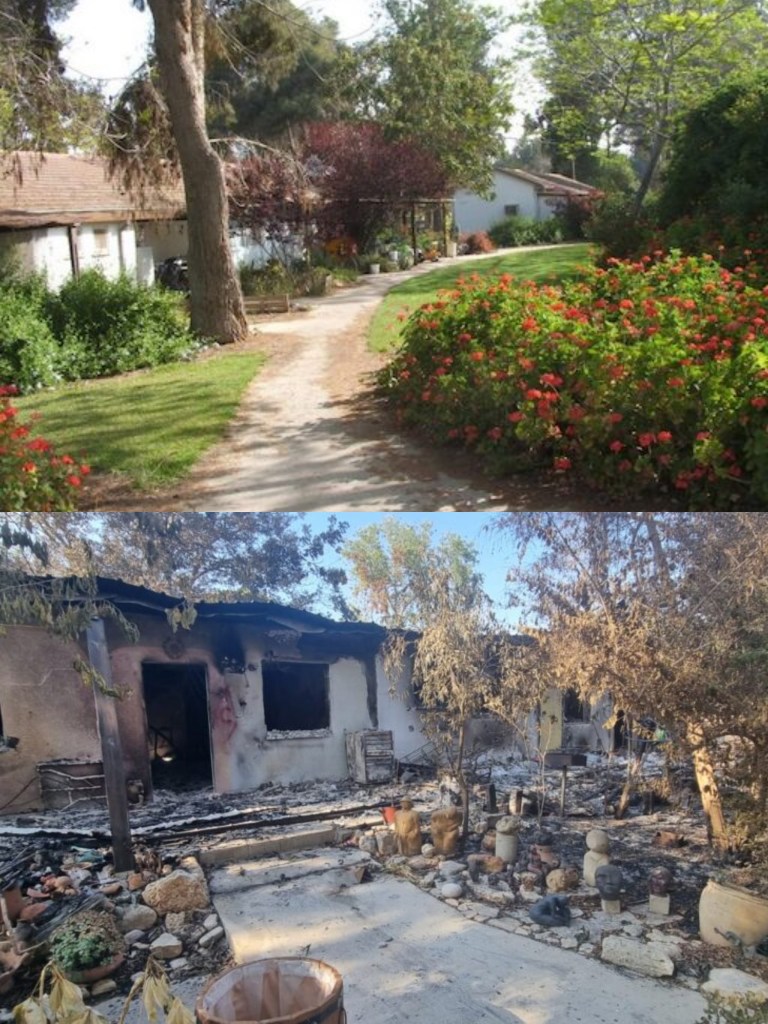
.

In a kibbutz that small, not only does everyone know everyone, but a lot of people are family. With 77 kidnapped, Nir Oz residents form the largest group of the 240 hostages. Entire families were dragged from their houses. Four generations. From nine month old Kfir Bibas to 86 year old Aryeh Zalmanovich.

This is the story of how nine members of the same extended family were taken hostage. This is the story of the Cunio/Aloni/Yehud family.

David and Sharon Cunio
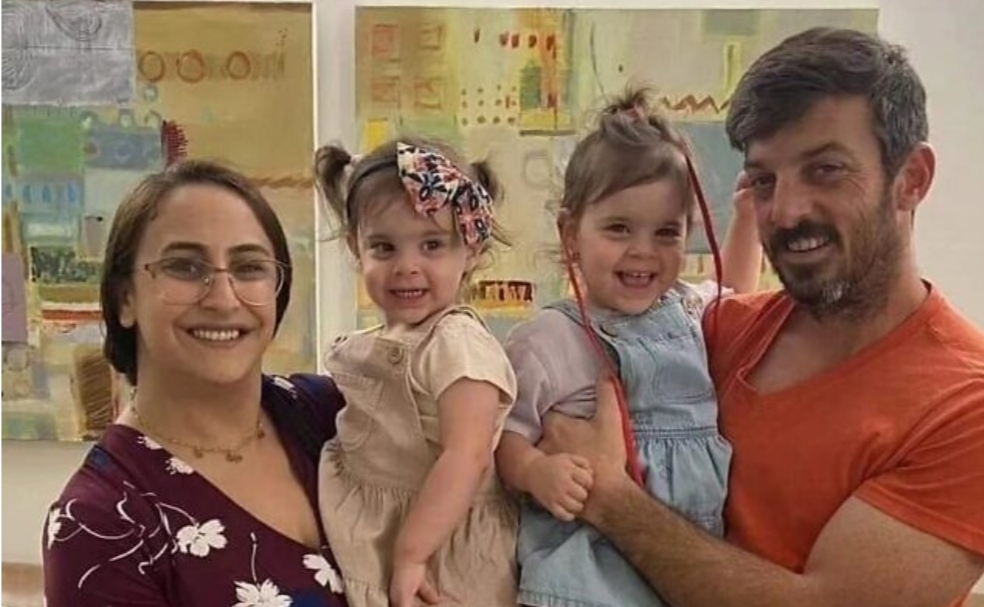
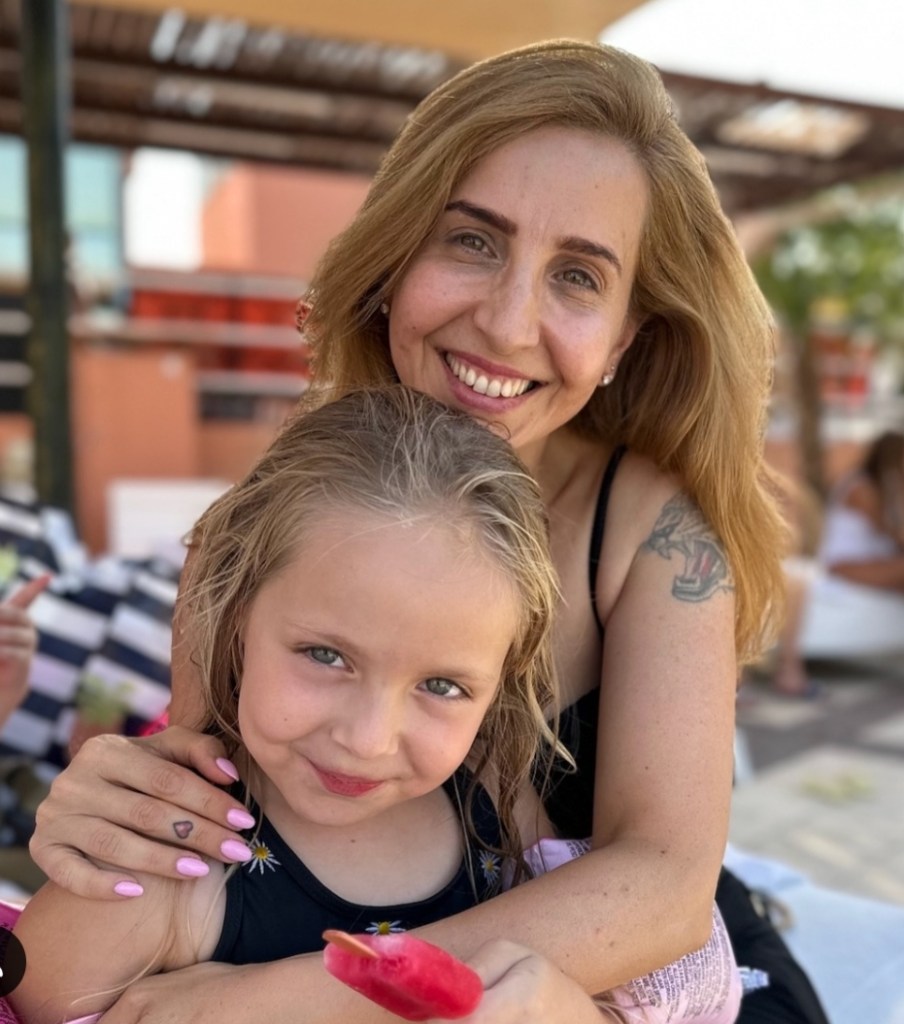
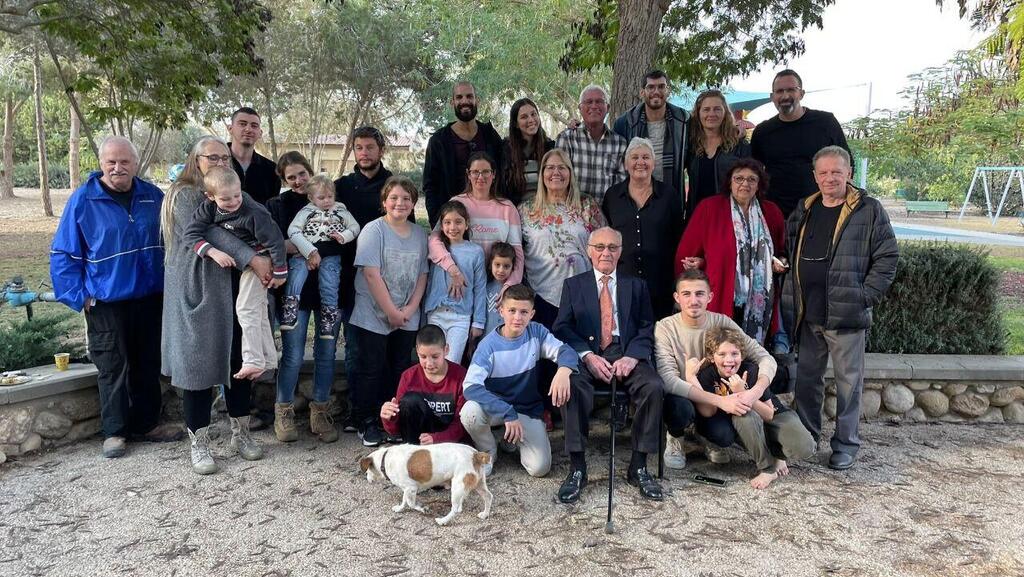
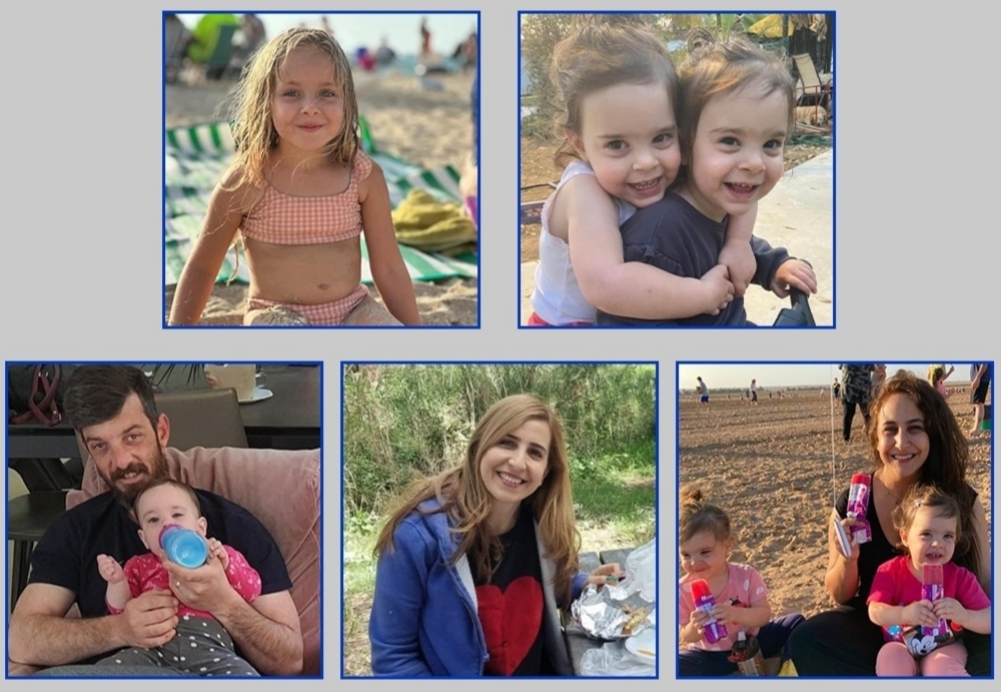
David Cunio is one of four brothers. One of them, Eitan, is his twin. David and Eitan are both actors. They appeared together in the Israeli film Youth from 2013. At the set of that movie, David met Sharon Aloni. They fell in love, got married and had their adorable twin daughters: Emma and Yuli. They lived in Kibbutz Nir Oz, as did all of David’s brothers and his parents, Silvia and Jose Luis Cunio, who immigrated to Israel from Argentina in 1986.

David and Eitan Cunio in Youth

Danielle and Emilia Aloni

Sharon’s sister Danielle is a single mother of a beautiful 5 year girl, Emilia. They live in Yavne, but the sisters are very close and visit each other a lot. On the day of the Hamas invasion, Danielle and Emilia were staying with the Cunio family.

Ariel Cunio and Arbel Yehud

Ariel Cunio is David’s youngest brother. He has been together with his girlfriend Arbel Yehud for five years. They had been travelling in South and Central America and they had just adopted a puppy, a few weeks before the Hamas invasion. Both Ariel and Arbel were born and raised in Nir Oz, and their families lived there.

Dolev Yehud
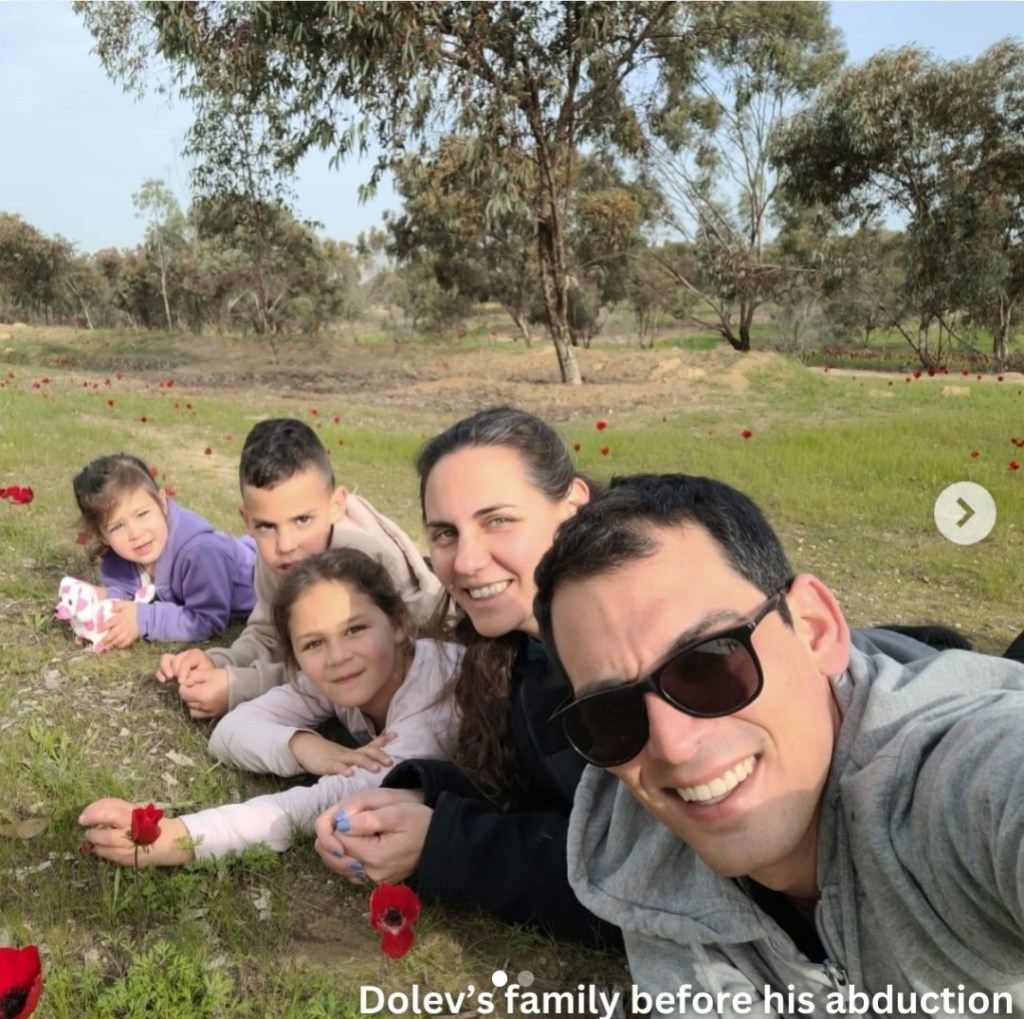
Dolev Yehud is Arbel’s older brother. He lived in Nir Oz too, with his wife Sigal and his three children. Dolev is a medical professional and volunteers with two different nonprofit organizations. He suffers from Hashimoto’s thyroiditis, a chronic autoimmune disease, which he manages with medication.

Hamas invasion

On October 7, 2023, al of these families barricaded themselves in their respective safe rooms while the terrorists roamed through the kibbutz, shouting and shooting. They kept in contact with each other through text, terrified and expecting the worst.

David, Sharon and Danielle hid in their safe room with the three children. At some point, they heard the terrorists in the house, and later, they realized the house had been set on fire. The room filled with smoke and they knew they had two choices: stay in the room and choke to death, or leave the room and face the terrorists. They chose the latter.

Ariel and Arbel were both also abducted from their apartment in the kibbutz. Dolev went out of his house to help the injured people outside, while his wife Sigal, who was nine months pregnant, hid in their safe room with the children. Fortunately, she and the children managed to stay hidden, but Dolev was taken by Hamas.

Months later, Danielle told Ynet this:

“It’s a fear that cannot be explained, these are emotions that the human mind can’t contain. We understand that we are going to end our lives in the cruelest way possible, by inhaling smoke and choking to death. I hug Emilia and say to her, ‘My love, I’m sorry, we’re about to die.’

We left farewell notes, and then I had to choose how I’d die – which death would be easier, quicker. Death by smoke inhalation felt very close. Sharon no longer argued at this point; she got up and helped me open the room’s window. We closed our eyes and waited. We heard gunfire outside, shouting.”

They fully expected to die. But they didn’t. They were taken captive separately, loaded on to a truck with other people, and driven to Gaza. Sharon and Danielle didn’t see each other again during their time in the tunnels of Hamas. Fortunately, they were able to stay with their children.

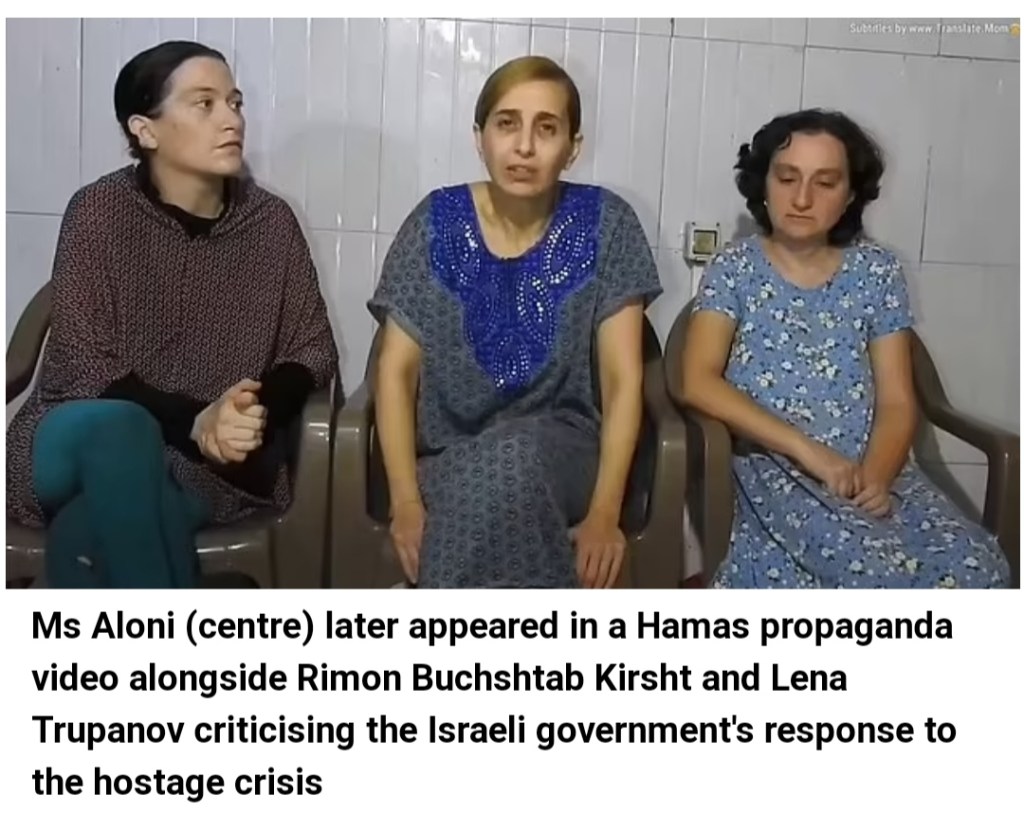
Sharon, Danielle and the children were hostages for seven weeks. Danielle appeared in a video released by Hamas after several weeks. She was told to say the same thing that the other hostages had to say in all of these videos: blame Israel, tell them to stop fighting so you can go home.
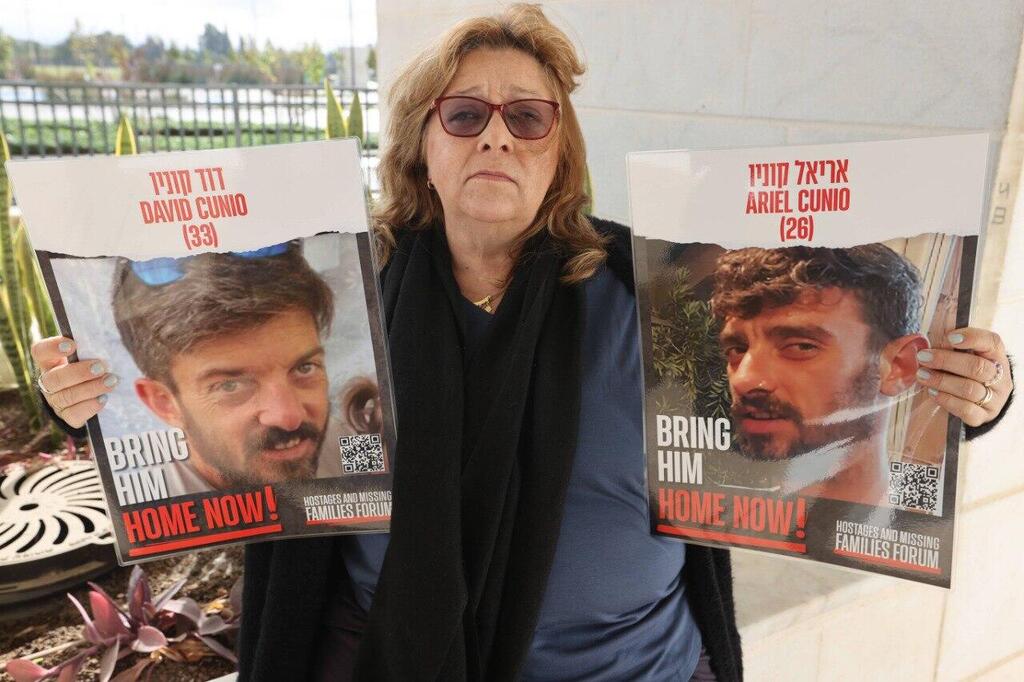
At the end of November, during the week long ceasefire, Sharon, Danielle and the three children were released. But David, Ariel, Arbel and Dolev are still hostages, more than 100 days later. There has been no communication and no updates about their situation.

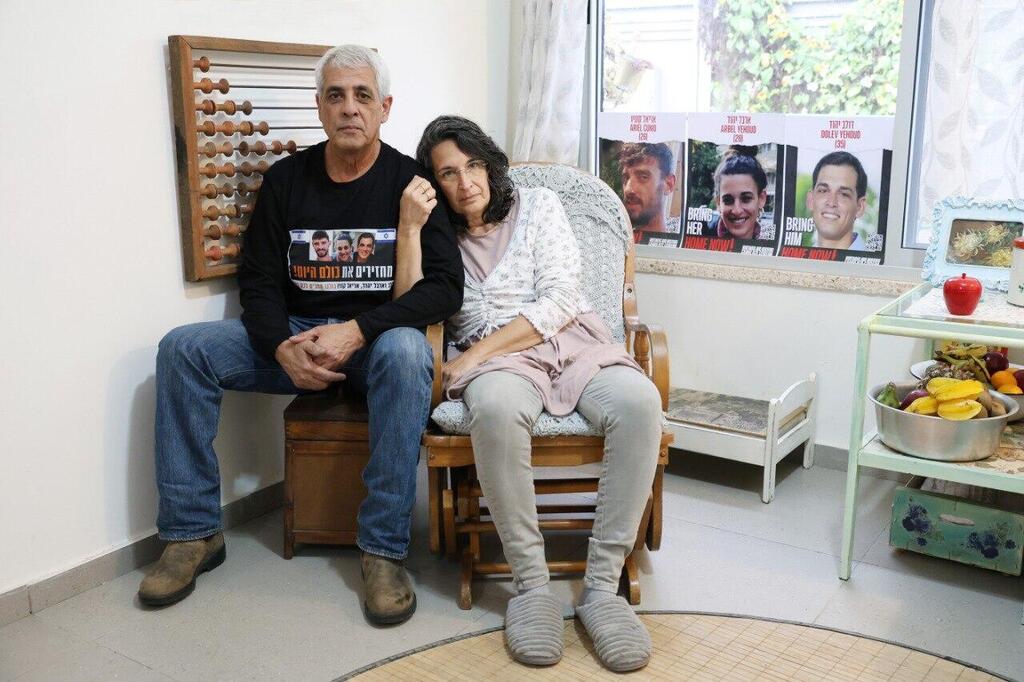
Silvia and Jose Luis Cunio, the parents of David and Ariel, and Yehi and Yael Yehud, the parents of Arbel and Dolev, are all under incredible stress. They haven’t heard a word about how their children are doing. They are hurting and worried. Yehi said to Ynet: “It feels like a part of the soul is missing, 100 days that feel to us like one long day that never ends.”

Dolev needs medication, that he has not been able to take for more than three months now. The Red Cross has refused to take medication to the hostages and has not visited them. Many of the hostages’ families are upset and angry about this. Some of the hostages are severely ill or wounded and there have been no updates on how they are doing. This is of course completely separate from the fact that Hamas has no right whatsoever to keep these people captive. Whatever they thought they would achieve by doing this, and by commiting the horrific crimes of October 7, is beyond me. All they have achieved is a terrible war and extensive suffering to people on both sides of the divide. They keep telling us to stop fighting, but refuse to give us back what they have taken from us: the hostages.

.
.

Ten days after Dolev was taken, his fourth child was born. Sigal, his wife, called the little girl Dor, a name very close to the name of her father. Sigal and Dolev have been together since they were 12 years old. “My life now is not a life, I’m missing half of it,” she said.

.
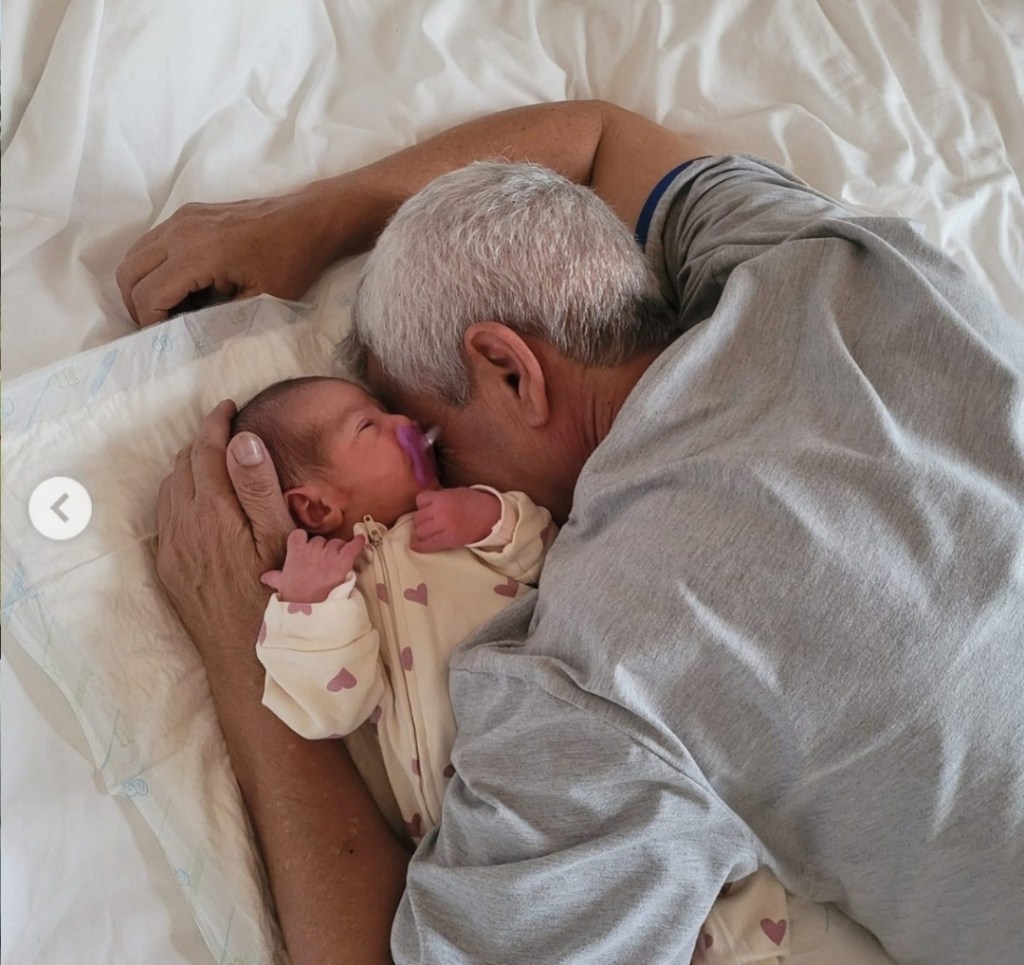
Granddad Yehi with baby Dor

Since her return from captivity, Sharon has spoken to the media about the ordeal she went through. She describes how at first, she and David and Yuli were brought to a civilian house and held there. They were worried about Emma, they feared they had lost her forever. Later, it turned out that Emma was with Danielle and Emilia.

After the house they stayed in was bombed, they were brought to the Nasser hospital in Khan Yunis and kept prisoner there. After three days there, Emma was brought to them and they were forced to thank their captors on camera.

They had to stay in a small room with a varying number of other hostages. Sharon slept with the two girls on a bloodstained mattress. They got two meals a day, consisting of rice and sometimes mouldy pita bread. Sharon lost 11 kilos and they all got food poisoning at least once.

“A lot of the times, the girls were just crying, saying ‘I’m hungry,’” she said. “It was devastating.”

“Every minute is critical. The conditions there are not good and the days go on for ever. It’s a Russian roulette. You don’t know whether tomorrow morning they’ll keep you alive or kill you, just because they want to or just because their backs are against the wall.” (Haaretz)

She said David blamed himself, because they lived in Nir Oz because of him. When they were told that Sharon and the children were going to be released, but not David, they held each other and cried for hours. David told her: “Fight for me. Don’t give up. Please yell what I cannot yell.”

So this is what she does. She tells her story and campaigns for the release of all the hostages, together with the rest of the families, in Israel and abroad. Her daughters ask for their daddy every day. She doesn’t know what to tell them. She says: “I die of fear every day, that he will be in the next brutal video they release. I am stuck. I’m on hold. For me, life stopped at the moment I was separated from David.” (The Times of Israel)

Hold on, Sharon. Hold on, David, Ariel, Arbel  and Dolev. We are coming for you. 🧡

#bringthemhome

.
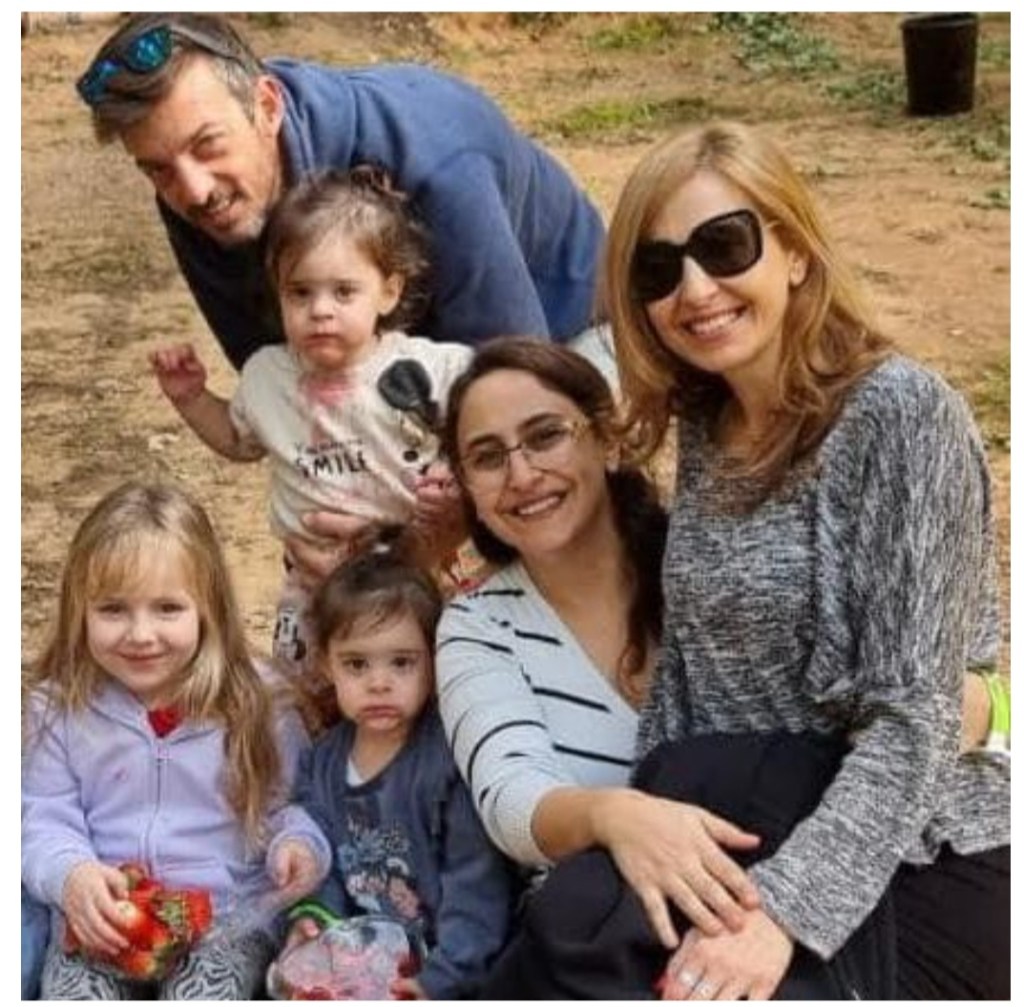
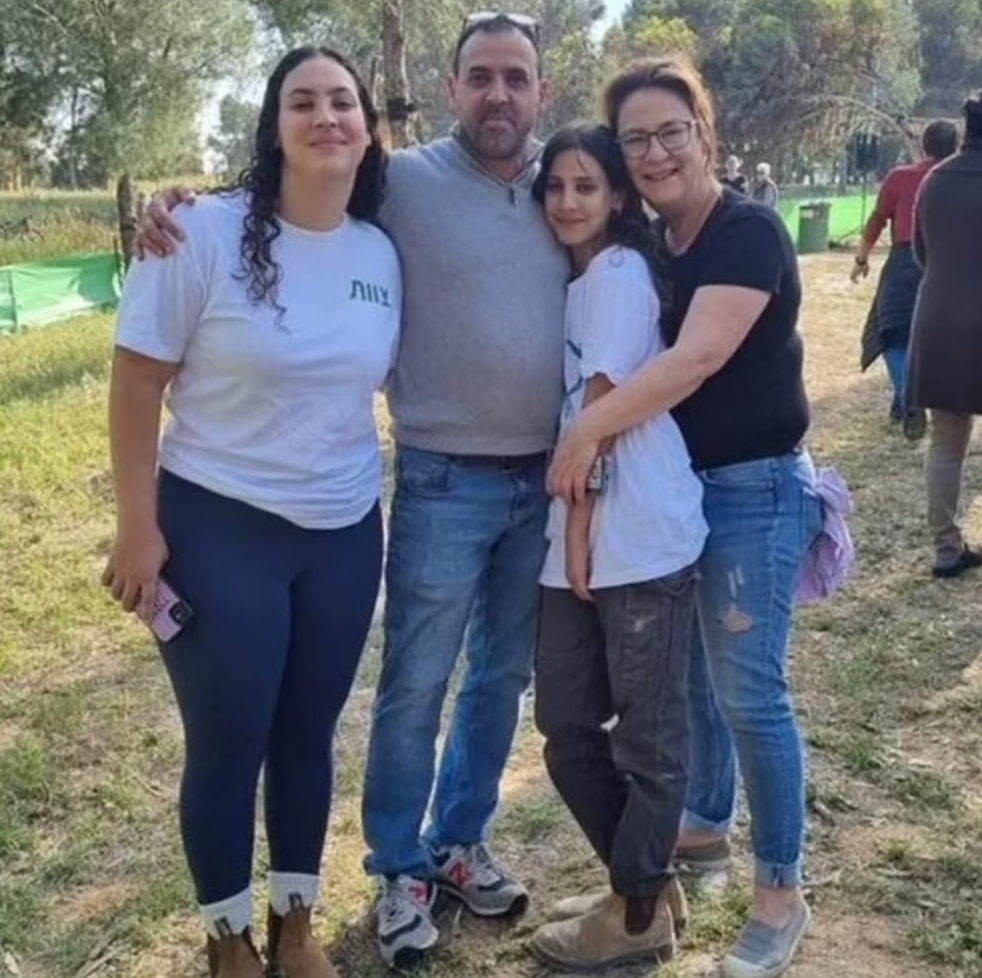
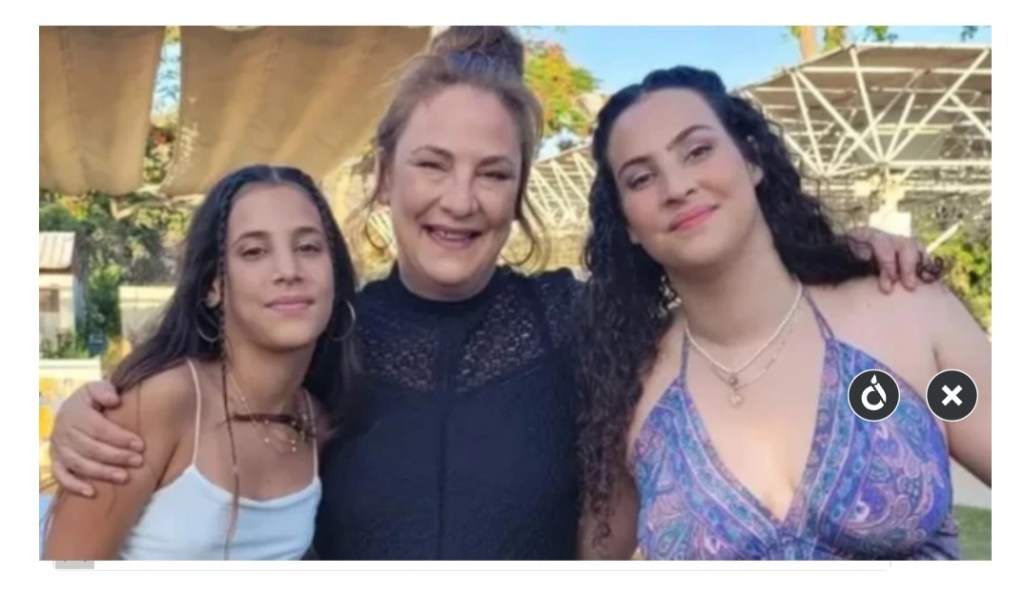
The Cunio/Aloni family
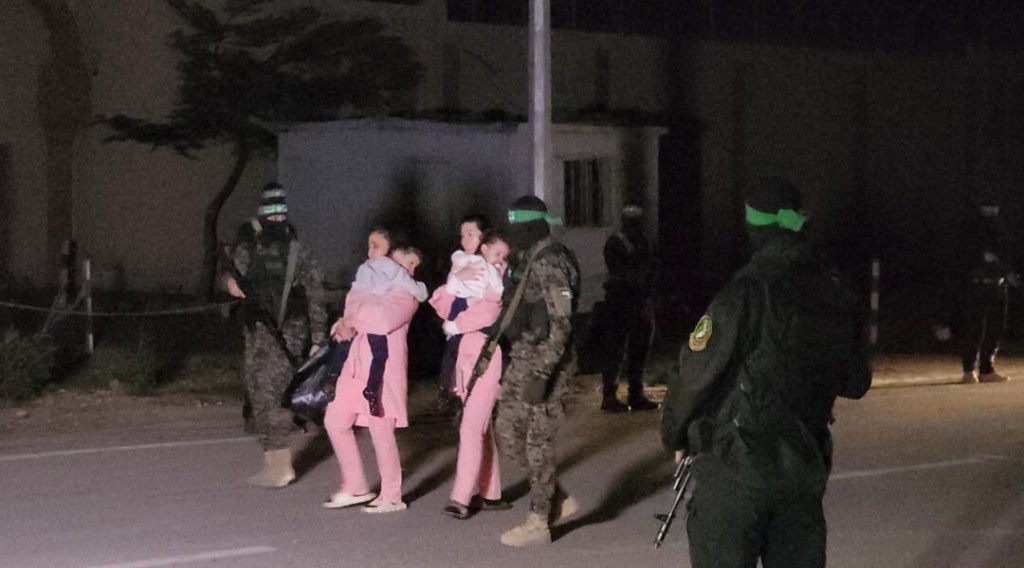
Sharon and fellow hostage Mika Engel carrying Emma and Yuli to safety
Release of Danielle and Emilia Aloni
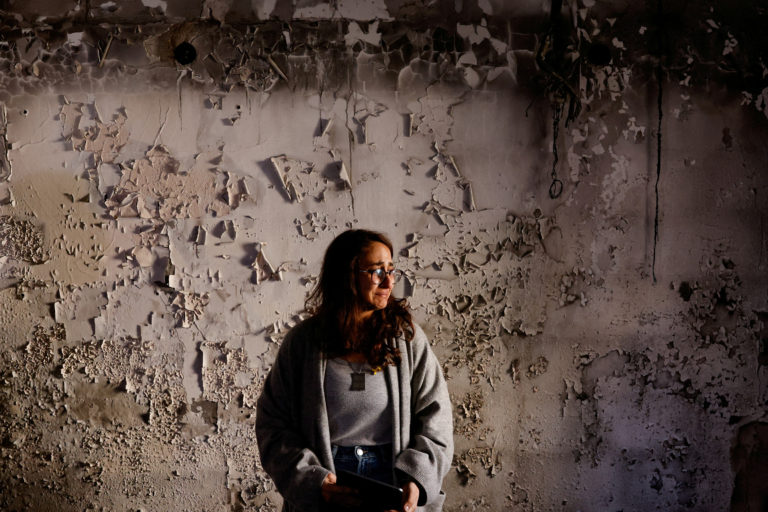
Sharon stands in front of her burned out house in Nir Oz

UPDATE 3/6/24:

The remains of Dolev Yehud have been identified in kibbutz Nir Oz. It turns out he was never abducted, but murdered and burned on October 7, along with so many others. This is devastating news. May his memory forever be a blessing. Dolev flies free now 🦋
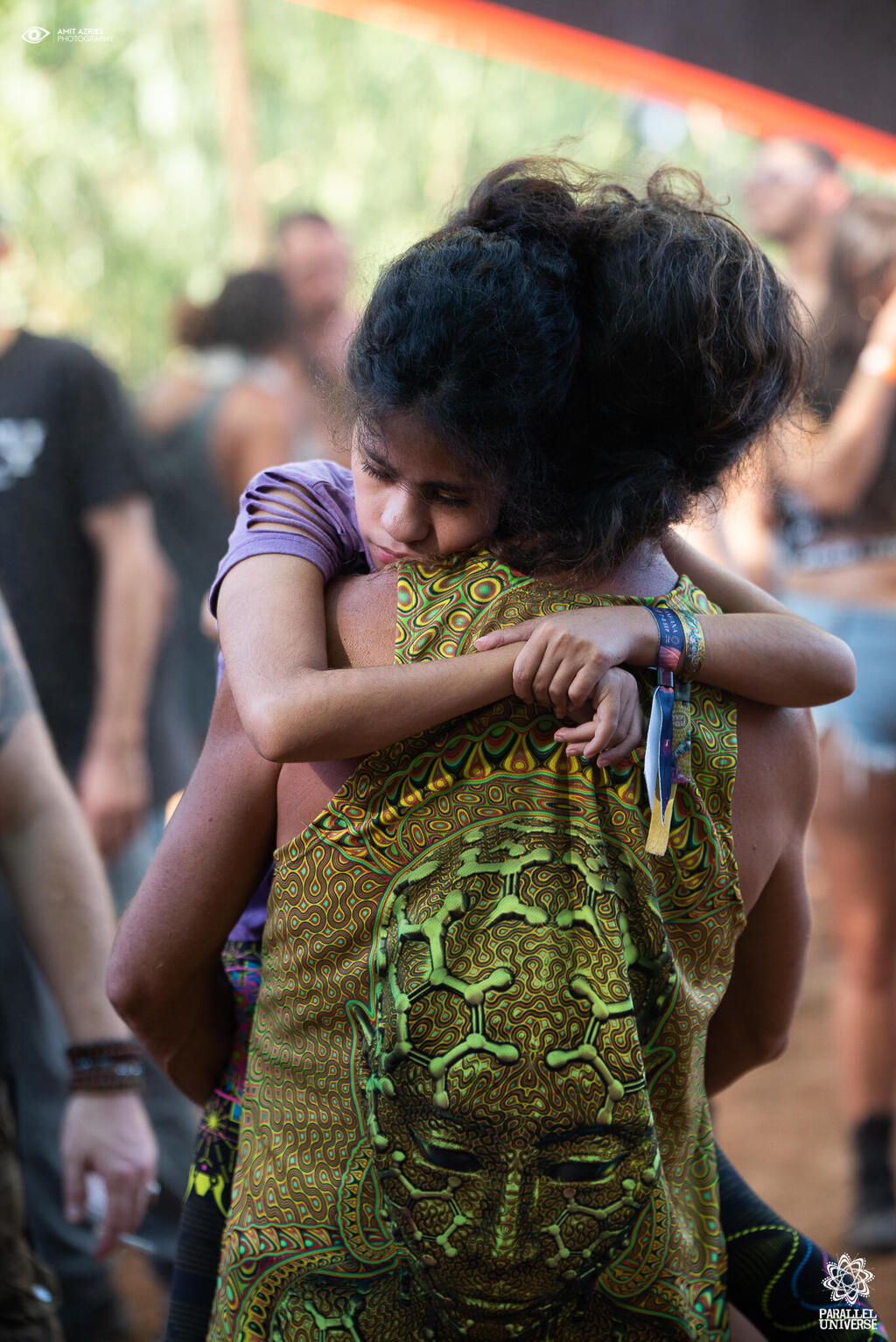
Erick and Ruth Peretz – together as one

The massacre at Supernova is one huge, terrible chain of demonic cruelty and horror. I have heard fragments of stories that I cannot repeat. They are lodged in my brain like shards of glass. I can’t examine them, at least not yet. Maybe one day, I will be able to do that research and get those sharp slivers out. Let the cut me until it bleeds. Sadistic torture and brutality. Sexual violence so awful and extreme that it makes you sick. It speaks of a group of people so depraved, so full of hate, with so much disdain for human life, that they would commit these crimes while laughing and filming themselves. It is inconceivable.

This monstrous group shot entire families with young children execution style. They burned down houses with babies inside. They murdered 90 year old Holocaust survivors in cold blood. They killed dogs defending their homes and laughed about it. They shot unarmed young people fleeing for their lives. And they killed a severely handicapped child in a wheelchair without a moment’s hesitation.

.

.

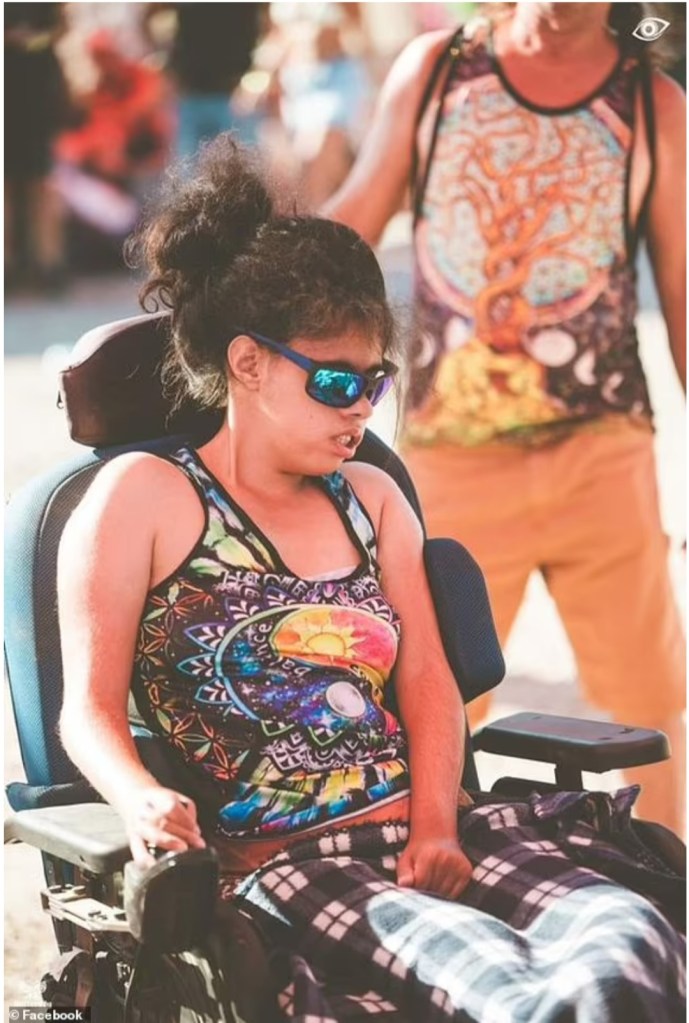
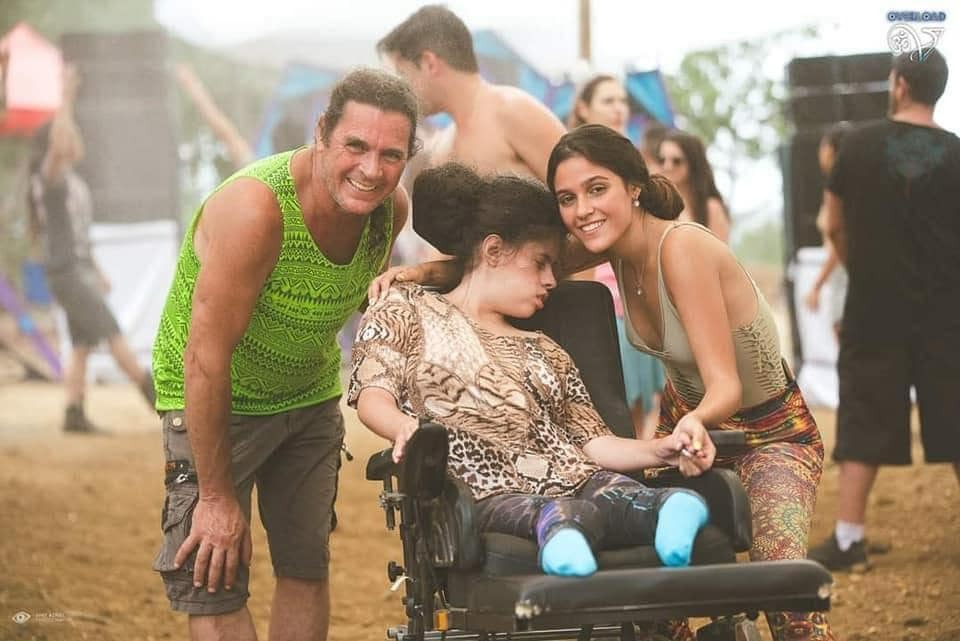
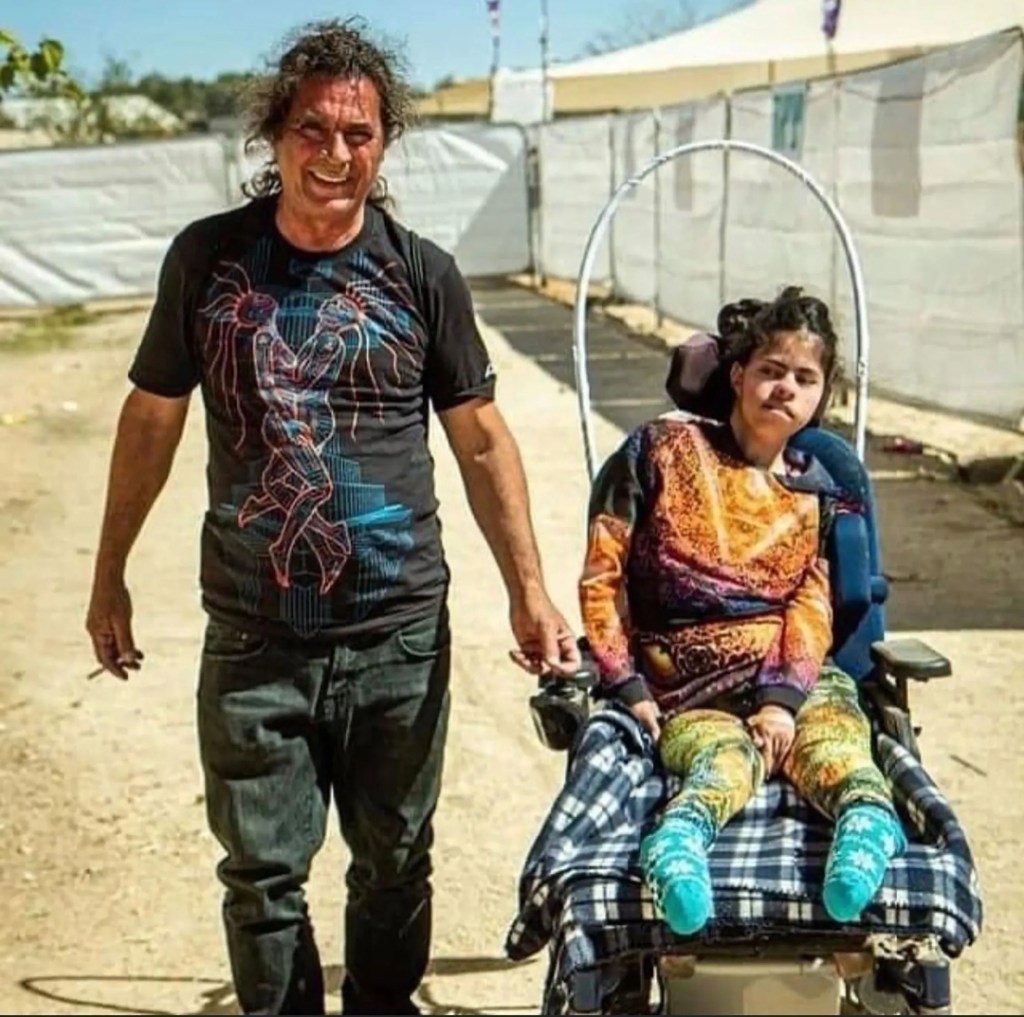
Erick and Ruth Peretz were a familiar sight at raves and music festivals in Israel. Ruth Peretz was 16 years old and suffered from cerebral palsy, muscular atrophy and mental disability. But that didn’t stop her from living her life to the fullest. Although she didn’t have much control over her body, Ruth loved music and dancing. So her dad, Erick, took her to parties whenever he could.

Erick was a happy-go-lucky man who loved surfing and dedicated his life to the care of his daughter. Ruth’s half-sister, Yaarit, told Ynet: “For years he would go to these festivals and bring Ruth, because it made her really happy and she loved it. There were times he would take her and she didn’t want to come home. It was their tradition, to go to festivals.”

Ruth was mostly nonverbal and could speak only a few words. Only her family knew how to communicate with her. From the moment she was born, Erick dedicated his life to her care. He stopped working and became her fulltime carer. Her older sister Yamit says: “Over the years, Ruth became the light in the house. My father took me by the hand and taught me how to hang out with Ruth. We were constantly at parties and at the beach. We were together all the time. My Bat Mitzvah trip was to festivals around the world.” (Shavvim.co.il)

.

Erick Peretz with Ruth and Yamit.

On October 7, Ruth and Erick were at the Supernova festival. They had been there for several days, camping out with all Ruth’s equipment. Yamit had been there with them the previous day, but left that evening. Erick and Ruth enjoyed themselves so much that they decided to stay the night. Early the next morning, Yamit and her half-sister, Yaarit, realized what was happening in the south of the country, and they called Erick in a panic. At that time, Erick and Ruth were ok and trying to get out of the site of the festival. “Everything is ok, I’m with security,” Erick told his daughters.

But that would be the last time Yamit and Yaarit heard their father’s voice. A friend of Erick’s, who was also at Supernova, posted later on Facebook, telling the story of the last moments of Erick and Ruth’s lives:

“About eight in the morning, Erick Peretz calls me over with a smile and invites me to have coffee with him. Come on, have fun, brother. His daughter Ruth is in the car with her phone, on YouTube. I start making the coffee in the back of the van. While we’re drinking coffee and laughing, at around eight-thirty, suddenly people are shooting at us. Erick’s car got hit by a bullet. I scream at him, “Get out of here!” He gets into the car and drives off with Ruth, and I run in the opposite direction, leaving everything behind. My brother calls me, I run to him, get in the car. We drive but we get stuck. Erick also gets stuck in the car because everything is blocked. We get out of the car. Erick takes Ruth and runs into the forest. I also started running towards the forest. While running I see people falling like bowling pins. I never saw Erick and Ruth again.” (Ynet)

For almost two weeks, Erick and Ruth’s fate was unknown. Their car and Ruth’s wheelchair were found at the site of Supernova, but there was no sign of the father and daughter. Their family was desperately worried. Ruth could not eat solid food and relied on tubefeeding. She would not survive in captivity.

.

Then, twelve days later, the burned and unrecognizable body of Erick Peretz was identified. In their grief, the family still had a sliver of hope that Ruth would be found alive. But Yamit was absolutely sure that her father and Ruth were together. She asked to delay the funeral of her father, to search the remains more carefully, to check if her little sister was with Erick. But the family didn’t agree to this, and Erick was buried.

Time went by, and a month later, Ruth still had not been found. It was impossible for her to still be alive after all this time. Yamit knew in her heart that Erick and Ruth were in that grave together. She said to Ynet: “I was a million percent sure that they were buried together. I had no doubt that they were together, from day one.”

In the end, Erick’s grave was opened and the contents were examined again. It turned out that Yamit was right. The remains were not only Erick’s, but Ruth’s as well. They had been burned and melted, twisted and entwined together. Yamit knew that her father would never have left her sister alone for even one second. If they were facing death, they would have faced it together.

The second funeral was for both father and daughter. The entire party scene grieved for these two beautiful, gentle souls, who wanted nothing in this world but to be together, camp out in nature and enjoy the music.

I don’t know what comes after death, but I hope Ruth and Erick are dancing and surfing. I hope they come to visit Yamit in her dreams, as she asked them to do at the funeral. I know that they are together, always, as they were in life.

.

The massacre of 12 foreign students

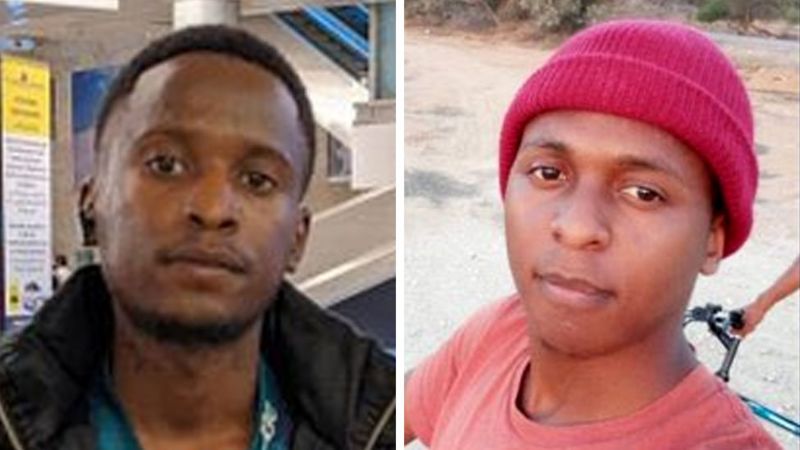
The Tanzanians

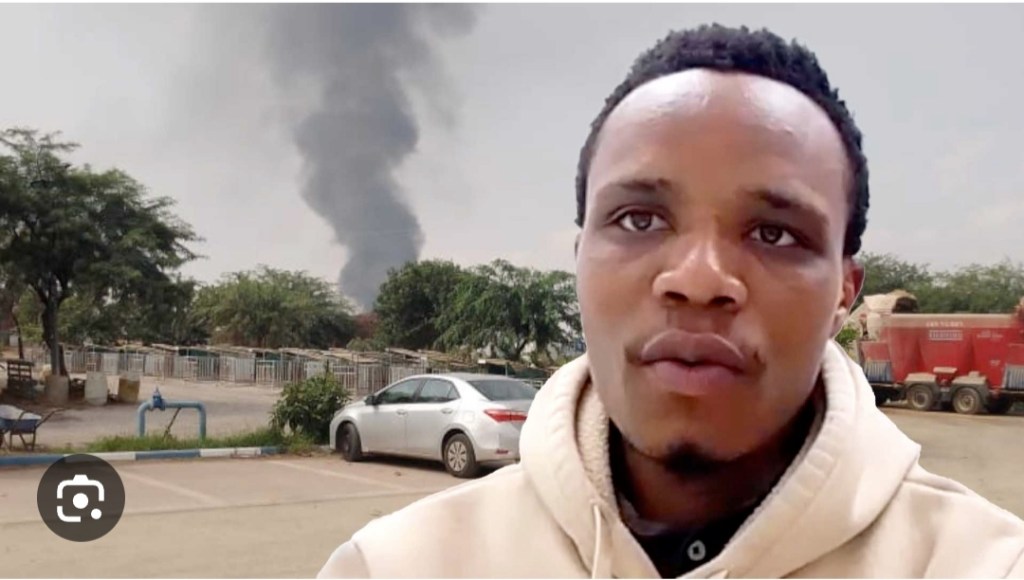
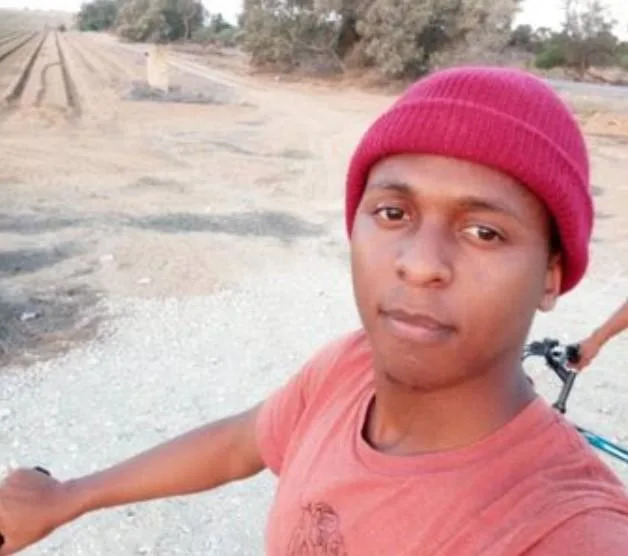
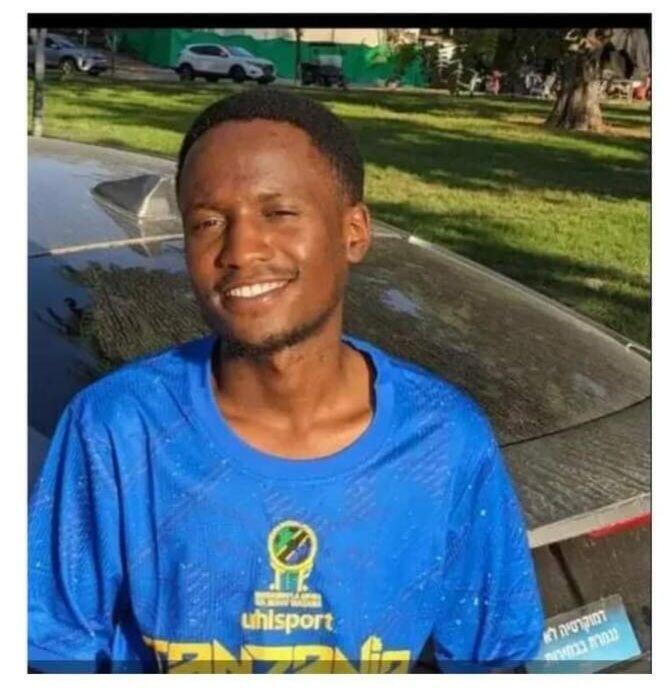
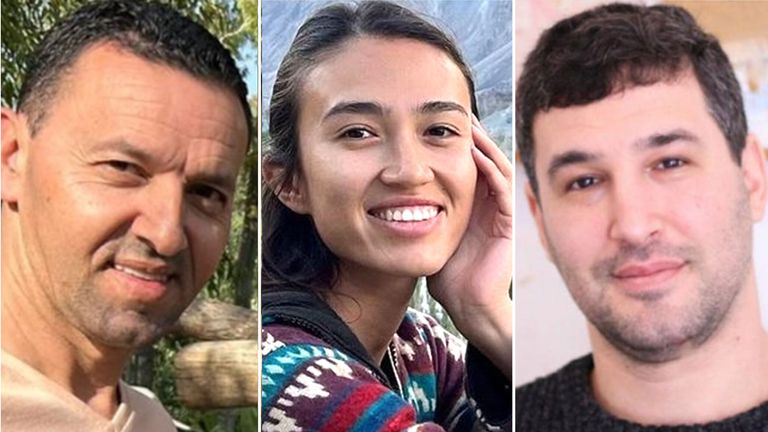
In September 2023, Joshua Mollel, Clemence Mtenga and Ezekiel Kitiku came to Israel for a work experience. They studied agriculture in Tanzania, their home country, and they were going to spend a year in a kibbutz in Israel, to learn and work. The three were excited to see a new country, meet new people and gain experience in their field of study. Clemence and Ezekiel went to stay in kibbutz Nir Oz, while Joshua was stationed in Nahal Oz, a kibbutz nearby.

For a month, they worked in the dairy farms of their respective kibbutzim. They learned what to do when the rocket siren sounded – go into the shelter immediately and stay there for 10 minutes. But thanks to the Iron Dome, the rockets usually didn’t do any damage.

On October 7, Ezekiel was the one working the early morning shift. Which saved him, but doomed his friend, Clemence Mtenga. When he heard the sirens and rocket explosions, Ezekiel quickly went into the shelter at the dairy farm. He texted both of his friends. At first, they answered and said they were ok, also hiding in shelters. But a few hours later, their phones went dead.

Hamas attacked both kibbutzim, but they didn’t get to the dairy farm of Nir Oz. This is what saved Ezekiel’s life. After the smoke finally cleared, Clemence Mtenga and Joshua Mollel were both missing.

.

Ezekiel Kitiku, superimposed on the photo he took on October 7. Smoke rising from the kibbutz in the distance.

For six weeks, Clemence Mtenga was believed to be a hostage. But on November 18, his body was finally identified. He had been murdered in cold blood by Hamas terrorists on October 7. Clemence was 22 years old, the youngest of four siblings. He was shy, studious and sang in the church choir. He wanted to start his own agriculture business. All those dreams are now shattered, his family broken and in mourning. Rest in peace, Clemence. I’m so very sorry this happened to you.

.

.

Joshua Mollel was also thought to be a hostage. For more than two months, his family and all of us here in Israel held on to hope, that he was alive, that he might be released because he was not Israeli, like the Thai hostages.

But as usual, we expected to much from the demonic death cult that is Hamas. They didn’t care who they slaughtered. On December 18, Hamas released a terrible, graphic video of the murder of Joshua Mollel. I haven’t watched it but I have read descriptions and it absolutely broke me. After all this time of hope and fear, it turned out that Joshua Mollel was murdered brutally by Hamas and his body abducted to Gaza. In no way did he deserve any of this. My heart goes out to his family.

Joshua was 21 years old. He was the eldest of five children. His father, Loitu Mollel, came to Israel after the news of his death broke, to see for himself where his son lived for the last month of his life, and where he was killed. He said that his son was “polite, obedient and serious”, and like Clemence, he had plans to start his own agricultural business.

About the gruesome footage, Loitu Mollel said: “I hope it is deleted from the internet. I hope no one watches it.” I have not watched it and I promise I never will. After seeing a still image from the video, I wish I could delete it from my brain. Please, if anyone ever comes across it, don’t watch it. Out of respect for Joshua and his family, but also to spare yourself the horror. I cried so much over the death of Joshua Mollel. It was so incredibly cruel and unjust. Again, I’m so sorry, Joshua. You should never have been sent to a kibbutz that close to Gaza. None of you should have.

.

The Nepalis

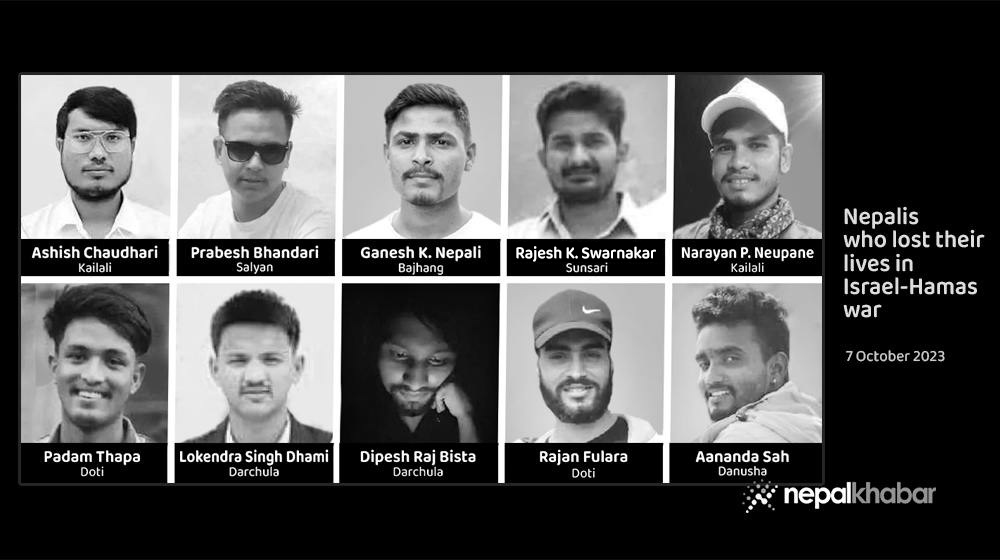
Of the seventeen Nepali students staying in kibbutz Alumim, only seven made it out alive. Let that sink in. Ten young men were brutally murdered by rabid terrorists, for no reason at all. Ten men who hadn’t done anything wrong, who were not Israeli or Jewish (not that that’s a good reason to kill someone), with hopes and dreams for the future, with families and loved ones at home.

The seventeen young men were at a work experience in the kibbutz, for a “learn and earn” program. All of them were the pride and hope of their families, who had poured all their resources into their sons’ education. The boys sent their earnings back home to support their families, and were planning to come back and start their own farms.

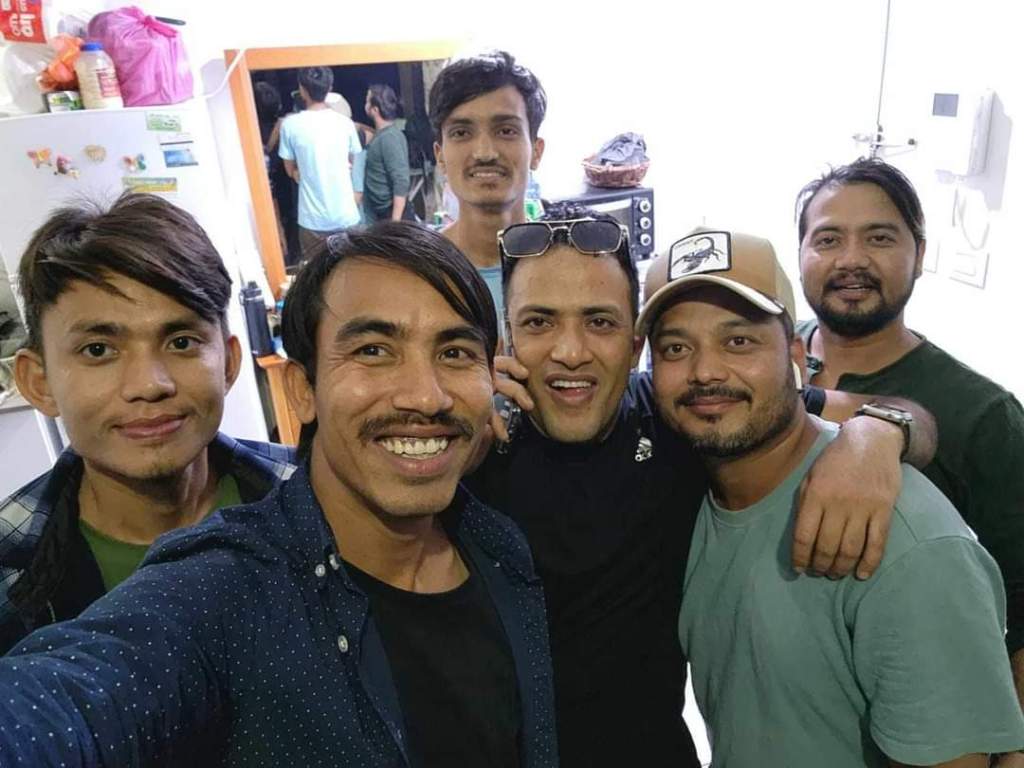
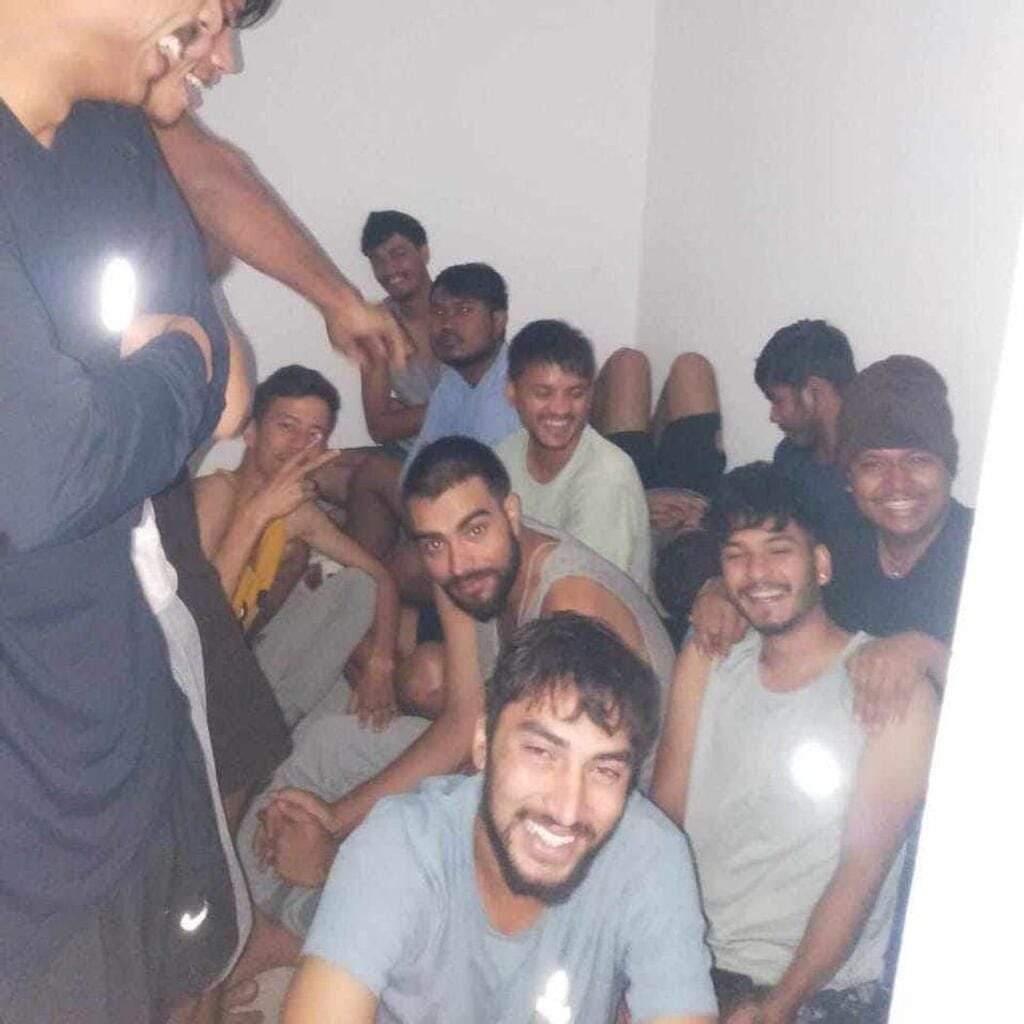
But Hamas had other plans. On October 7, the day started off with a hailstorm of rockets from Gaza. The Nepali students waited it out in a shelter with the Thais, still feeling like this wasn’t serious, it would all pass soon. Laughing and taking selfies. Playing games.

.

.

Most of the people in these photos are now dead.

In an interview in The Guardian, a survivor, Dhanbahadur Chaudhari, tells the story of what happened that day. As they hid in the bomb shelter, the terrorists shot into the bunker and threw grenades inside. The explosions killed and injured countless people. Chaudhari says: “Shrapnel hit me as well. When I woke up I was covered in blood and I could see my friends dead and injured around me. One friend didn’t have legs, another didn’t have hands. There were dead bodies of my friends in the door of the bunker.”

Despite this unimaginable horror, Chaudhari did his best to save his injured friends, bandaging their wounds and bringing them water. But help wouldn’t come until the evening, and several of the injured died from blood loss.

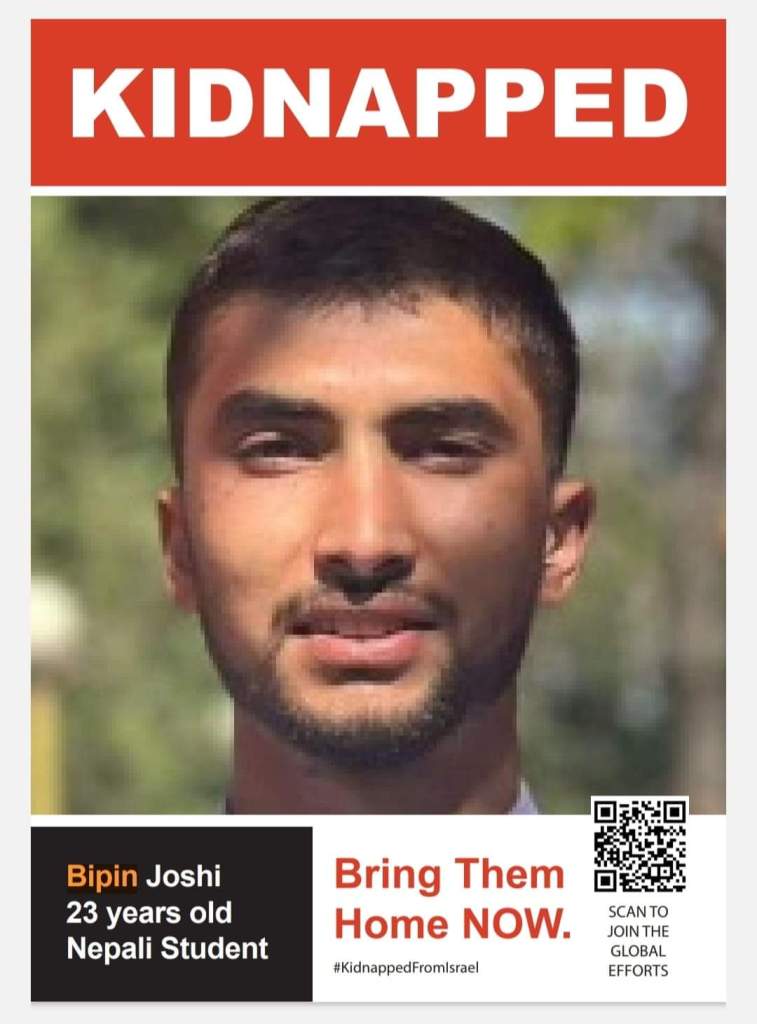
Seven of the students made it out of that bunker alive. But of those seven, one of them was kidnapped to Gaza. Bipin Joshi was not among the dead or the survivors. He was grabbed and taken by force, as a trophy, a bargaining chip. He was later seen in security footage from the Al-Shifa hospital, being dragged somewhere. It is clear that hostages were kept in that hospital and that it was used for terrorist activity.

Bipin Joshi is 23 years old. He is a son, a brother and a friend. He was excited about his adventure in Israel. “I will see the world, mum!” he told his mother. He would learn and earn money at the same time. What’s not to like? Now, he is stuck in the dungeons of Hamas, enduring God only knows what. The Nepali government is doing everything to get him out of there. But to no avail. Hamas does not give up their human shields that easily.

.

.

The senselessness of the killing of these foreign young men really gets to me. They had nothing to do with anything. They were just there. It breaks my heart. And why were they stationed in kibbutzim that close to Gaza? Sure, none of us could ever have expected anything like this. But there have been terror and rocket attacks in the Gaza Envelope since 2005. It is wrong and careless to risk the lives of foreign students like this.

I hope and wish that Bipin Joshi will be freed one day. He has been captive for more than 3 months now. The injustice of this is infuriating. We need the international community to condemn and pressure Hamas to release the hostages BEFORE agreeing to any sort of ceasefire. We cannot leave Bipin Joshi, Noa Argamani, Kfir Bibas and so many other innocent people behind in the hands of Hamas. They have no right to hold them prisoner. Give them back to us!!

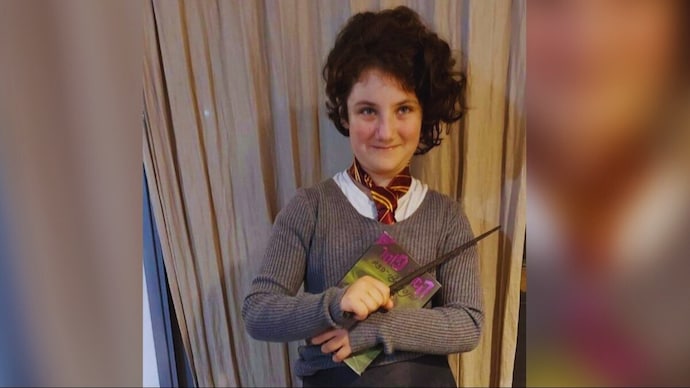
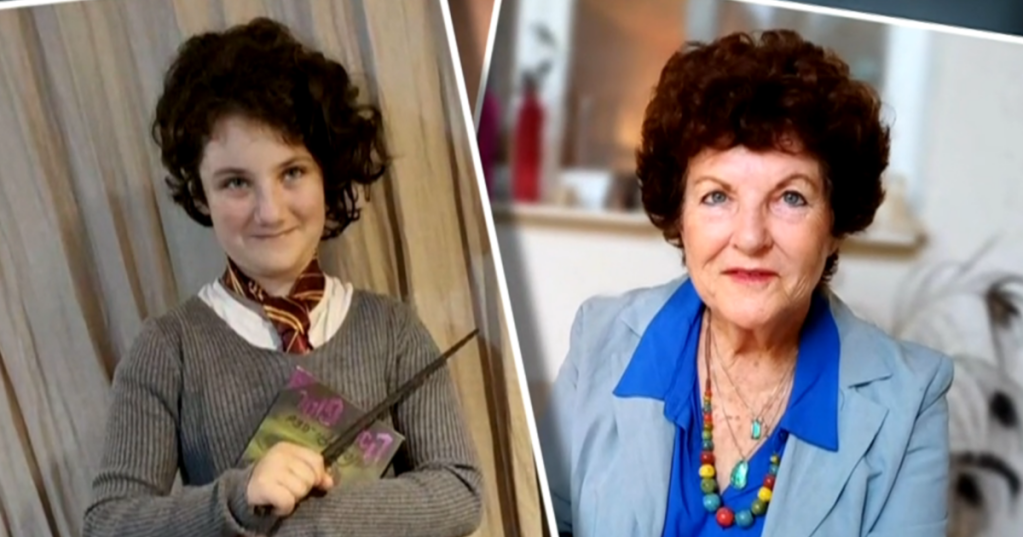
Noya Dan of Gryffindor

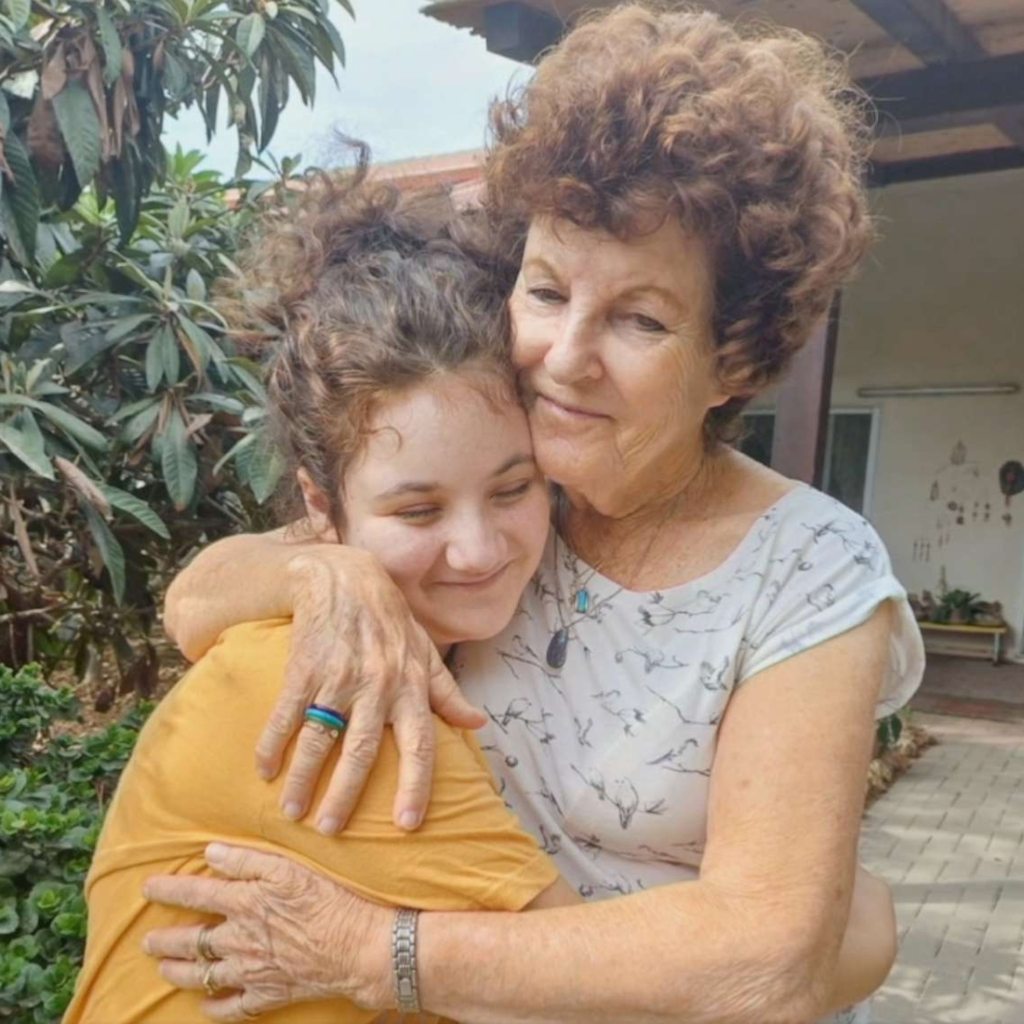
I wonder if Noya Dan tried to cast a spell when they came for her. Expecto Patronum, Expelliarmus, Colloportus? If they were real, any of those spells would have protected her and her grandmother. Twelve year old Noya was a huge Harry Potter fan. She read all the books, watched all the movies and probably practiced spells all the time. Her House was Gryffindor, of course.

But none of that would have helped her. Without magic, what can a twelve year old girl and an eighty year old grandmother really do when faced with murderous terrorists armed with automatic guns?

Noya lived in kibbutz Kissufim with her mother, Galit, and her younger sister. Her grandmother, Carmela Dan, lived nearby in kibbutz Nir Oz. Noya and Carmela were very close and Noya often stayed over in her grandma’s house.

On Friday October 6, Carmela’s family celebrated her 80th birthday together in kibbutz Nir Oz. Noya asked to stay the night at her grandmother’s. So while her mother and sister went home to Kissufim, Noya stayed in Nir Oz.

Early the next morning, both Nir Oz and Kissufim were invaded by Hamas. As an endless barrage of rockets exploded in the air and terrorists hunted down Israelis, the different family members hid in their secure rooms and kept in contact via text.

Galit hid in the closet of her safe room with her youngest daughter, while terrorists took over their house and used it as headquarters, shooting at people from the windows. Noya and her grandmother sheltered in the safe room of Carmela’s house. Carmela’s other daughter, Hadas Calderon, fought desperately to keep the door of her safe room shut, while Hadas’ children were with her ex-husband in his shelter.

To all of them, texting each other, it must have felt like the world was ending. Every time I think about the people in these kibbutzim, and what they must have gone through, my mind short-circuits. I just cannot imagine the horror.

The last message Galit received from her daughter Noya, was a voice recording. She said: “Mom, there was a big boom at the door that scared me. All the windows in Grandma’s house were broken at the entrance. Because there was another boom, there are many broken windows. Mommy… I’m scared.”

The last one she received from her brother in law, Ofer Calderon, was very short: “Galit. Holocaust.”

.

.

Ofer Calderon is a friend of a friend of mine. I feel connected to this family. I feel connected to all of these people, with a thousand different threads.

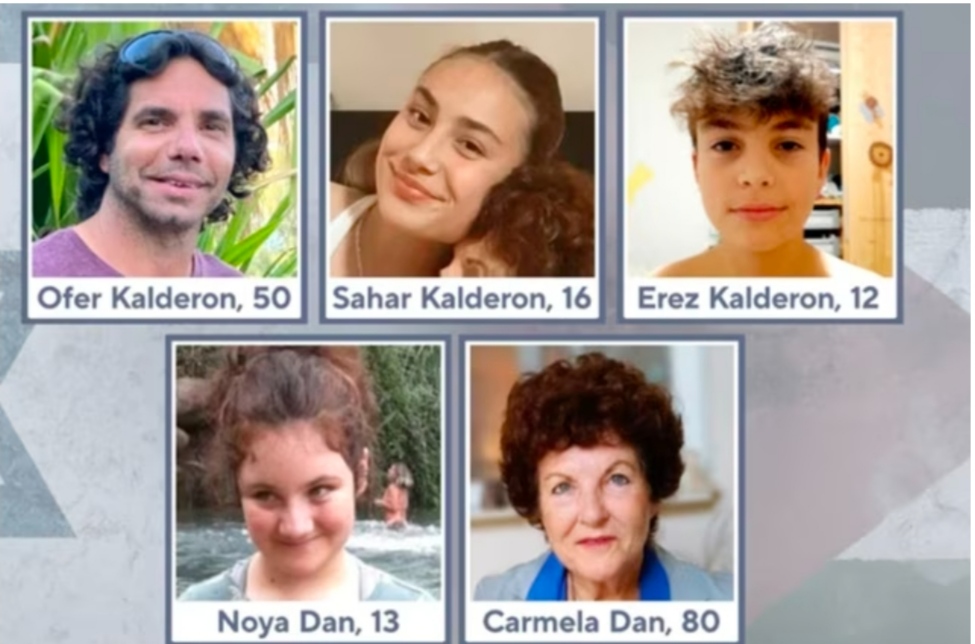
When the day drew to a close and the IDF regained control over the kibbutzim, Noya and Carmela were missing, just like Ofer Calderon and his children, Sahar and Erez.

Again, I cannot imagine what Galit and Hadas must have felt when they managed to live through this hell, only to find out their children were gone. If I try, something grabs my lungs and squeezes all the air out of them.

Cries of help went up from these wounded kibbutzim, these shattered communities. Where are our children, our parents, our friends?

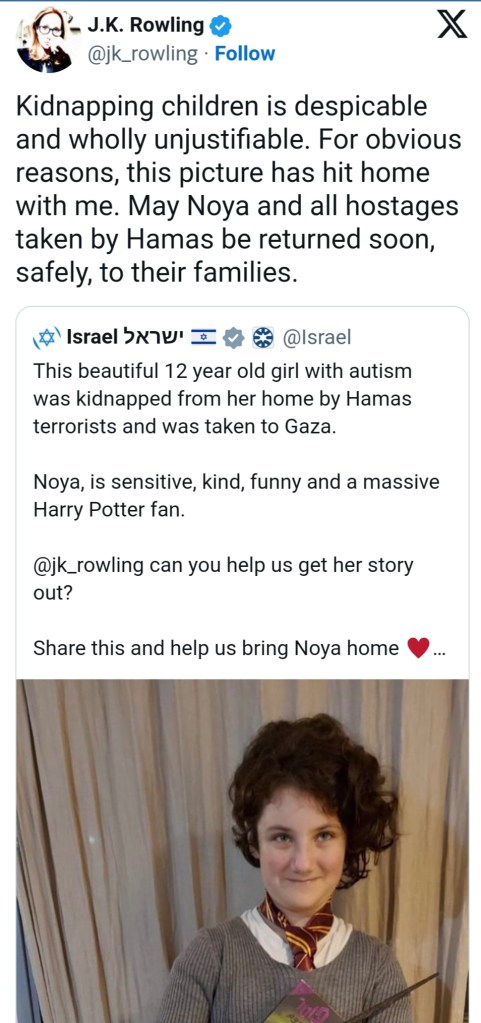
Noya’s picture was posted on X/Twitter, where it drew the attention of J.K. Rowling herself. She reposted it with a heartfelt message:

.

“Kidnapping children is despicable and wholly unjustifiable.” No beating around the bush, no talk about “context” or “proportionality” or “freedom fighters”. For this, J.K. Rowling is my hero. The whining about how she disrespected trans women sounds ridiculously trivial compared to something as huge as this. If you use all the right words and pronouns to refer to people, but you refuse to condemn a horrific massacre by terrorists, what kind of person are you, really?

Noya and Carmela were assumed to be hostages, until their bodies were identified ten days later. They were found at the border with Gaza, burned beyond recognition.

No one knows for sure what happened to them, if they were abducted and then murdered and dumped, or if they were first killed and then Gazans tried to kidnap their bodies but didn’t succeed. There is a “pay for slay” system in place in Gaza, where people get paid by Hamas for killing Jews. A dead body is worth money to them. Shocking? Inhuman? Yes. We’ve heard it all by now.

Galit had to try and deal with the murder of her daughter and her mother, while supporting her sister, whose children were held hostage. For seven long weeks. Try to imagine that. Just try.

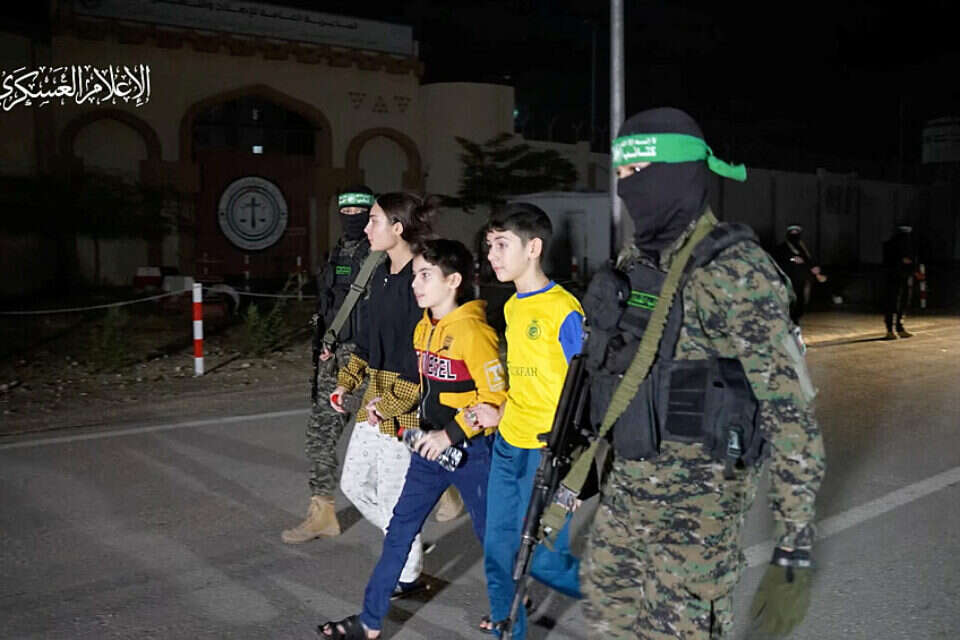
Fortunately, Sahar and Erez Calderon were released during the ceasefire. The relief must have been incredible. But their father, Ofer Calderon, is still in captivity now, three months later.

Sahar and Erez walk to safety together with Eitan Yahalomi, escorted by the same terrorists who dragged them from their homes.

But there was no relief for Galit. No homecoming for Noya and Carmela.

Noya was a bright, funny and loving girl. She was also autistic. Galit said: “Noya is my eldest; she is mine alone. I’m a single mother, and she’s a uniquely special child.”

Carmela Dan held American and French citizenship. She loved gardening, cooking and spending time with her family. Like many Israelis who live near the border, she volunteered for a nonprofit organization that brings sick Gazans to Israel to get critical healthcare.

Nothing will bring Noya and Carmela back. Not even magic. Fly high, little wizard. I hope the next life turns out better for you. 💔

Update 16/1/24

This is an update on the situation of Noa Argamani and Yossi Sharabi.

On January 14, Hamas released a video showing Noa, Yossi and another hostage, Itay Svirsky.

.

.

They read off a script obviously written by Hamas, telling Israel to stop the war and to save them. The same thing was said in earlier videos of other hostages. The message is always the same: stop the war, or we will kill your hostages. But never: if you stop the war, we will release the hostages and negotiate. Because that is not what their goal is.

To understand this, you must realize the fundamental reason of Hamas’ existence is jihad: a holy war against everything that isn’t radical Islam, and especially Jews. This principle trumps everything, even the lives of the Gazan people, peace and a chance for their own state. This kind of thinking is so alien to us in the West that we cannot believe this is really their mindset. I couldn’t believe it for twenty years living in Israel. Until October 7.

At the end of this video, Hamas showed this:

.

.

This is psychological warfare of the highest degree. The entire country is in mental and emotional anguish. It is very, very hard to deal with this kind of cruelty. It is a game that they play, to inflict the worst pain on us. They know we care desperately about these people. They also know that we cannot do this sort of things back to them – it goes against every principle of humanity. Also, they would laugh at us. They don’t care! They care about exterminating Jews and establising the Islamic State. At any cost. Even if every single Palestinian has to die for it.

How do you negotiate with people like that? You can’t. It’s impossible. The only thing they want is our death. That is why we have to conquer Hamas. If we fail, we will not only sign our own death warrant, but Europe’s, too.

Yesterday, 15/1/24, Hamas released another video. This time, it was only of Noa, who told us that Yossi and Itay were dead. According to the script she read, they were killed in an Israeli airstrike. We don’t know if this is true or if they were simply murdered by Hamas. At the end of the video, they showed two bloody and broken bodies. It was impossible to tell who they were. I haven’t watched it. But this is what I heard.

For all of their families, the excruciating pain goes on. They don’t know anything for sure. All they have is questions, which won’t be answered. Noa is alive, for now. I think that the civilians who captured her, sold her to Hamas. And they know that Noa one of the most famous hostages and that she is precious to us. They can use her as leverage. Although what they want from us is impossible.They want for Israel to cease existing and for every Jew to die. We obviously cannot let that happen.

The only thing we can hope is that the IDF will conquer Hamas, find the hostages and bring them home. Soon. Then, we can talk with the Gazans and see how to move on from here. But not before.

#bringthemhome

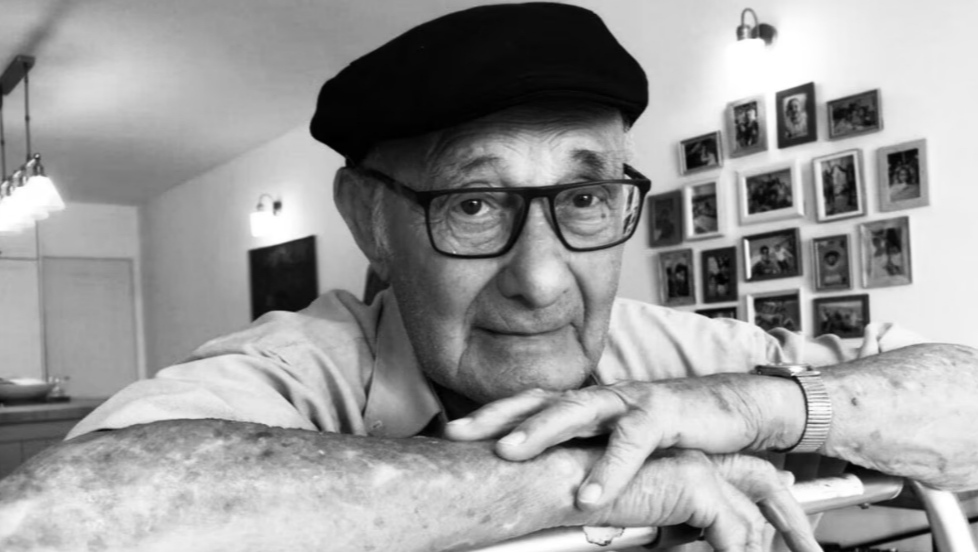
Moshe Ridler, Holocaust survivor

There used to be a house in our kibbutz where someone played to piano so beautifully that everyone passing the house stood still to listen. I remember going for walks with my first baby, when he cried and wouldn’t sleep, and standing by that house, bouncing the baby in his carrier, listening to the piano music.

The man who played the piano was called Menachem. He was a holocaust survivor. The story went that, as a child, he spend a year hiding and living in a closet before being smuggled out to Israel. Alone. He was one of the orphans Lena Kuchler-Silberman took under her wing. Several of these children settled in my kibbutz. Some of them are still here today. Menachem passed away years ago and fortunately, did not have to know what happened on October 7.

I was strongly reminded of Menachem when I read the story of Moshe Ridler.

Moshe loved music and played the piano, too. He even danced, still, at the age of 91. And he was a Holocaust survivor, too.

He survived the European Holocaust. But not the Hamas Holocaust on October 7, 2023.

.

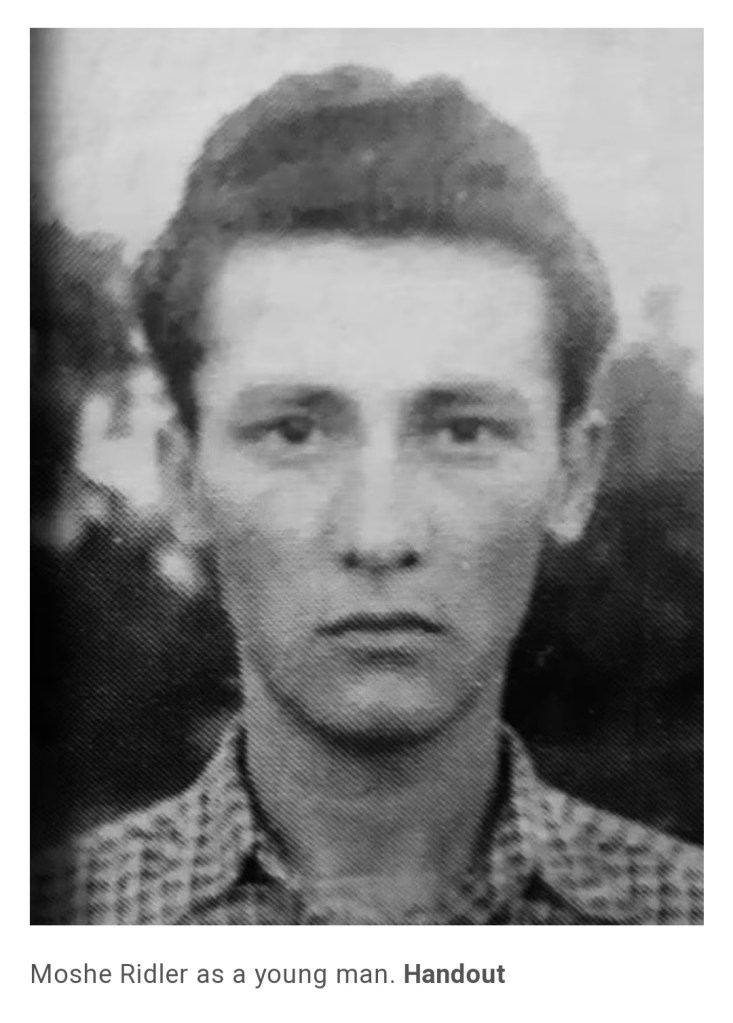
Moshe was born in 1931 in the town of Hertsa in Romania. In 1940, he and his family were sent to a concentration camp in Ukraine. His mother and sister both died there of typhus. His father and his other sister were sent to work camps. Moshe stayed behind, alone.

At the age of 11, he overheard two men talking about escaping the camp. He convinced them to take him, too. They escaped together in the night. Moshe ran, and ran, until he fell down and passed out from exhaustion. When he woke up, he was lying by a fire in a family’s living room. He had run 30 kilometers, to another town, where the Ukrainian family found him and put him by the fire, because he was cold as ice.

The family dressed him as a Ukrainian boy and they pretended he was one of their children. They saved his life. Finally, when the war ended, he was reunited with his father and sister, and they returned home to Romania.

.

In 1951, Moshe moved to Israel. He joined the Israeli police force and later helped with the transportation and immigration of Ethiopian Jews to Israel, which was a complicated operation.

One of Moshe’s children, Pnina Hendler, lived in kibbutz Holit in the Gaza Envelope. When Moshe was very old and needed help, she moved him to her kibbutz, so he could be near her and his grandchildren. They hired a caregiver from Moldova, who spoke with Moshe in Romanian.

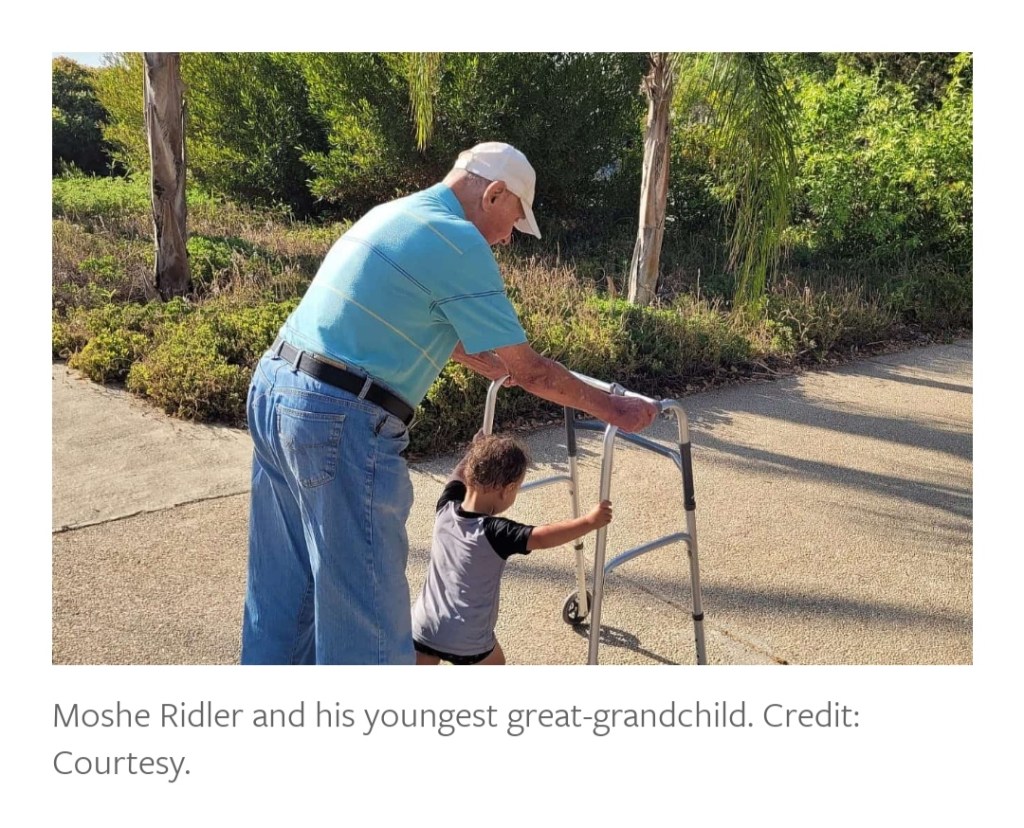
Moshe was happy in the small kibbutz. He swam in the pool every afternoon and spent time with his grandchildren and great-grandchildren. He told them stories, played the piano and danced with his walking stick. “He was the granddad of the kibbutz,” Pnina said.

Moshe was so proud of his family. He had three children and 18 grandchildren and great-grandchildren. To him, they symbolized his victory over the Nazis, who had tried to wipe out his people.

But on October 7, 2023, at 91 years old, the new Nazis got to Moshe Ridler. Hamas attacked kibbutz Holit at 6:30 in the morning. They went from house to house, like in the Russian pogroms, and shot everyone they found.

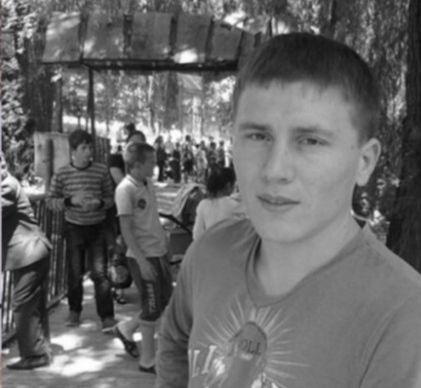
Moshe Ridler, 91 years old, was murdered by Hamas, together with his caregiver, Petru Boscov. They were killed by a handgrenade thrown into the room.

Was Moshe, a great-granddad, a threat to the Palestinian people? The idea is beyond ridiculous. Did Petru Boscov even have anything to do with the Palestinian-Israeli conflict? Nothing at all. He wasn’t even Jewish. Their murderers did not care. They were killing machines on a rampage.

.

Petru Boscov leaves behind a wife and three young daughters in Moldova.

Moshe’s violent death is devastating to his family. To survive one Holocaust, only to be killed by another at age 91, is the worst kind of irony. “In my worst nightmares I never imagined such an end,” said Pnina Hendler. She can only hope that her father was killed instantly and didn’t realize what was happening.

Etti Farhi, the director of the Foundation for the Welfare of Holocaust Victims, said on Ynet: “Instead of aging with dignity, Moshe was murdered in cold blood. We at the foundation are appalled by the terrible cruelty that befell him once again.”

Are you proud, Hamas? Of eradicating the terrible danger that was Moshe Ridler, a 91 year old great-granddad? You cowards. You will go down in history as the Nazis of the 21st century. The evil reincarnation of Hitler. But Moshe Ridler lives on in his children, grandchildren and great-grandchildren. He has won already, by living to be 91 years old and having a large and loving family. If I was religious, I would say he smiles down at them from heaven. Some part of me believes he does.

.

Blood feuds and family clans: Bedouin Israelis

(This is my video about the Bedouin victims of Hamas.)

28 Bedouin Israelis were killed by terrorists and rockets on October 7. Another 7 were taken hostage. Two of them, minors, were released during the ceasefire and one is known to have been killed in Gaza. The rest still languishes underground.

An estimated 200,000 Bedouins live in Israel, most of them in the Negev desert. They are a group of historically nomadic tribes, who used to roam the entire Arab peninsula and North Africa. Since the beginning of the 20th century, most Bedouins are no longer nomadic, but live in camps, villages and towns. Ethnically Arabs, they are Muslims and speak an Arabic dialect. However, they do not consider themselves Palestinians. They call themselves “Negev Arabs”. They live not only in Israel, but also in Jordan and in the Sinai pensinsula of Egypt.

I have always thought of Bedouins as the Gypsies / Travellers of the Middle East, and there are some similarities between the two groups. Like Gypsies, Bedouins hold on tightly to their culture and identity, even while surrounded by the modern world. Some things have had to change, but their distinct customs and lifestyle are very important to them. They have their own laws and codes of conduct, which are based on Islam. Their system is complicated and I don’t know much about it, but I know that kinship ties and honour codes are extremely important to them, and that their hospitality and their pita bread are famous.

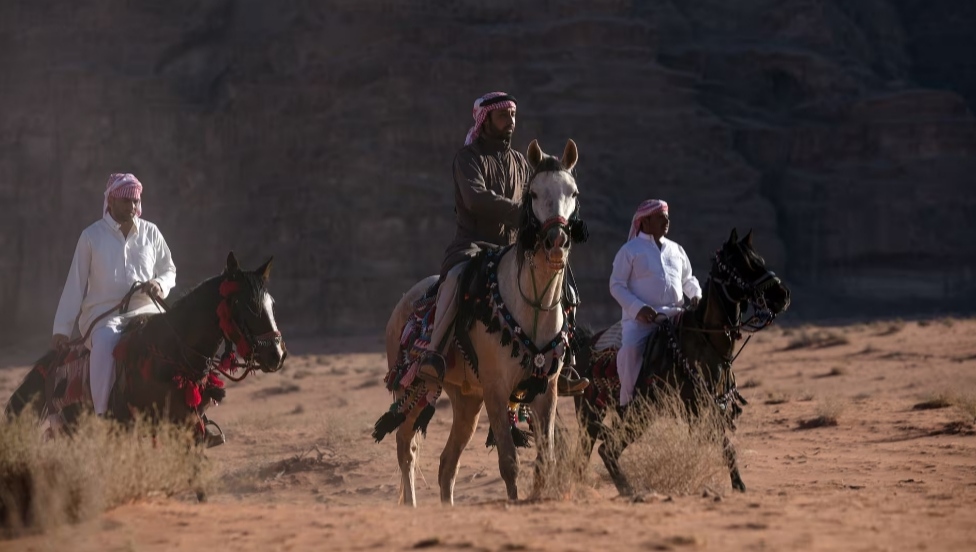
Because they live mainly in the Negev desert in designated towns and villages, I don’t meet many Bedouins. But since I started my small hobby farm and taking in rescue animals, I have had some interaction with them. Some of those were positive, like the time when we went to a Bedouin town to buy a saddle and they proudly showed us their amazing, home-bred Arab horses, complete with beautifully decorated tack. And others less so, like when I sold a (different) saddle online and a group of four Bedouin men came over and basically intimidated me into accepting a much lower offer than I wanted. Well, you live and learn, and I wrote this down to male bullying more than anything else.

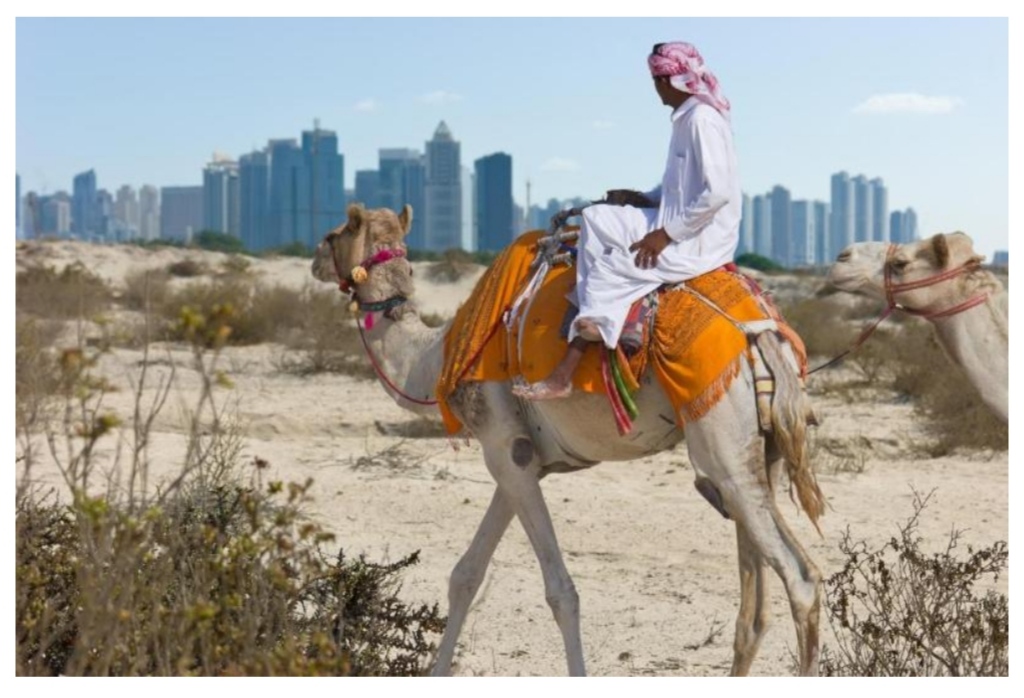
Bedouins were historically dependent on their animals to survive. For thousands of years, they relied on their camels for transport, milk and meat. I don’t know anyone who can handle a camel except the Bedouins. I am used to large animals, but I treat camels with extreme caution. They are amazing but so strange to me! I have no idea how they work. Whenever we go for trips to the desert, my face is glued to the window looking for Bedouin camps with camels and especially, horses.

Arab horses are world renowned for their beauty, speed and strength. They are like the Jaguar of horses. And these magnificent creatures just live by Bedouin tents, between the goats, kids riding them bareback. Sometimes you see people riding on the streets, parading proudly with beautiful, coloured tack and decorations.

If Arab horses are the Jaguars of the horse world, Saluki dogs are the Jaguars of dogs. The Saluki is a breed that was traditionally used by Bedouins for hunting. These days, hunting is illegal in Israel, so anyone using their dogs to hunt runs the risk of the dogs getting confiscated. You don’t see Salukis much anymore. The breed that is now mostly associated with Bedouins is the Cana’an dog, a breed that is extremely watchful and makes great guard dogs. I should know, because I have Cana’an mix and he never stops barking.

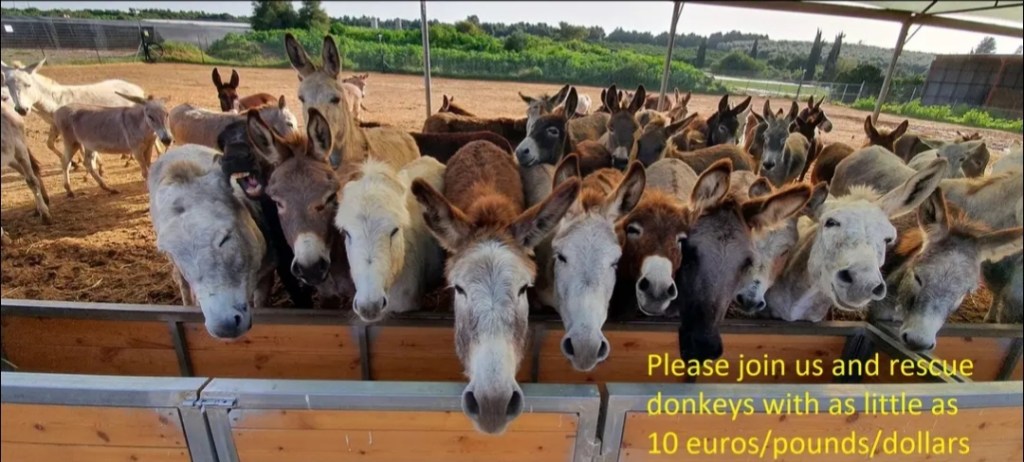
Now, the Bedouins are famous for their animal breeding and riding skills – but not always for their animal-friendliness. I have three rescue donkeys that have escaped from Bedouin villages. Two of them are terrified of people, full of scars and obviously traumatized. Sadly, donkeys are the dregs of the farm world. They have mostly been replaced by tractors and trucks, but are sometimes still used by Bedouins for riding, carrying burdens and pulling carts. They are frequently overloaded, mistreated and neglected, sometimes even subjected to extreme and malicious abuse. This is obviously not limited to Bedouins – people everywhere abuse animals. But there are several practices common amongst Bedouins that I consider problematic.

One of them is tying the legs of animals together. Traditionally, Bedouins don’t build fences and let their animals roam freely to find food for themselves. But obviously, they can’t go too far or run away when their owners come to get them. So their legs are tied together in such a way that they can walk small distances to graze, but not run. This is done to all animals: goats and sheep, camels, horses, donkeys. I have seen camels with all four legs and their head tied together. They could only hobble a few paces.

I don’t like it, but if this is done safely and with wide leather straps, I wouldn’t consider it abuse. But often, it is done with straw twine, which cuts into their legs and leaves wounds that never heal. These poor animals suffer constant pain. All my donkeys have these scars on their legs – except the one who was born in my care. One of them also has scars on his chest, probably from pulling a cart with an ill-fitting harness. Donkeys are extremely sensitive and intelligent animals. They figure out how to beat the system and untangle themselves. And when they’re gone, they’re gone. They remember everything and they will never go back to owners who abused them. So they start roaming. They walk along the roads and often end up in kibbutzim, where there are fields and horses. That way, I have now gathered three rescue donkeys – they were found wandering around, alone and hungry, with wounds on their legs. They have become less afraid with time, but they will never fully trust any human.

There are several large scale donkey sanctuaries in Israel. The most famous ones are Pegasus, Starting Over and Safe Haven for Donkeys. These people do incredible work that is vastly underrated. Donations and publicity are always greatly appreciated.

But I digress! I will get off my animal care soapbox now and concentrate on human rights. Because Bedouins and modern Israeli society do not always mesh well. Most Bedouins live in towns in the Negev, like Rahat or Tel Sheva. But there are many illegal villages, where the desert people decided to build their tents and huts, as is their tradition. But the land does not belong to them and the state does not recognize these villages. As a result, these places lack basic necessities like electricity, plumbing and, most importantly, bomb shelters and sirens. They are also not covered by the Iron Dome, the rocket interception system which keeps most of Israel safe from bombs launched at us from Gaza and Lebanon.

On the 7th of October, 2023, Hamas started their deadly invasion with a barrage of rockets shot into Israel. As many of the Bedouin villages do not have bomb shelters, seven people were killed by the impact of rockets. Six of those were children, and one a grandmother. This is absolutely heartbreaking. It is unacceptable that people have to live in this country without adequate protection against rockets. Hamas has been throwing rockets at us since 2005, when Israel left Gaza. You’d think every square inch of the country would be protected by now.

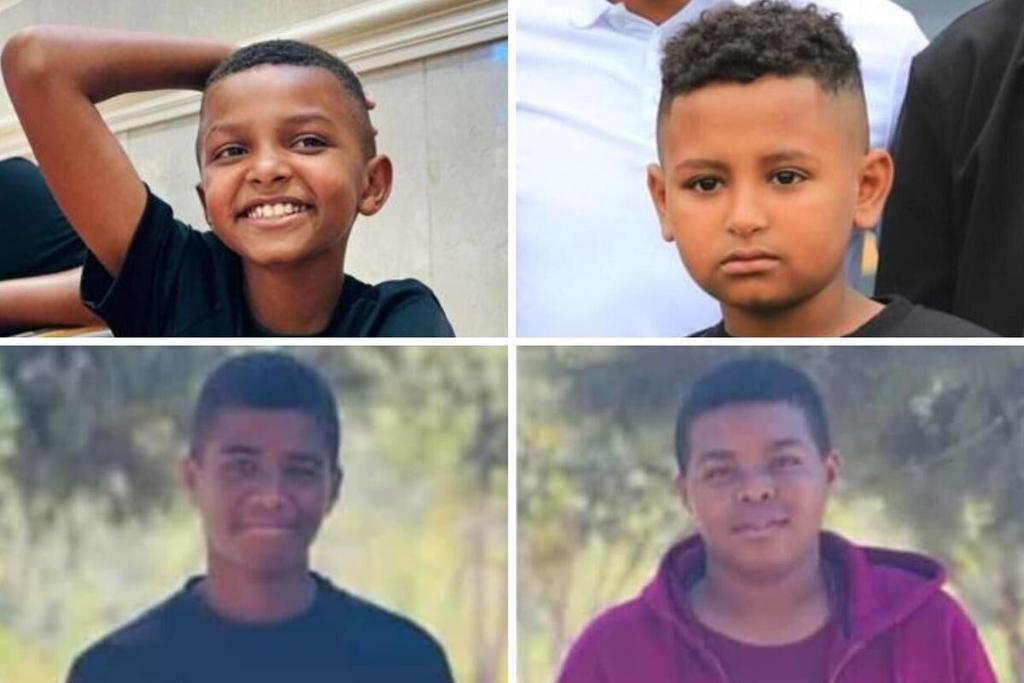
Malik, Jawad, Mohammed and Amin Al-Gourhan. Four children killed by a single rocket launched from Gaza.

Apart from casualties by rocket impacts, Hamas murdered 21 Bedouin Israelis. Some Bedouins serve in the Israeli army, but most of those killed on October 7 were civilians. Not that Hamas cared. They destroyed everything in their path.

Fatma Alttalaqat, 35, was a Bedouin mother of nine children. She was on the way to work with her husband and baby, when Hamas terrorists stopped the car and shot her point blank. Her body was found riddled with 40 bullets. She leaves a broken family behind, who cannot comprehend how Palestinians could shoot an innocent woman wearing a hijab in cold blood. I can’t either. It is inhuman.

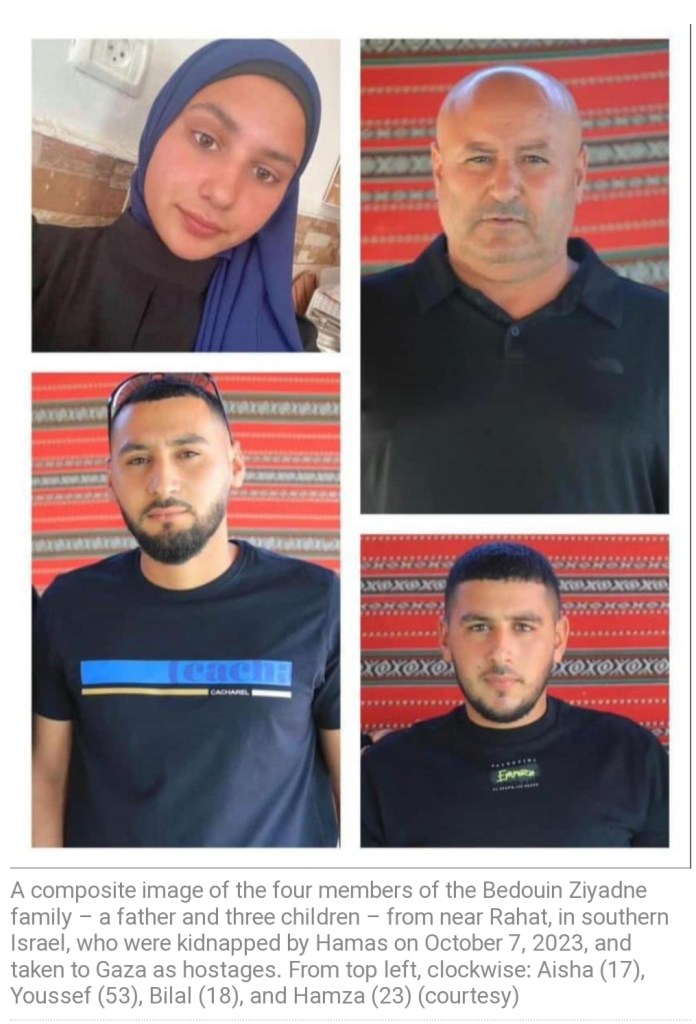
I found no photo of Fatma, because Bedouins do not like publishing photos, especially not of women. The one exception was Aisha Alziadne, out of necessity.

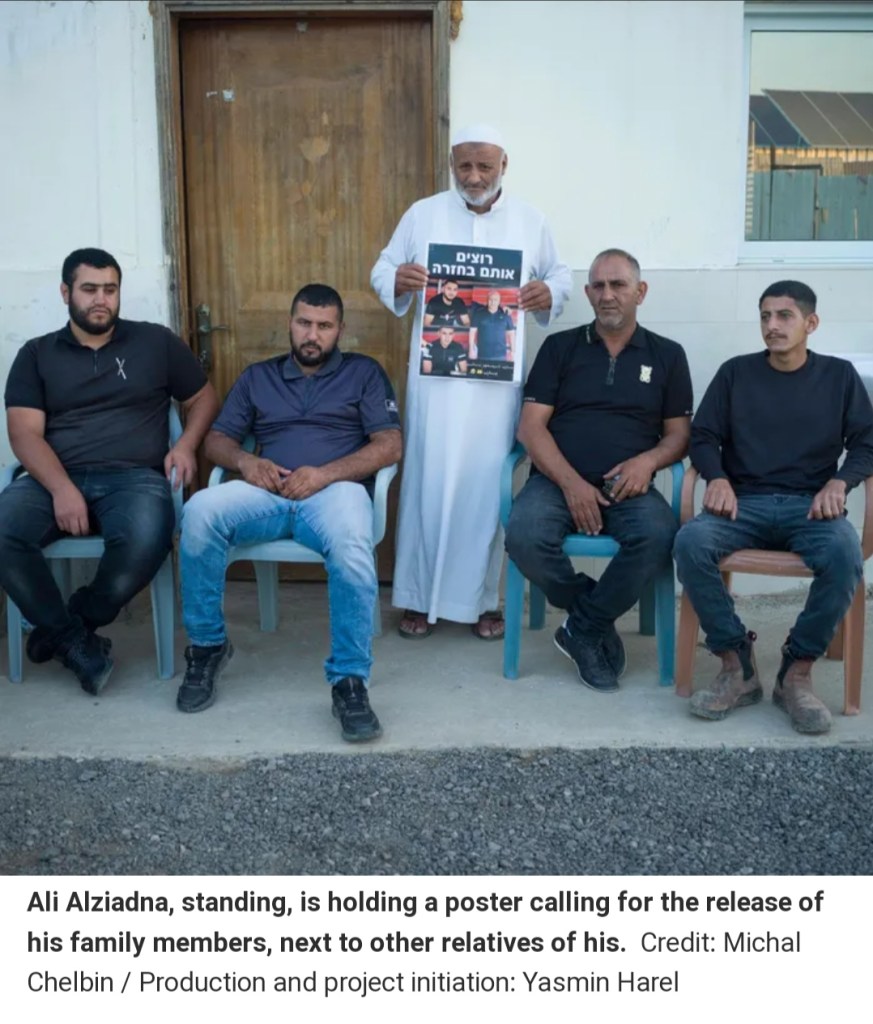
Four members of the same Bedouin family, the Alziadne clan, were abducted by Hamas. Youssef Alziadne has worked in the dairy farm of kibbutz Holit for seventeen years. When they were old enough, three of his children, Hamza, Bilal and Aisha, starting working with him. On October 7, they were all at work when the terrorists invaded kibbutz Holit. At the end of the day, all four were marked as missing. Later, they were seen in security footage, being led into Gaza on foot. Their status was adjusted to hostages.

A member of the same family, Abed Alrahman Ataf Alziadne, 26, was killed on Zikim Beach. Just like Fatma Alttalaqat, his body was absolutely riddled with bullets. He was machine gunned to death by rabid lunatics. It is horrific.

After 7 weeks of captivity, minors Aisha and Bilal were released. But Hamza and Youssef remain in the tunnels of Hamas. Their extensive family is terrified for them. Youssef has two wives and 19 children. He suffers from diabetes and his family is worried that he does not have his medication. Hamza is married and a father of two children. He suffers from migraines and does not have his medication either.

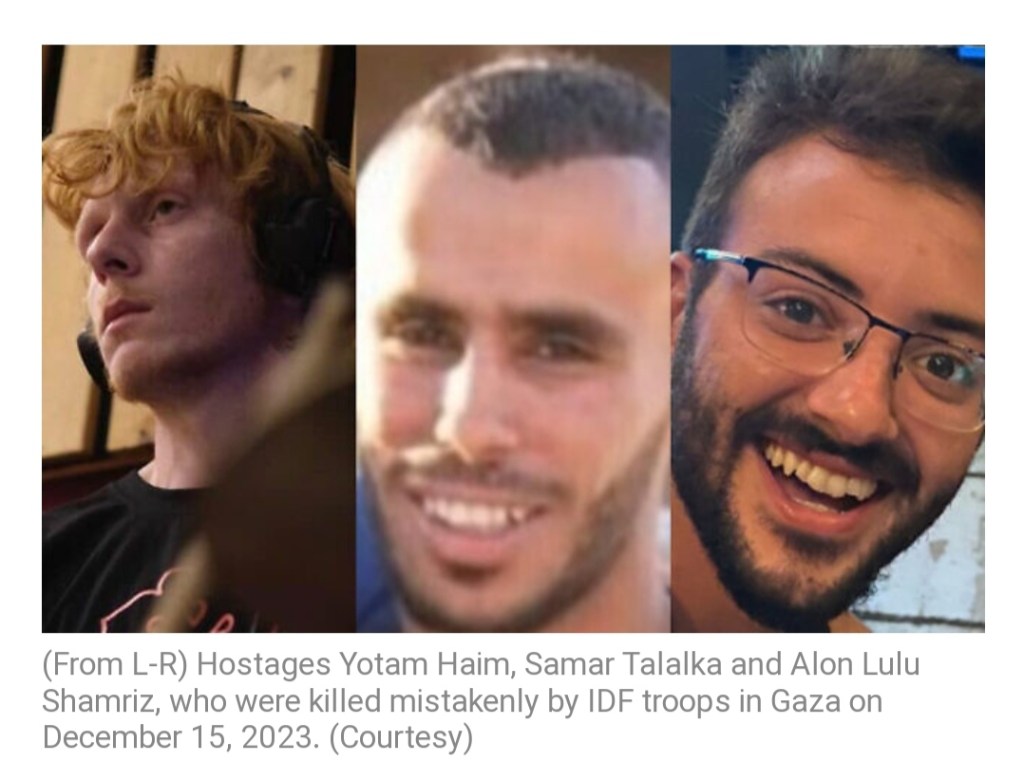
Other than the Alziadne family, there are three more Bedouin hostages. One of them was Samer Talalka. On December 15, Samer managed to escape his prison together with two other Israeli hostages. They tried to get the IDF to notice and rescue them, but instead, the IDF soldiers thought they were being ambushed and shot them. Tragically, the three were killed by fire from their own army. The absolute last thing anyone wanted.

One of the other Bedouin hostages remains unnamed, at the request of his family. The last one is Hisham al-Sayed, who has been held captive by Hamas since 2015.

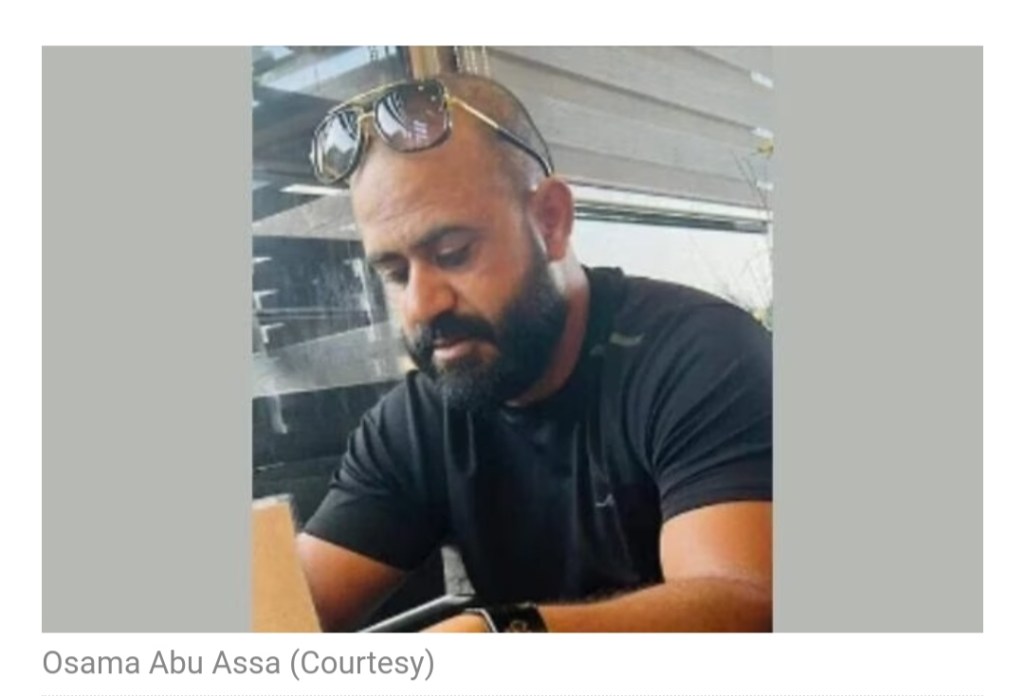
One other victim of Hamas that I want to mention is Osama Abu Assa. Osama was a Bedouin man from Tel Sheva, who worked as a security guard near kibbutz Re’im. In the early morning of October 7, he was returning home from his night shift when the sirens started wailing. He ran for a bomb shelter and hid there with other people. A security camera recorded the entire sequence of events. I saw the beginning of the video. The terrorists started firing into the bomb shelter and shouting for people to come out. Osama ran out, ducking to avoid the bullets flying around him. He shouted at them that all the people in the shelter were Arabs, that they were all civilians, women and children. This was not true, the other people in the shelter were Jews. Osama saved their lives. But he paid for it with his own life. The terrorists started beating him up. I couldn’t continue watching at that point, but I know they violently beat him, forced him to undress and robbed him of all his valuables – before finally executing him. Knowing this makes me sick to my stomach. What a horrendous, senseless murder. Osama was a good man who protected innocent people. Why? Why did they kill him? It is pure evil.

There is a twist to this story. Osama belonged to a large family clan with a lot of influence in the Bedouin community. His family has sworn bloody revenge and had offered a reward of 1 million dollars for information leading to Osama’s murderers. In an interview with Ynet, Osama’s brother, Joad Abu Assa, told the interviewer:

“(…) this is a blood feud – these people tortured him and it’s not a simple matter. My Bedouin, Druze and Jewish friends approached me asking to help us. If their families don’t fear us, they’ll do it again and again because this is a blood feud. Bedouins in Israel kill one another over trivialities all the time, so don’t you expect everyone, and the world, to rise up in this case?”

About Hamas, Joad Abu Assa said:

“Hamas is a crime syndicate, not a state working against a state. People there murder people for money and their own interests. This isn’t about a state or the war, this is about the people there. They only want more money and then fire rockets at Israel so that it has a chance to take a picture of a dead Palestinian child and show the world. We know this and we’ve had enough of Hamas, ISIS, and their violence. It’s not only about my brother, we’re aching for the Jewish children who were murdered as well, and the 80-year-old woman who was abducted, who does something like this?”

And finally:

“(…) their Islam doesn’t represent us, they’re not true Muslims. A Muslim doesn’t murder, they hide behind our Islamic religion, ours is a religion of peace and respect. Our religion tells us not to murder. It says much, but not to torture.”

I know I shouldn’t want revenge. I should want peace for everyone involved. And I do. But this, coming from an Israeli Bedouin, really lifts my spirit. I know about blood feuds. They’re seriously scary. But instead of fighting each other, the Negev Bedouins now have a common enemy: Hamas. They understand Arab culture in a way we don’t. And they are armed and ready. They are not done with Hamas.

Aisha, come home. By Yaara Eshet.

100 Days

Today, the hostages have been in captivity for 100 days. Most of the minors and their mothers, and elderly women, as well as most Thais and the 2 Filipinos, were released during the ceasefire after 7 weeks. But 136 living people are still assumed to be held prisoner in Gaza. Some of the hostages have died (were murdered) and their bodies are known to still be held captive, like Joshua Mollel, whose bloody murder was broadcast by Hamas. Some are known to be seriously injured, like Hersh Goldberg-Polin, whose arm was blown off during an explosion on October 7. Some are only teenagers, like Eden Alexander, who is 19 years old. Some are very old, like Oded Lifschitz, 83.

Some of those who are still being held are friends or family members of my friends. Like Noa Argamani, who is my friend’s cousin. Like Ofer Calderon, David Cunio and Ariel Cunio, who are friends of my friends.

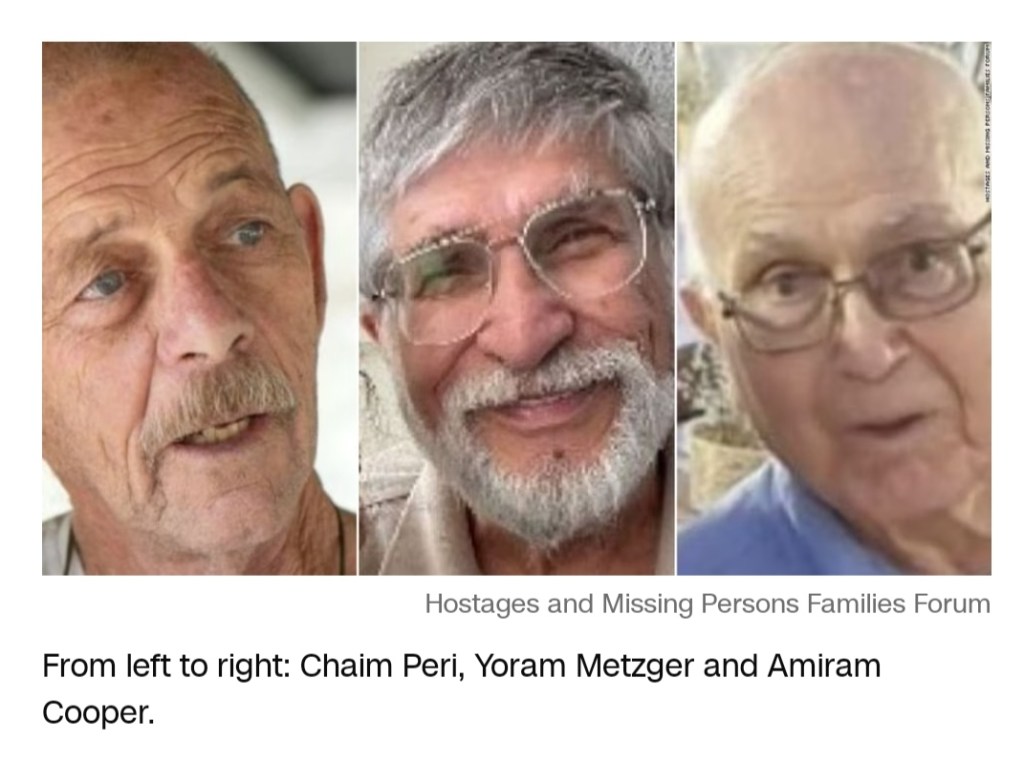
There have been practically no signs of life. A few weeks back, Hamas released a video of three of the oldest hostages, Haim Peri (79), Yoram Metzger (80) and Amiram Cooper (84). They were sitting in a row in front of the camera, looking thin and weak, with long beards. They pleaded with the Israeli government to stop the war and rescue them. Of course, they had been told exactly what to say by men with automatic guns, so we have no idea what they actually wanted to say.

This kind of thing has the dual effect of raising our hopes – they’re alive! – and feeding our anxiety: time is running out. It’s a known tactic of psychological warfare. It is entirely possible that these three elderly men were executed immediately after the recording of that video.

I hope to heaven that this is not what happened. I hope the majority of the hostages are alive and will one day be found safe and brought back home. But sometimes, I wonder if any of them are still alive right now. And if they are, what hell are they going through? We know from the released hostages that they were kept in harsh circumstances, fed very little and threatened constantly. Some men were beaten with electric cables. Some women were kept in cages and sexually assaulted, over and over again.

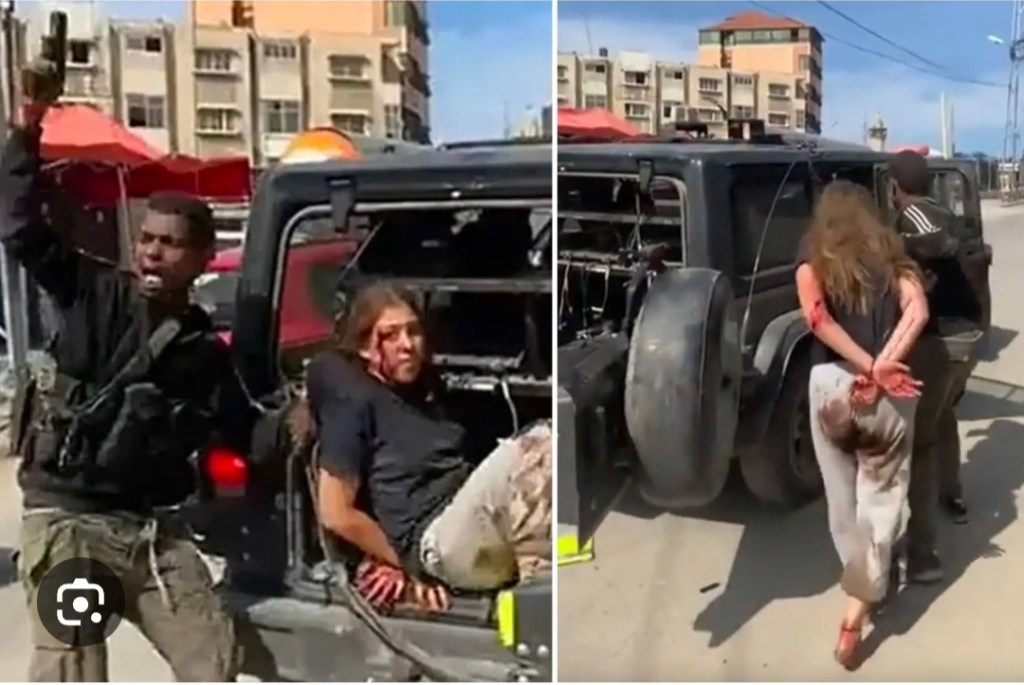
Some were not even abducted by Hamas at all. Some were taken by Islamic Jihad, another terror organization. And some were taken by civilians, who followed Hamas out of the gates and joined cheerfully in the plunder, murder and destruction. These civilians chose young girls and women to kidnap for themselves. No one knows where they are, but we can guess what is being done to them. Sexual violence was a big part of the October 7 massacre. It is no secret that many bodies were found naked and bleeding, gangraped violently and then shot. Hamas member have bragged about raping Israeli women.

.

.

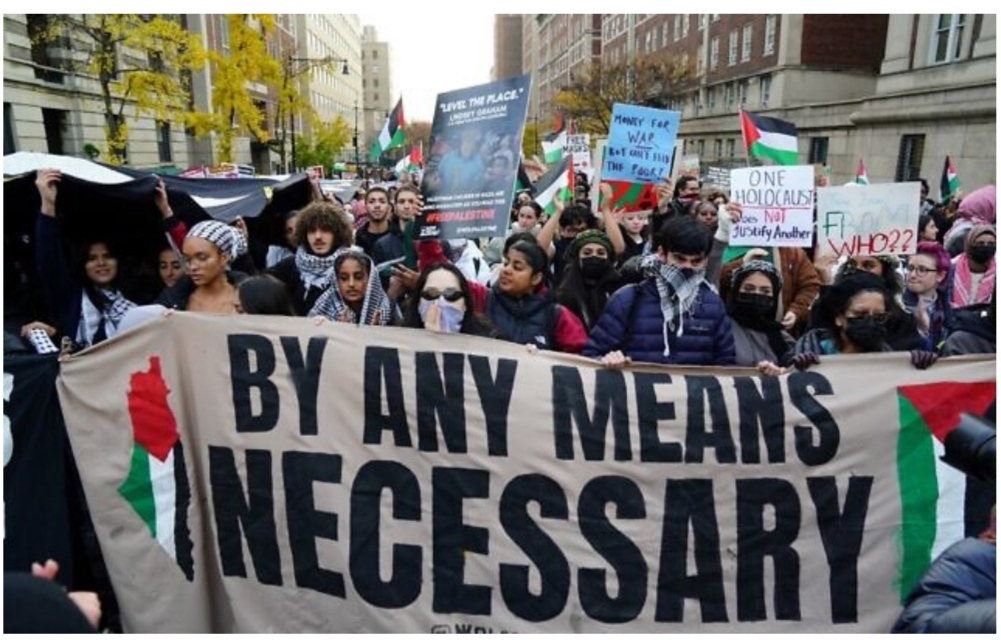
But somehow, this is still being contested by the world. Somehow, people all over the world manage to turn this atrocity around and twist it. Humans everywhere love to blame Jews. It has always been like this in history and these times are no exception. We are apparently to blame for progroms and holocausts, for hatred and massacres, just because we are Jews and we should not be wherever we are. People manage to justify to themselves what Hamas has done. They want to absolve their guilty conscience by saying: “Well, the Jews had it coming.” And they cheerfully campaign for Palestine, donate to Gaza (which all goes straight to Hamas), walk around with kefiyahs on their heads and feel like cool, edgy, progressive humans.

You’re not. You’re antisemites and neo-Nazis. Just a few days ago, someone from my own country stole my words, twisted them around and gleefully managed to suggest that not only did we have it coming, but Israel orchestrated the attack themselves, just to have an excuse to “commit genocide” in Gaza.

I have never been so ashamed to be Dutch in my life. People like this make me sick. They are holocaust deniers, victim blamers and no better than the Death Eaters themselves. But I know what is going to happen. Hamas has said it themselves, numerous times: the West is next. One day very soon, things like this will happen in Europe. Then, these people will finally start to realize that radical Islam is a horrific evil that wants to conquer the world and destroy everyone that doesn’t live exactly according to their draconian rules. But then, it will be too late.

I want to take this opportunity to draw attention to the women and children still in the hands of Gazans, and likely subjected to physical, sexual and psychological violence. Is this what you want? Is this what you want to see in your own country? To them, women are objects. Trophies, to be owned, stolen and discarded as they please. We need to fight this evil and make sure they do not conquer Europe! Because no matter what I shout, I care deeply about my old country. My heart breaks to see it slowly being subjected to Sharia law. As much as it breaks for these beautiful women. Please, please help us bring them home. Raise your voice. Say NO. This is evil, no matter what your race, religion or nationality is.

.

.

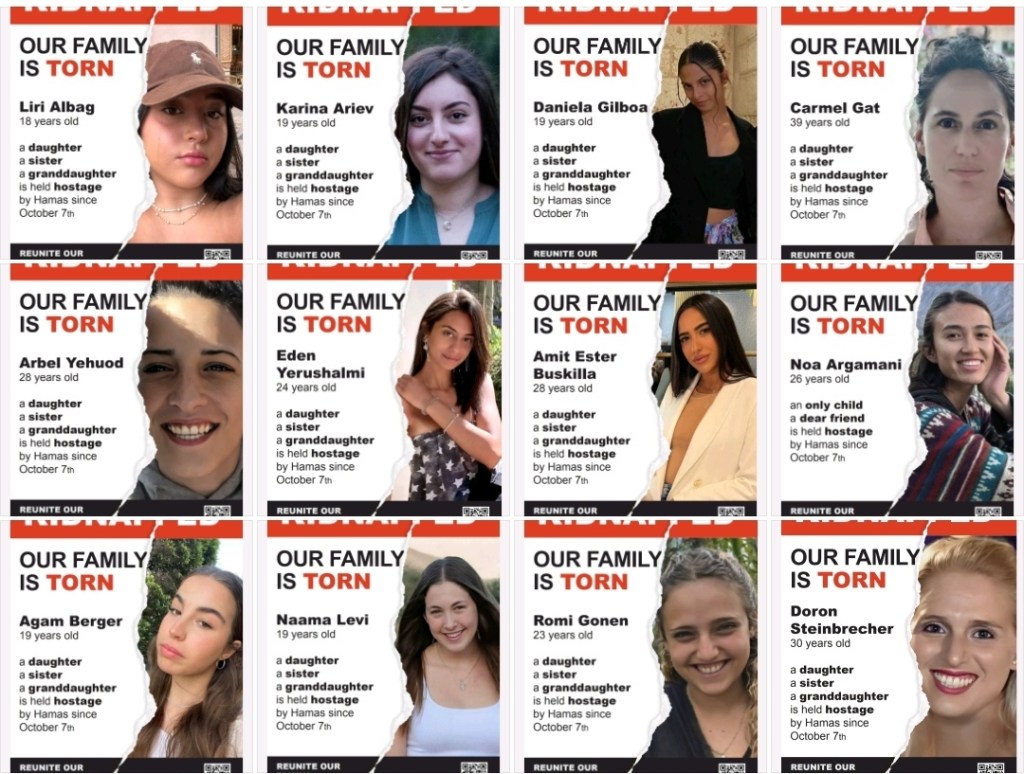
Liri, Karina, Daniela, Carmel, Arbel, Eden, Amit, Noa, Agam, Naama, Romi and Doron are still being held hostage. 100 days.

.

.

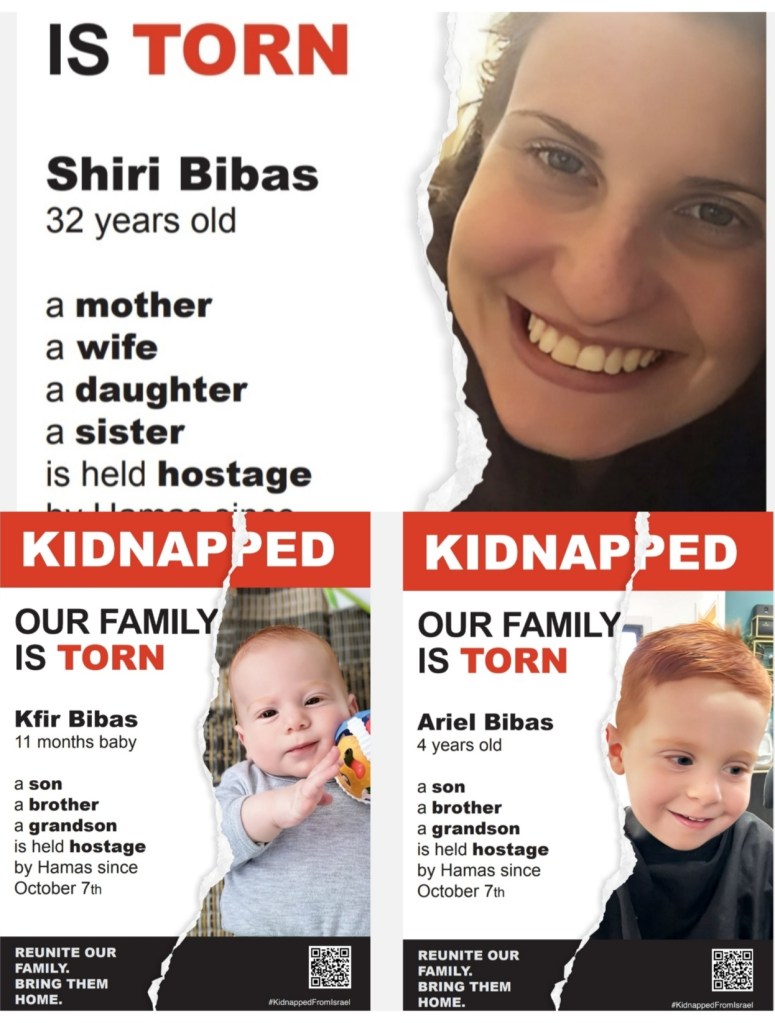
Shiri, Ariel and Kfir Bibas are still not back home. Kfir recently turned one year old. He has been captive for 100 days of his short little life.

.

.

Look them in the eyes, these young girls. See what the Death Eaters did to them. And then stand behind that with a clear conscience. I dare you.

#bringthemhome

The Sharabi Family

This story is about Eli and Yossi Sharabi, two brothers from Yemeni descent. They are the eldest and middle of three brothers who were born and grew up in kibbutz Be’eri. Eli, the eldest, married a British woman from Bristol called Lianne. Just like Thomas Hand, Lianne came to Israel as a kibbutz volunteer at age 19. That is when she met Eli Sharabi and decided to stay. They got married, had two lovely daughters and built a happy life together in kibbutz Be’eri.

.

This is Eli with Lianne, Noya (16) and Yahel (13).

.

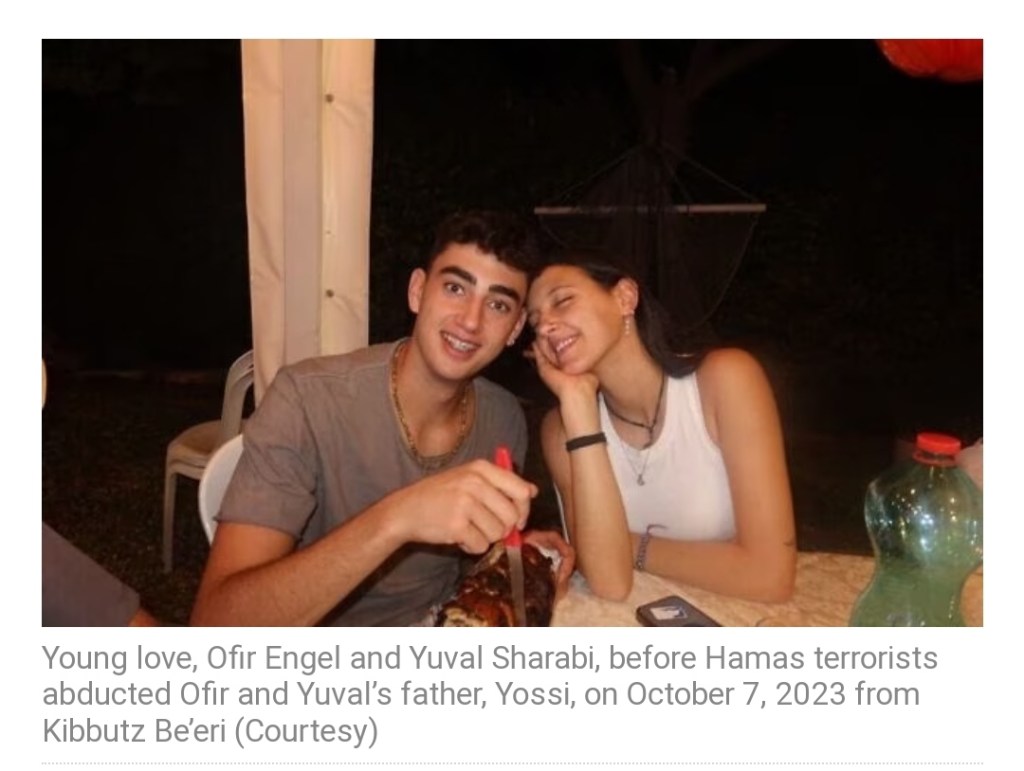
And this is Yossi’s family. He married Nira Herman, a nurse. They had three beautiful daughters: Yuval (17), Ofir (14) and Oren (13). They lived their lives, went to work and to school, saw family and friends. Like all people everywhere.

Until October 7, 2023. Black shabbath, the destruction of kibbutz Be’eri at the hands of Hamas. Terrorists broke through the Gaza border, gunning down everyone they saw, and invaded the kibbutz. Heavily armed men went from house to house, hunting down Israelis, leaving a trail of murder and destruction. Eli and Lianne’s home was on the list, too. When the intruders broke in, Mocca, the family dog, ran at them barking. Hiding in their safe room, the family heard the gunmen shoot their dog and then laugh. This mental picture is burned into my brain and makes my blood run cold.

In interviews, Nira later said that Lianne texted her, saying: “Nira, I can hear them. They are here at our house. They are shooting and shouting: “Die Israel”. Please call for help.”

Nira did call for help, but it would not come until hours later. It was too late for Lianne, Noya and Yahel. They were murdered in such a brutal way that it took weeks for their remains to be definitively identified. I don’t know the details of what was done to them, and I prefer not to know. But Noya and Yahel, young teenage girls, could only be identified through DNA testing.

.

Eli Sharabi lost his entire family on that horrific morning. But we don’t know whether he realizes they are dead. He was abducted by Hamas and there has been no contact with him whatsoever. We don’t know if he is alive at all, or if he will ever come home. But even if he does, he has no home anymore, no house, no kibbutz, no family. His entire life has been destroyed by the Death Eaters. I cannot imagine anything worse. My heart bleeds for Eli Sharabi.

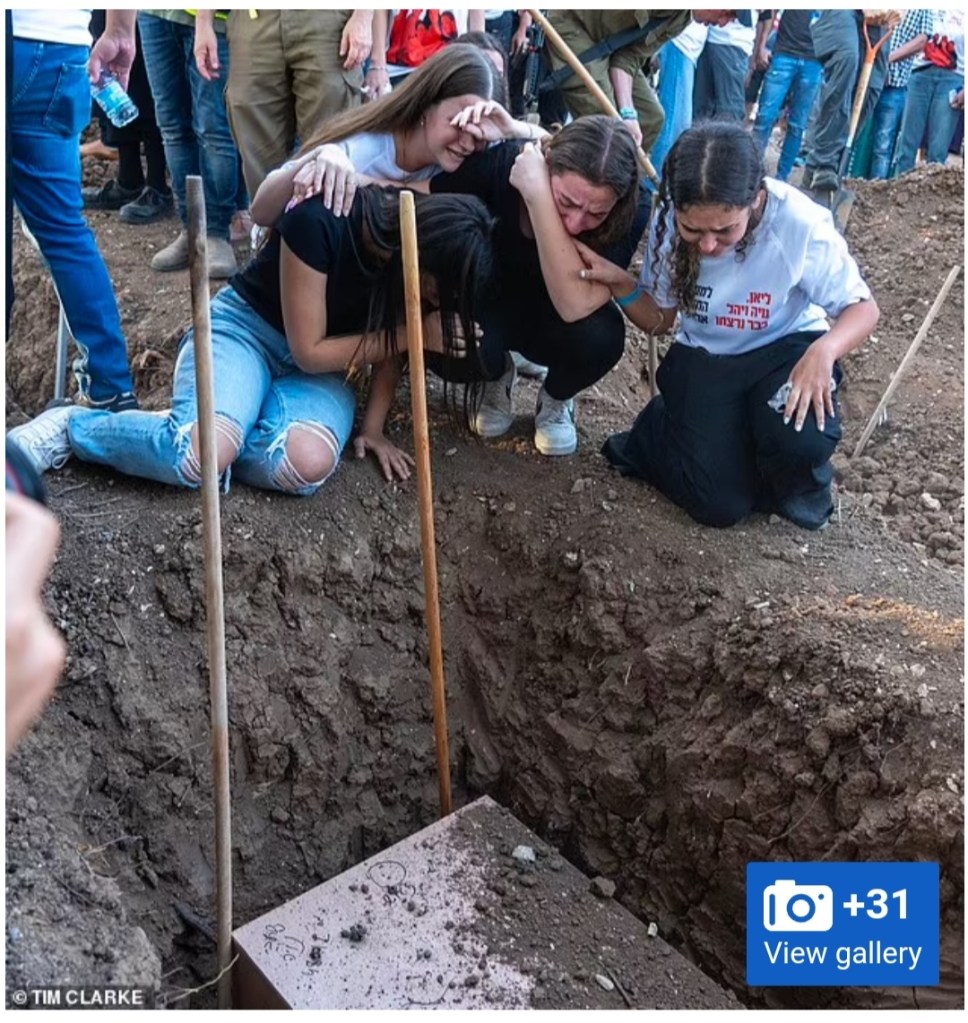
The following image is from Lianne, Yahel and Noya’s funeral (in the Daily Mail).

.

Yossi, Nira and their children were also hiding in their safe room. They could hear the terrorists outside, shouting and shooting. People started calling Nira, who is a nurse, with panicked requests for help, what to do for family members who had been shot. Nira tried to instruct them as well as she could without being able to leave her house and see the wounded people for herself. Lianne texted her, begging her to call for help. Ten minutes later, she lost contact with Lianne. Nira’s nephew called from the Supernova music festival, telling her they were under attack and he was coming to their kibbutz. Nira had to tell him not to come, that the terrorists were in Be’eri, too. Later, she heard that her nephew was killed at the site of Supernova.

To these people, it must have felt like the world was ending. The terror and despair they must have felt is unimaginable.

At 12:30, the Death Eaters reached Nira and Yossi’s house. They did the same thing as in Eli and Lianne’s home: they shot and killed their dog, Shoko, and laughed. Yossi then got up, walked out of the safe room and told the terrorists to take him and leave his family. In the documentary Burning in the hearts of Be’eri, Nira later described the following scene:

“They took us from the house, and they brought us downstairs to the garden. They took our phones with their weapons [aimed at us]. All three terrorists. They were dressed in black with the whole package and everything. (…) And they took pictures, a selfie, you know, to spread it all around. And they just took the flag. We had a flag of Israel down in the house, and they just ripped it and they started to smash it. And they start to yell in Arabic, “Down with Israel! This is Palestine! This is not Israel! Israel does not exist! Kill all the Jews!” “

The terrorists then told them to give them their car keys. They made Yossi Sharabi, Ofir Engel (Yuval’s boyfriend) and Amit Shani, their neighbour’s son, get into the car. Then, they drove away with the three Israelis as hostages. Nira and her daughters and their neighbour, Amit’s mother, stood there and cried, looking after the car that took their loved ones away.

Seven weeks later, in the ceasefire, minors Ofir and Amit were released. The video footage of the reunion of Ofir and his girlfriend, Yuval Sharabi, is so very touching. Amit’s grandmother, Simcha Shani, was shot in the stomach but survived the ordeal. The entire family is extremely lucky to all be alive and together.

Unlike the Sharabi family. Not only were Lianne, Noya and Yahel murdered, but both Eli and Yossi are still hostages. Nira and her daughters cannot return to Be’eri, their house has been burned to the ground. They stay in a hotel in Eilat, and try to survive the hours, days, weeks and months that they are apart from their husband and father. Nira says she has no idea why the terrorists didn’t simply shoot them all. They had no problems shooting other women and children.

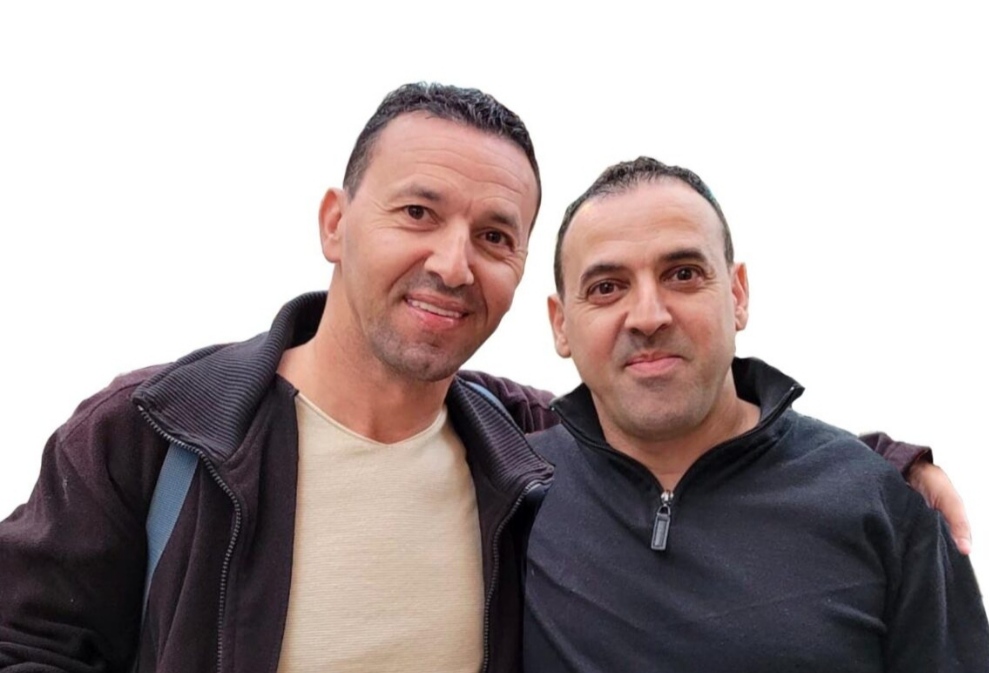
Yossi and Eli’s younger brother, Sharon, supports them the best he can and campaigns for the release of his brothers. He keeps Shabbath and so he did not get any of the messages that his family sent him that day, until the evening, when he switched on his phone and saw what had happened to them. He says: “My job is to bring my brothers home.”

.

I don’t know if Eli and Yossi Sharabi are alive or if they will ever come home. I hope and pray they are and they will. But what they will find if they do, will be incredibly hard for them.

#bringthemhome

.

Update 17/1/24

With a heavy heart, I have to add here that Yossi Sharabi was murdered in Hamas captivity. This has been made public yesterday.

Hamas released a video on January 14, 2024, showing three hostages: Noa Argamani, Yossi Sharabi and Itay Svirsky. They were forced to say that if Israel didn’t stop the war, they would die. Hamas ended the video with a nice little game: we got to guess who was going to be murdered that night.

Sadly, Noa was the only one who survived this demonic game.

I am heartbroken for Nira and her daughters. This family had to go through way too much.

Rest in peace, Yossi Sharabi.

Yehonathan Semo – a hero after death

1200 civilians were murdered on October 7, 2023. Not killed in battle or casualties of war. There was no war. They were shot, stabbed and burned in a premeditated act of mass murder by invaders, while they hid unarmed in their homes. There is a world of difference, and this is why we cannot ever forget or forgive. Not ever.

But of course there have been and continue to be soldier casualties. Most of these are young men, because young men most often get sent to the front in active battle. In Israel, everyone, male or female, must serve in the army for three years after finishing high school, from the age of around 18 to 21. Orthodox religious people are exempt from army duty (always a topic of heavy discussion) and so are Arab Israelis, although they can and do enlist if they want to. After this compulsory army service, everyone is expected to serve around one month a year in the reserve army until age 40.

As a mother of teenage boys, army duty at 18/19 seems ridiculously young to me. Why do we have kids defending our country? Of course, there are the reservists and the professional soldiers, who are older. But most casualties are 19, 20, 21 years old. It gets to me every time again. Every time again a young life is lost, a mother’s heart is broken, a family ripped apart, siblings and girlfriends and friends traumatized.

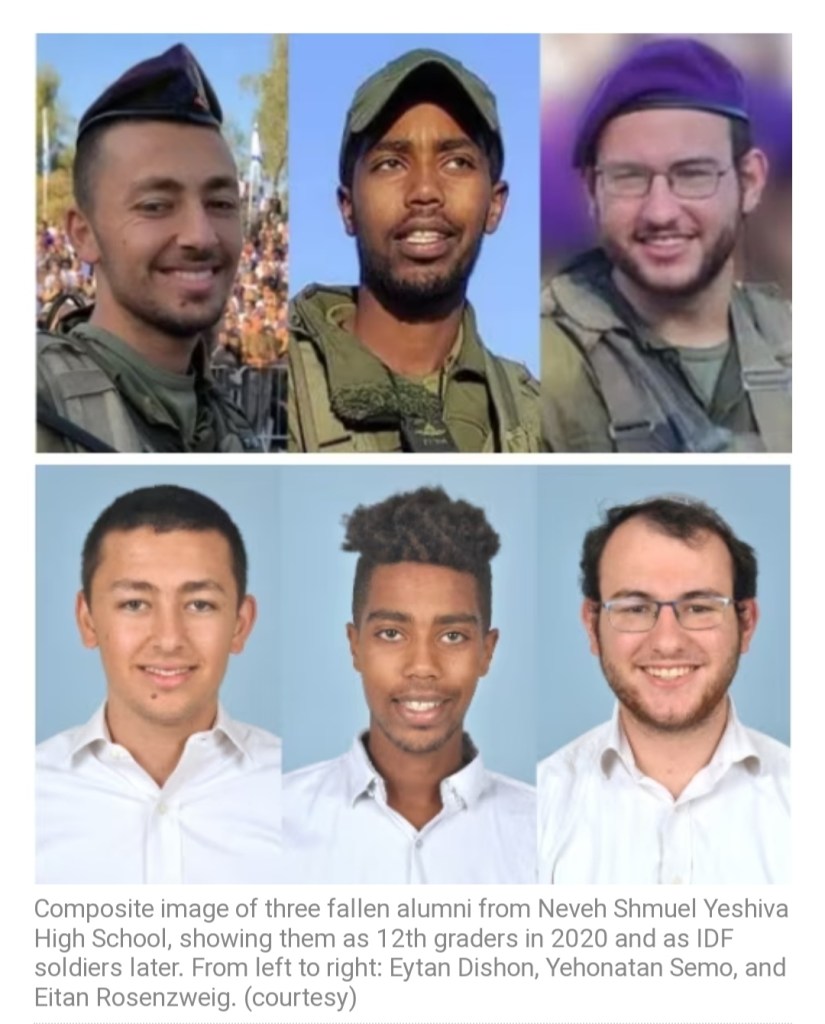
One of those soldiers was Ethiopian Israeli Yehonathan Semo. He was sent to Gaza after October 7, was heavily injured on November 8 and died of his wounds on November 10. He was 21 years old. He was a Staff Sergeant in the Paratroopers’ 202nd Battalion.

Yehonathan went to Neveh Shmuel Yeshiva High School. Apart from him, two other boys from the same class were killed in the war: Eytan Dishon and Eitan Rosenzweig. All three were only 21 years old.

.

Obviously, the death of these three young men left a deep impression on the rest of their classmates. Yehonathan was hospitalized two days before he died, so a group of his friends and former classmates were able to visit and say goodbye. He was described as a “people’s person”, someone who was always surrounded by friends, open and outgoing. He was also an athlete, a fast sprinter and a good soccer player.

The death of these three boys is nothing short of tragic. But there is a beautiful side to this story, too. Yehonathan Semo carried an organ donor card when he was injured. After his death in the hospital, his family gave permission for his organs to be donated. And this is how Yehonathan Semo saved six lives after his own death.

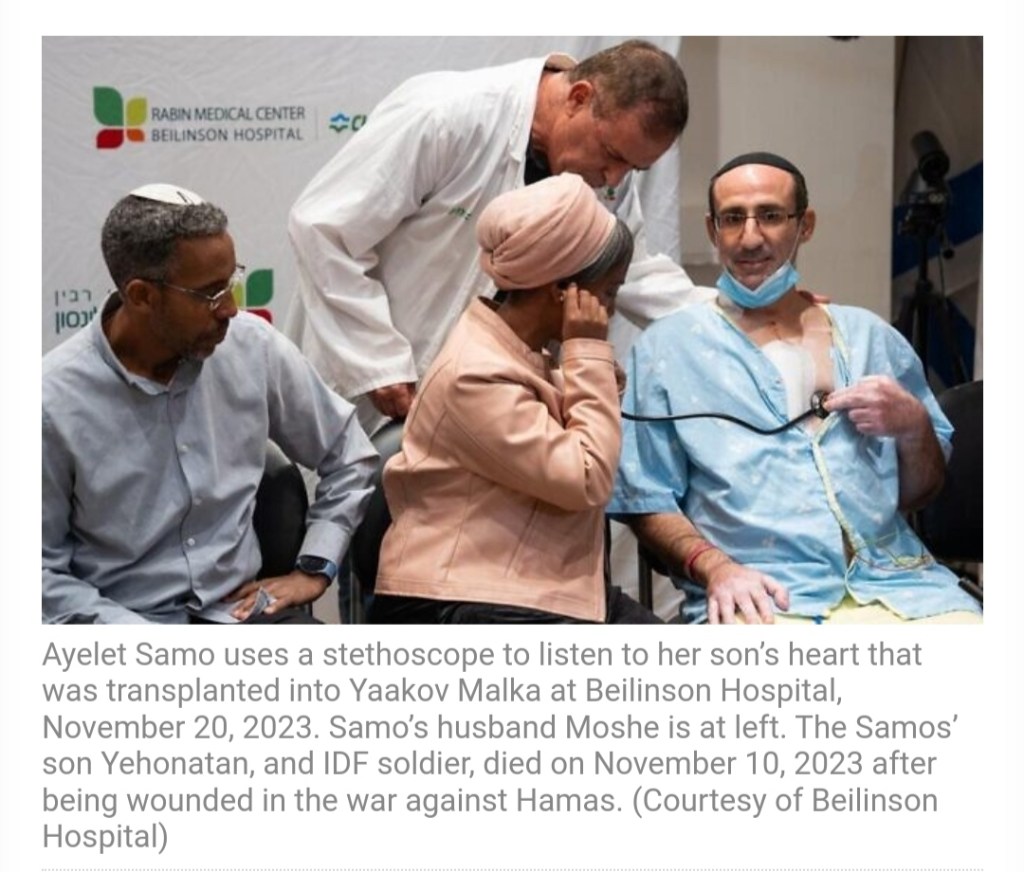
Meir Atsaba, 36, a father of two, who suffered from a lung disease, received Yehonathan’s lungs. Yaakov Malka, a 46 year old father of four, got his heart. The surgeon who performed the transplant said: “This heart, which was once in the body of the late Yehonathan and today beats in the body of Yaakov, is the heart of the State of Israel.”

Yehonathan’s parents, Ayelet and Moshe Samo, visited Yaakov Malka and listened to the heart of their son beating in Yaakov’s chest.

Ayelet said: “We feel overwhelmed, but the knowledge that we have made life possible for others strengthens us.”

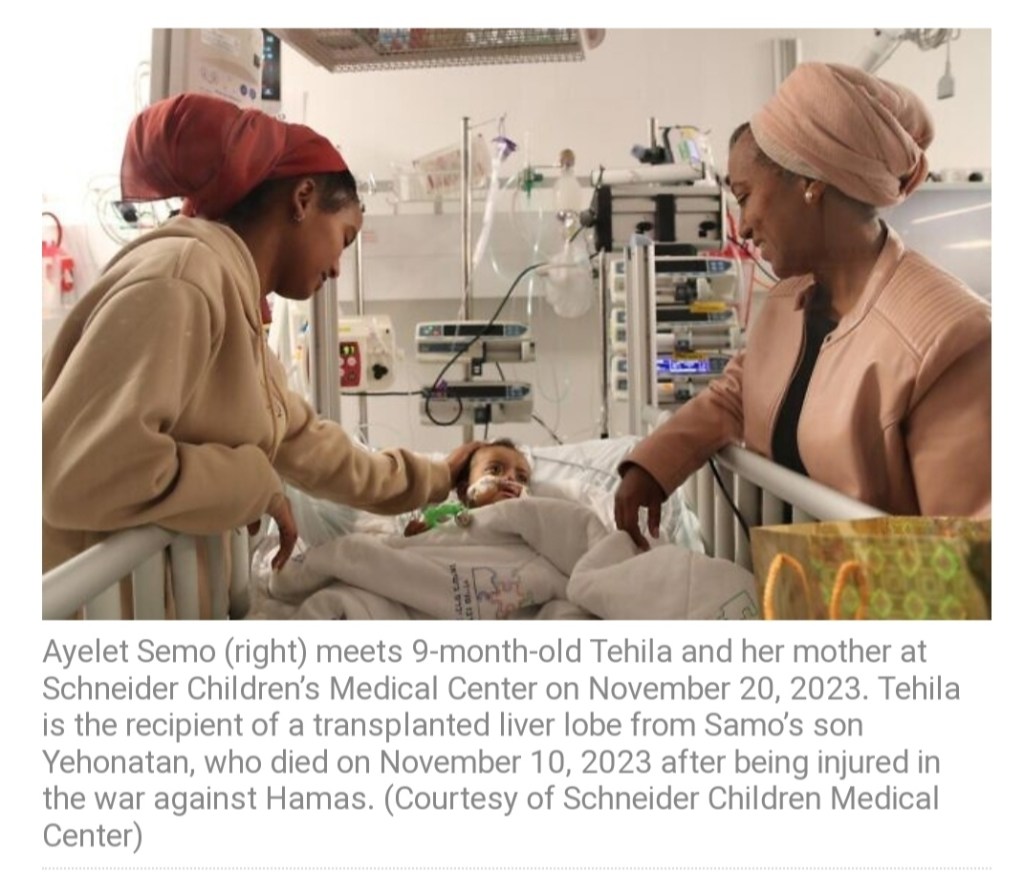
They also visited 9 month old Tehila, who was born with a genetic liver disease. She received part of Yehonathan’s liver.

A 10 year old child received one of Yehonathan’s kidneys, while the other kidney and the rest of his liver went to two 50 year old patients.

This is not the only story of fallen soldiers donating their organs, but it is one that touched the entire nation deeply and inspired many to sign donor cards. So at least something good can come out of this terrible mess.

I hope that Yehonathan’s parents, friends and four younger siblings are able to find some comfort in the fact that their loved one managed to save six people’s lives after his death. But he will still leave a huge gap in their lives forever.

Rest in peace, Yehonathan Semo. May the next life turn out better for you.

.