The massacre of 12 foreign students

The Tanzanians

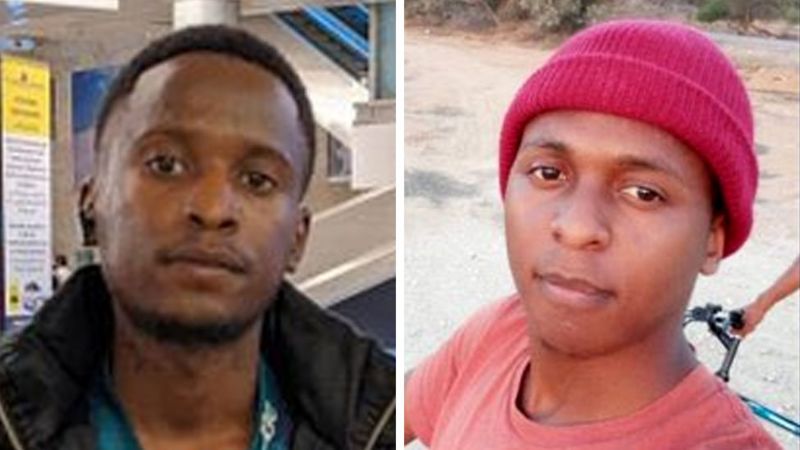
In September 2023, Joshua Mollel, Clemence Mtenga and Ezekiel Kitiku came to Israel for a work experience. They studied agriculture in Tanzania, their home country, and they were going to spend a year in a kibbutz in Israel, to learn and work. The three were excited to see a new country, meet new people and gain experience in their field of study. Clemence and Ezekiel went to stay in kibbutz Nir Oz, while Joshua was stationed in Nahal Oz, a kibbutz nearby.

For a month, they worked in the dairy farms of their respective kibbutzim. They learned what to do when the rocket siren sounded – go into the shelter immediately and stay there for 10 minutes. But thanks to the Iron Dome, the rockets usually didn’t do any damage.

On October 7, Ezekiel was the one working the early morning shift. Which saved him, but doomed his friend, Clemence Mtenga. When he heard the sirens and rocket explosions, Ezekiel quickly went into the shelter at the dairy farm. He texted both of his friends. At first, they answered and said they were ok, also hiding in shelters. But a few hours later, their phones went dead.

Hamas attacked both kibbutzim, but they didn’t get to the dairy farm of Nir Oz. This is what saved Ezekiel’s life. After the smoke finally cleared, Clemence Mtenga and Joshua Mollel were both missing.

.
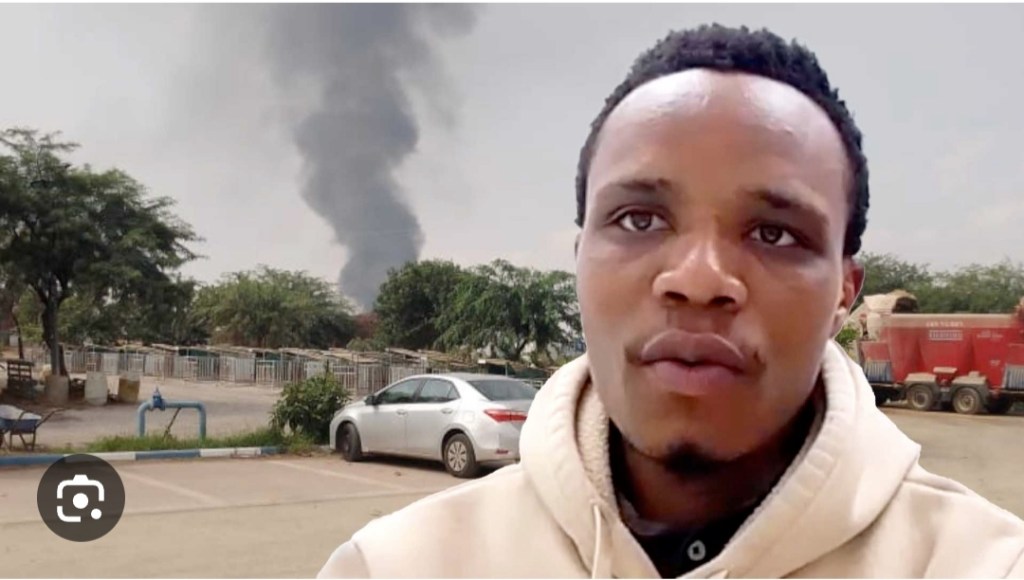
Ezekiel Kitiku, superimposed on the photo he took on October 7. Smoke rising from the kibbutz in the distance.

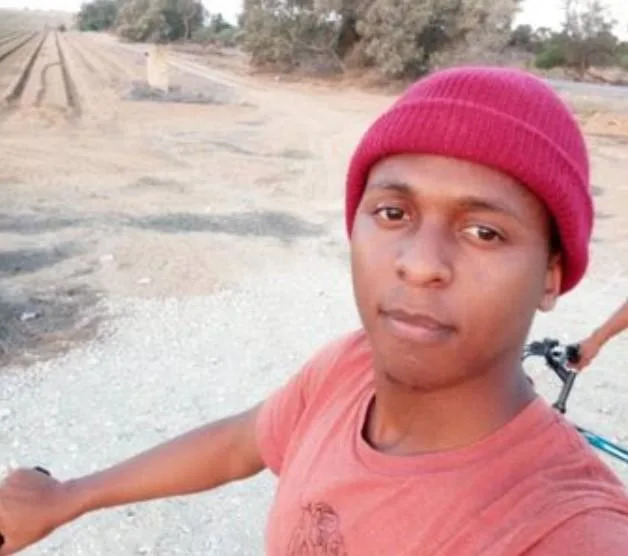
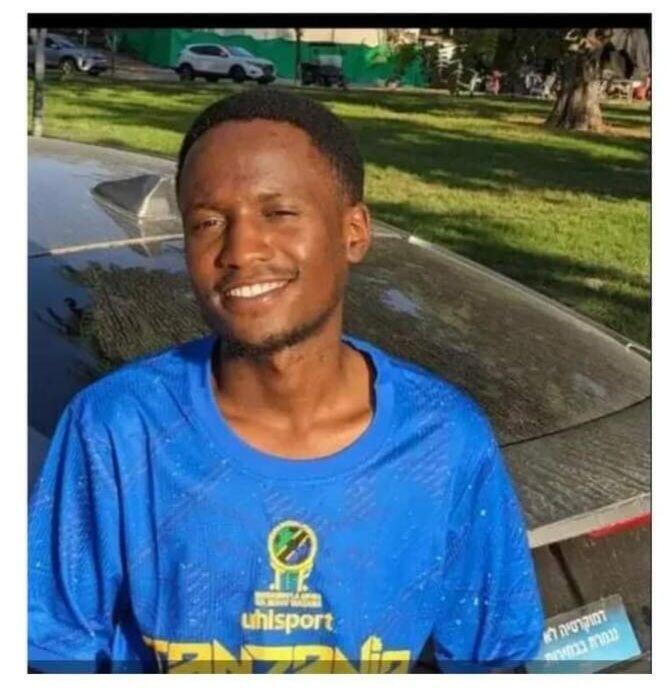
For six weeks, Clemence Mtenga was believed to be a hostage. But on November 18, his body was finally identified. He had been murdered in cold blood by Hamas terrorists on October 7. Clemence was 22 years old, the youngest of four siblings. He was shy, studious and sang in the church choir. He wanted to start his own agriculture business. All those dreams are now shattered, his family broken and in mourning. Rest in peace, Clemence. I’m so very sorry this happened to you.

.
.

Joshua Mollel was also thought to be a hostage. For more than two months, his family and all of us here in Israel held on to hope, that he was alive, that he might be released because he was not Israeli, like the Thai hostages.

But as usual, we expected to much from the demonic death cult that is Hamas. They didn’t care who they slaughtered. On December 18, Hamas released a terrible, graphic video of the murder of Joshua Mollel. I haven’t watched it but I have read descriptions and it absolutely broke me. After all this time of hope and fear, it turned out that Joshua Mollel was murdered brutally by Hamas and his body abducted to Gaza. In no way did he deserve any of this. My heart goes out to his family.

Joshua was 21 years old. He was the eldest of five children. His father, Loitu Mollel, came to Israel after the news of his death broke, to see for himself where his son lived for the last month of his life, and where he was killed. He said that his son was “polite, obedient and serious”, and like Clemence, he had plans to start his own agricultural business.

About the gruesome footage, Loitu Mollel said: “I hope it is deleted from the internet. I hope no one watches it.” I have not watched it and I promise I never will. After seeing a still image from the video, I wish I could delete it from my brain. Please, if anyone ever comes across it, don’t watch it. Out of respect for Joshua and his family, but also to spare yourself the horror. I cried so much over the death of Joshua Mollel. It was so incredibly cruel and unjust. Again, I’m so sorry, Joshua. You should never have been sent to a kibbutz that close to Gaza. None of you should have.

.
The Nepalis

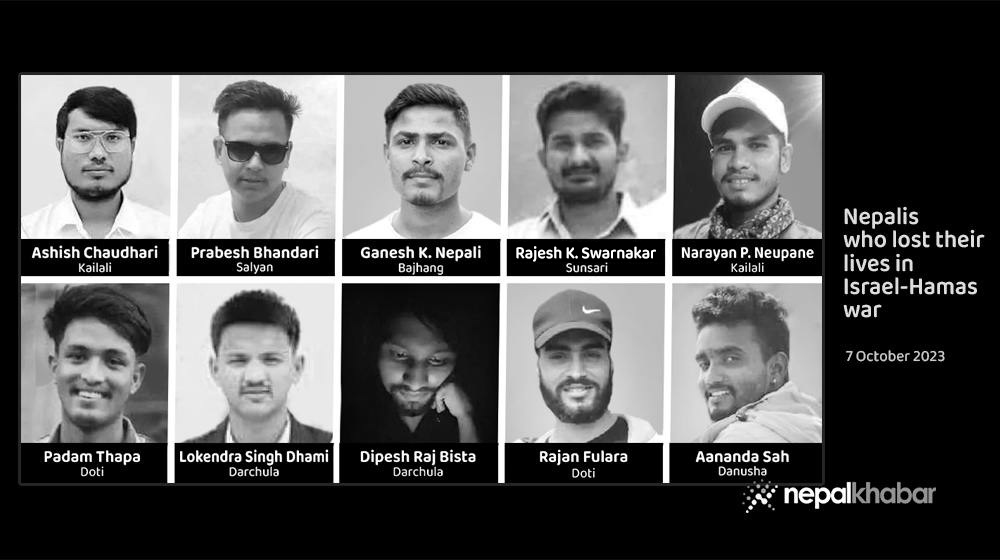
Of the seventeen Nepali students staying in kibbutz Alumim, only seven made it out alive. Let that sink in. Ten young men were brutally murdered by rabid terrorists, for no reason at all. Ten men who hadn’t done anything wrong, who were not Israeli or Jewish (not that that’s a good reason to kill someone), with hopes and dreams for the future, with families and loved ones at home.

The seventeen young men were at a work experience in the kibbutz, for a “learn and earn” program. All of them were the pride and hope of their families, who had poured all their resources into their sons’ education. The boys sent their earnings back home to support their families, and were planning to come back and start their own farms.

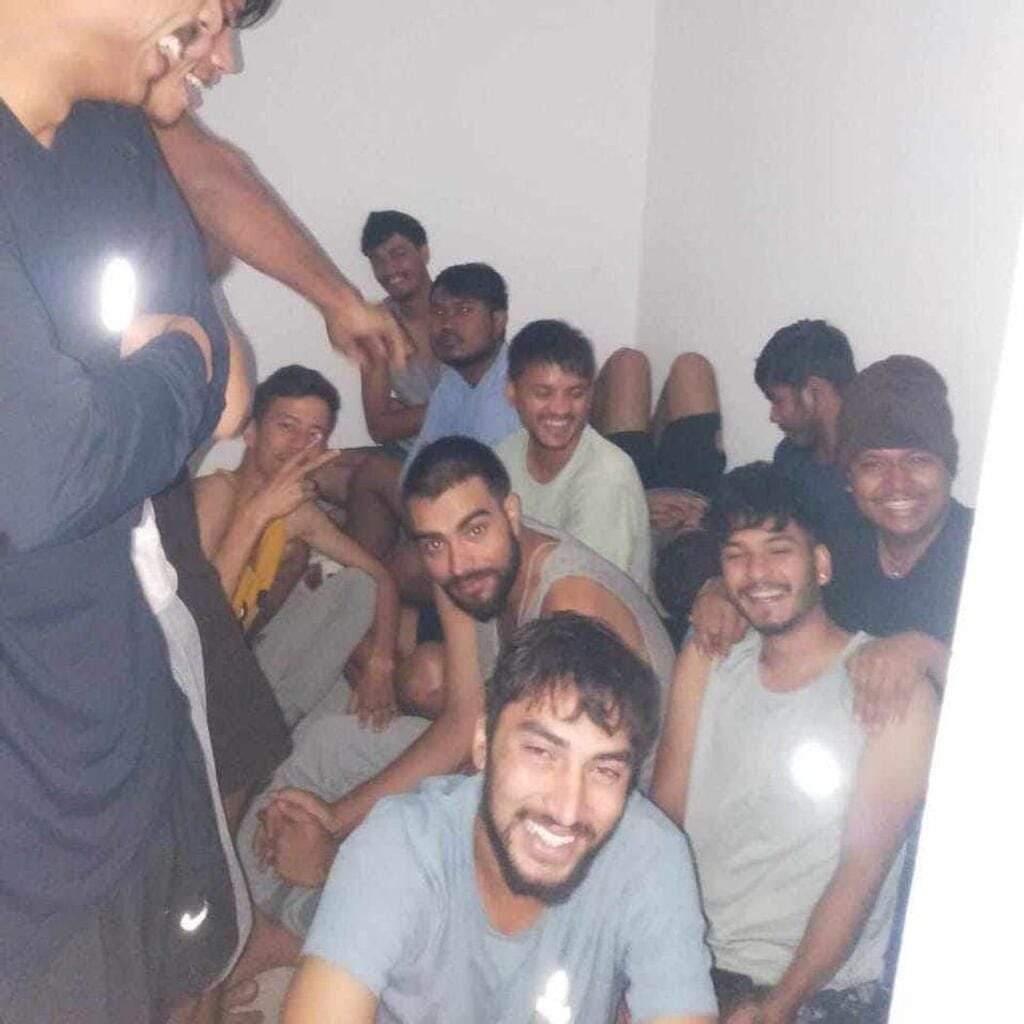
But Hamas had other plans. On October 7, the day started off with a hailstorm of rockets from Gaza. The Nepali students waited it out in a shelter with the Thais, still feeling like this wasn’t serious, it would all pass soon. Laughing and taking selfies. Playing games.

.
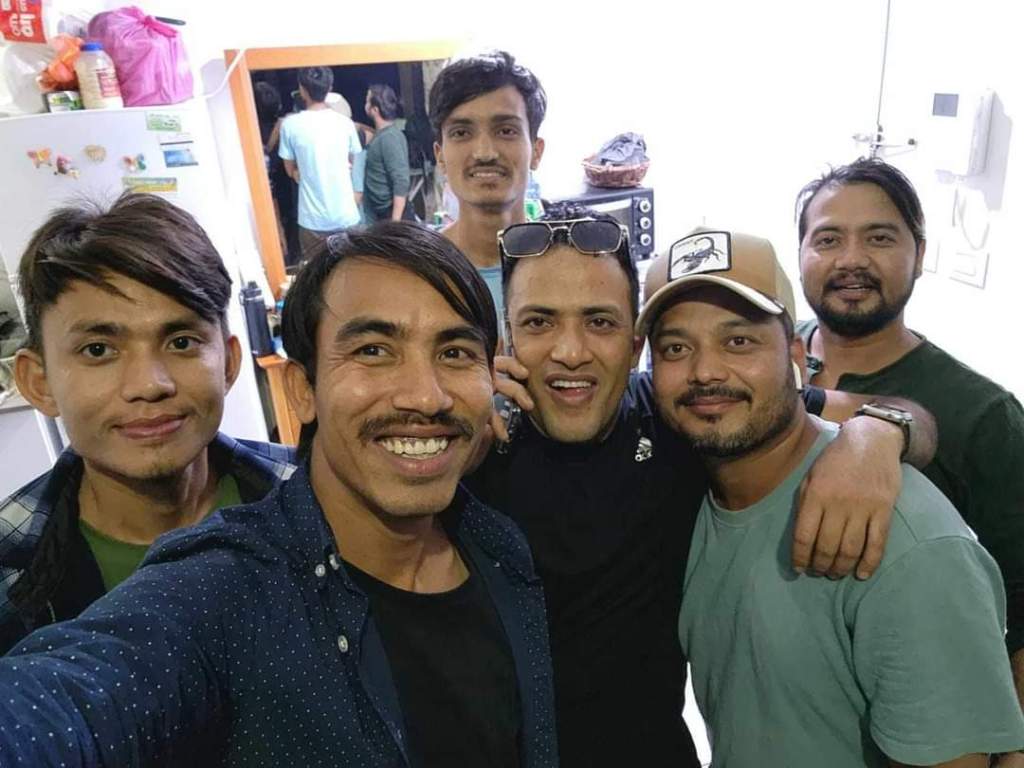
.

Most of the people in these photos are now dead.

In an interview in The Guardian, a survivor, Dhanbahadur Chaudhari, tells the story of what happened that day. As they hid in the bomb shelter, the terrorists shot into the bunker and threw grenades inside. The explosions killed and injured countless people. Chaudhari says: “Shrapnel hit me as well. When I woke up I was covered in blood and I could see my friends dead and injured around me. One friend didn’t have legs, another didn’t have hands. There were dead bodies of my friends in the door of the bunker.”

Despite this unimaginable horror, Chaudhari did his best to save his injured friends, bandaging their wounds and bringing them water. But help wouldn’t come until the evening, and several of the injured died from blood loss.

Seven of the students made it out of that bunker alive. But of those seven, one of them was kidnapped to Gaza. Bipin Joshi was not among the dead or the survivors. He was grabbed and taken by force, as a trophy, a bargaining chip. He was later seen in security footage from the Al-Shifa hospital, being dragged somewhere. It is clear that hostages were kept in that hospital and that it was used for terrorist activity.

Bipin Joshi is 23 years old. He is a son, a brother and a friend. He was excited about his adventure in Israel. “I will see the world, mum!” he told his mother. He would learn and earn money at the same time. What’s not to like? Now, he is stuck in the dungeons of Hamas, enduring God only knows what. The Nepali government is doing everything to get him out of there. But to no avail. Hamas does not give up their human shields that easily.

.
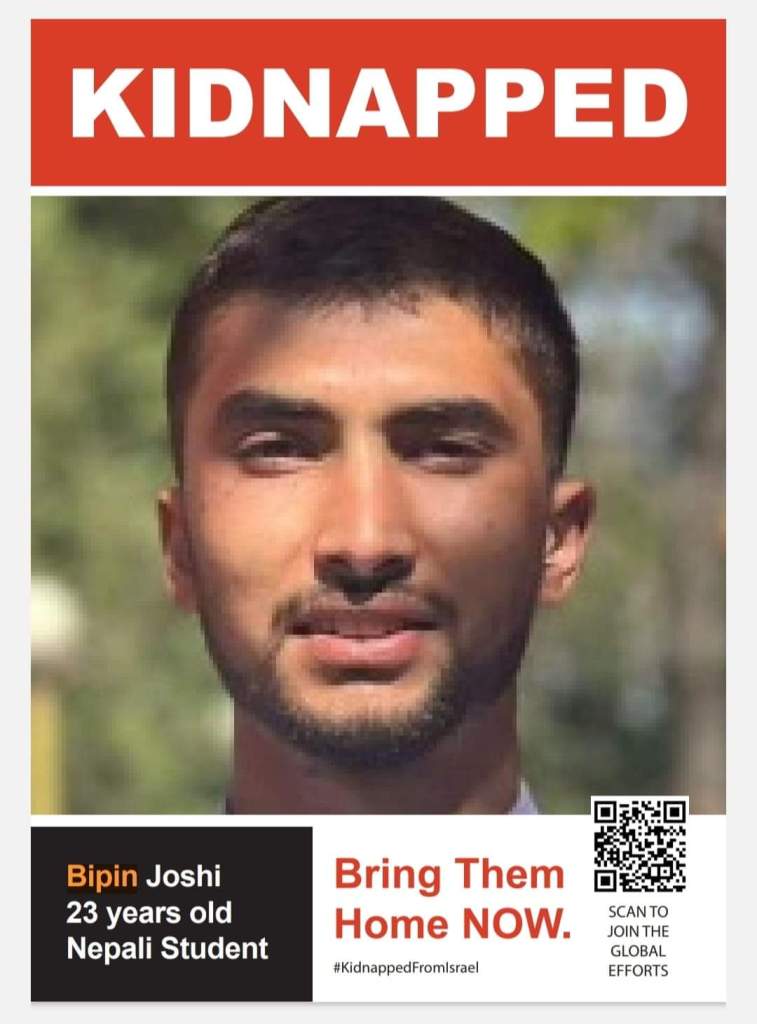
.

The senselessness of the killing of these foreign young men really gets to me. They had nothing to do with anything. They were just there. It breaks my heart. And why were they stationed in kibbutzim that close to Gaza? Sure, none of us could ever have expected anything like this. But there have been terror and rocket attacks in the Gaza Envelope since 2005. It is wrong and careless to risk the lives of foreign students like this.

I hope and wish that Bipin Joshi will be freed one day. He has been captive for more than 3 months now. The injustice of this is infuriating. We need the international community to condemn and pressure Hamas to release the hostages BEFORE agreeing to any sort of ceasefire. We cannot leave Bipin Joshi, Noa Argamani, Kfir Bibas and so many other innocent people behind in the hands of Hamas. They have no right to hold them prisoner. Give them back to us!!
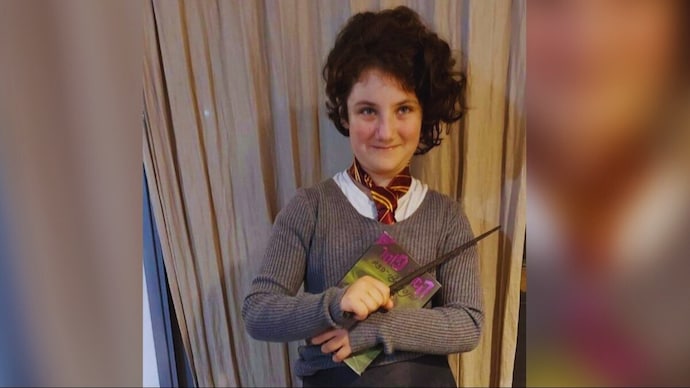
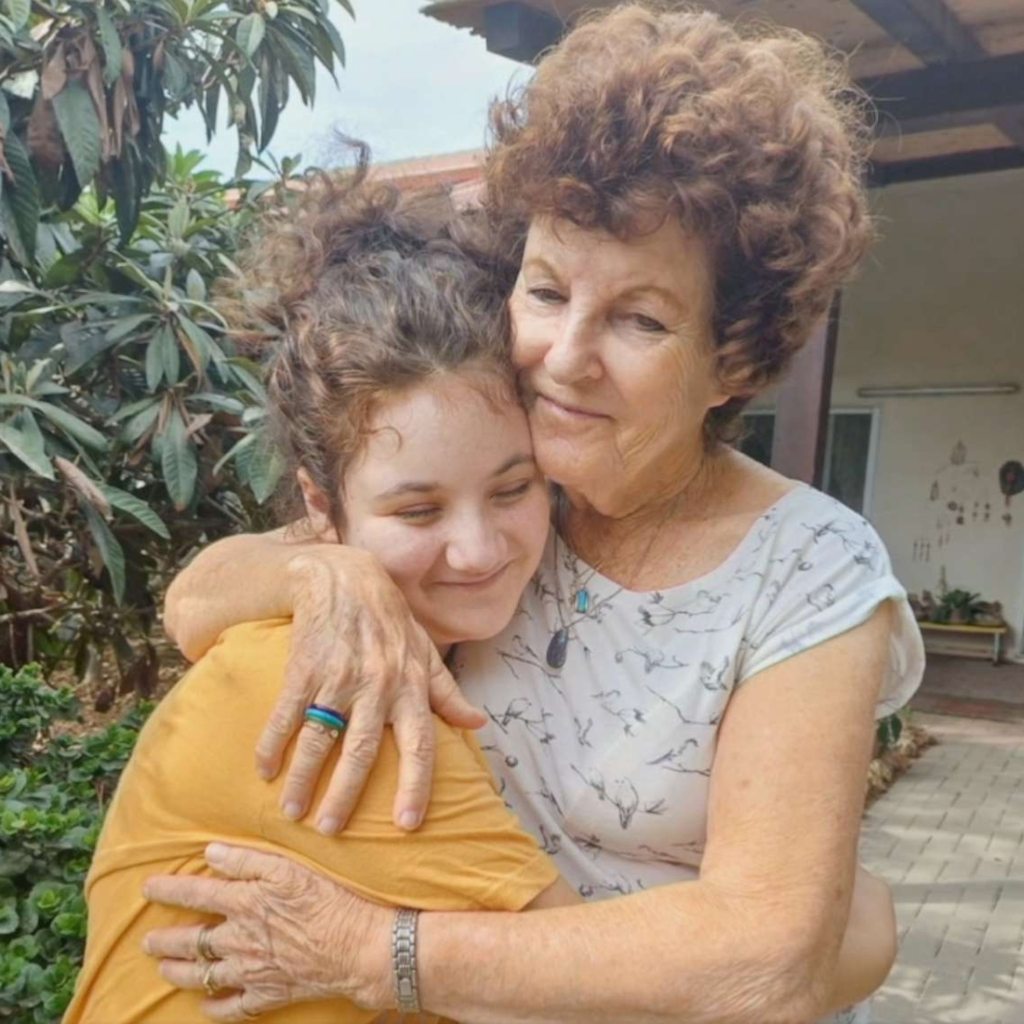
Noya Dan of Gryffindor

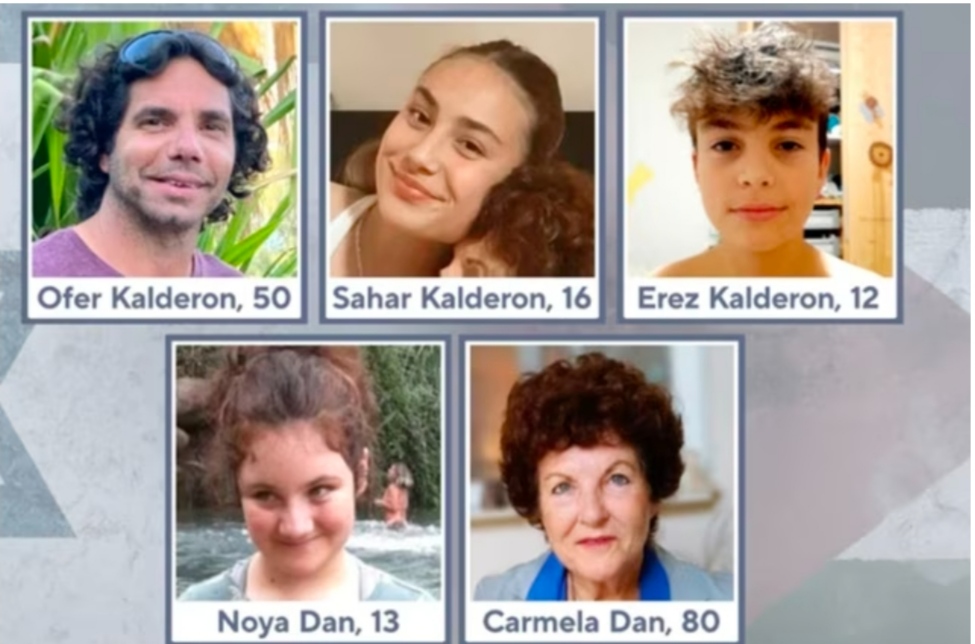
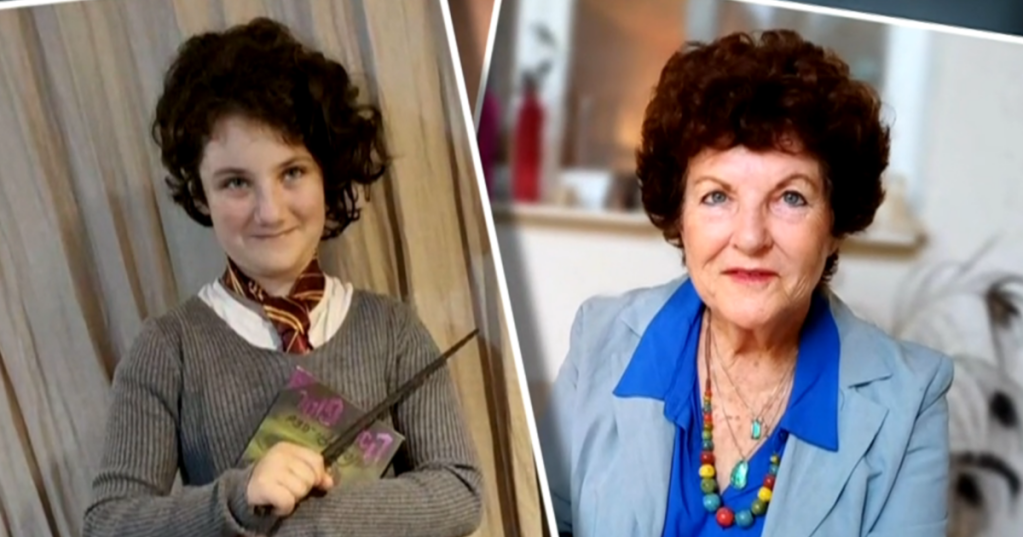
I wonder if Noya Dan tried to cast a spell when they came for her. Expecto Patronum, Expelliarmus, Colloportus? If they were real, any of those spells would have protected her and her grandmother. Twelve year old Noya was a huge Harry Potter fan. She read all the books, watched all the movies and probably practiced spells all the time. Her House was Gryffindor, of course.

But none of that would have helped her. Without magic, what can a twelve year old girl and an eighty year old grandmother really do when faced with murderous terrorists armed with automatic guns?

Noya lived in kibbutz Kissufim with her mother, Galit, and her younger sister. Her grandmother, Carmela Dan, lived nearby in kibbutz Nir Oz. Noya and Carmela were very close and Noya often stayed over in her grandma’s house.

On Friday October 6, Carmela’s family celebrated her 80th birthday together in kibbutz Nir Oz. Noya asked to stay the night at her grandmother’s. So while her mother and sister went home to Kissufim, Noya stayed in Nir Oz.

Early the next morning, both Nir Oz and Kissufim were invaded by Hamas. As an endless barrage of rockets exploded in the air and terrorists hunted down Israelis, the different family members hid in their secure rooms and kept in contact via text.

Galit hid in the closet of her safe room with her youngest daughter, while terrorists took over their house and used it as headquarters, shooting at people from the windows. Noya and her grandmother sheltered in the safe room of Carmela’s house. Carmela’s other daughter, Hadas Calderon, fought desperately to keep the door of her safe room shut, while Hadas’ children were with her ex-husband in his shelter.

To all of them, texting each other, it must have felt like the world was ending. Every time I think about the people in these kibbutzim, and what they must have gone through, my mind short-circuits. I just cannot imagine the horror.

The last message Galit received from her daughter Noya, was a voice recording. She said: “Mom, there was a big boom at the door that scared me. All the windows in Grandma’s house were broken at the entrance. Because there was another boom, there are many broken windows. Mommy… I’m scared.”

The last one she received from her brother in law, Ofer Calderon, was very short: “Galit. Holocaust.”

.

.

Ofer Calderon is a friend of a friend of mine. I feel connected to this family. I feel connected to all of these people, with a thousand different threads.

When the day drew to a close and the IDF regained control over the kibbutzim, Noya and Carmela were missing, just like Ofer Calderon and his children, Sahar and Erez.

Again, I cannot imagine what Galit and Hadas must have felt when they managed to live through this hell, only to find out their children were gone. If I try, something grabs my lungs and squeezes all the air out of them.

Cries of help went up from these wounded kibbutzim, these shattered communities. Where are our children, our parents, our friends?

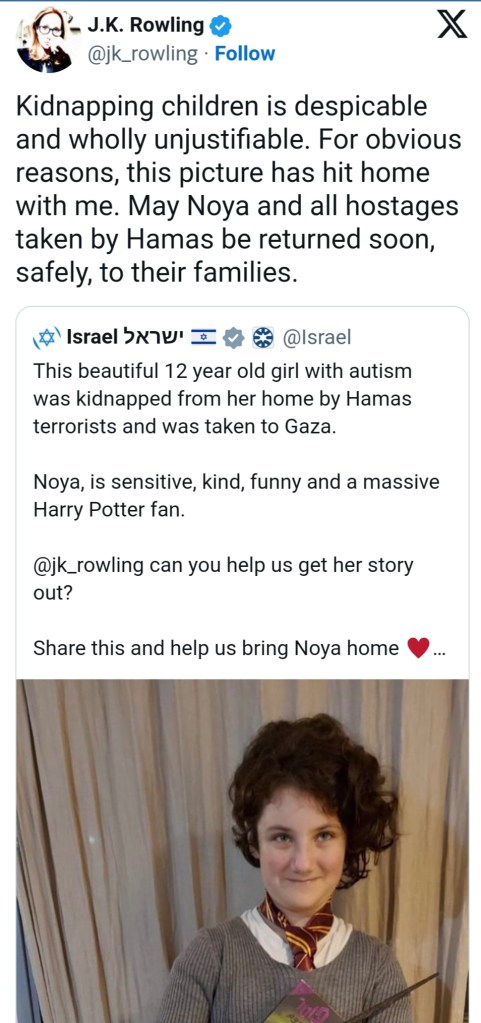
Noya’s picture was posted on X/Twitter, where it drew the attention of J.K. Rowling herself. She reposted it with a heartfelt message:

.

“Kidnapping children is despicable and wholly unjustifiable.” No beating around the bush, no talk about “context” or “proportionality” or “freedom fighters”. For this, J.K. Rowling is my hero. The whining about how she disrespected trans women sounds ridiculously trivial compared to something as huge as this. If you use all the right words and pronouns to refer to people, but you refuse to condemn a horrific massacre by terrorists, what kind of person are you, really?

Noya and Carmela were assumed to be hostages, until their bodies were identified ten days later. They were found at the border with Gaza, burned beyond recognition.

No one knows for sure what happened to them, if they were abducted and then murdered and dumped, or if they were first killed and then Gazans tried to kidnap their bodies but didn’t succeed. There is a “pay for slay” system in place in Gaza, where people get paid by Hamas for killing Jews. A dead body is worth money to them. Shocking? Inhuman? Yes. We’ve heard it all by now.

Galit had to try and deal with the murder of her daughter and her mother, while supporting her sister, whose children were held hostage. For seven long weeks. Try to imagine that. Just try.

Fortunately, Sahar and Erez Calderon were released during the ceasefire. The relief must have been incredible. But their father, Ofer Calderon, is still in captivity now, three months later.

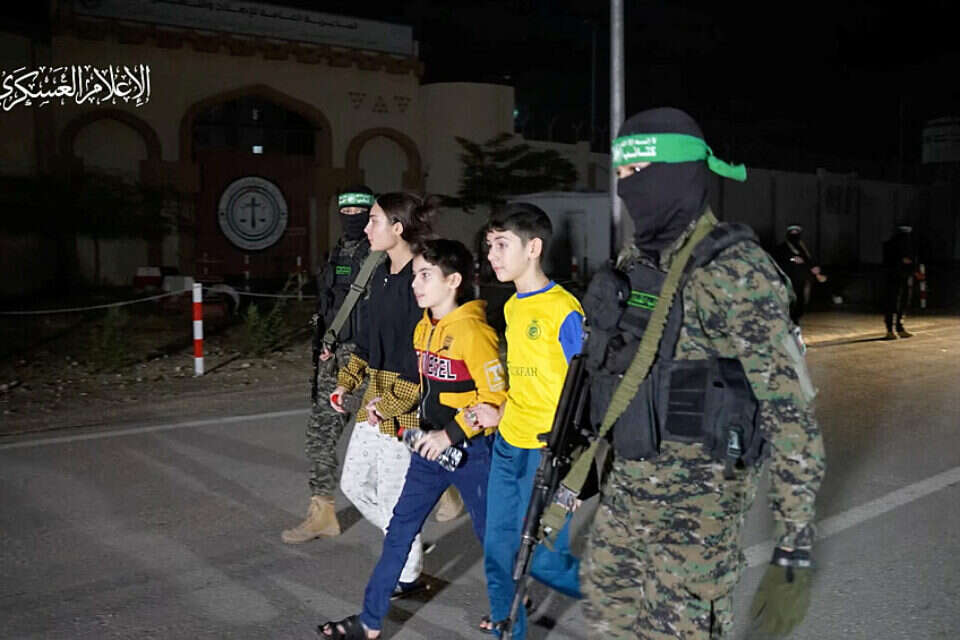
Sahar and Erez walk to safety together with Eitan Yahalomi, escorted by the same terrorists who dragged them from their homes.

But there was no relief for Galit. No homecoming for Noya and Carmela.

Noya was a bright, funny and loving girl. She was also autistic. Galit said: “Noya is my eldest; she is mine alone. I’m a single mother, and she’s a uniquely special child.”

Carmela Dan held American and French citizenship. She loved gardening, cooking and spending time with her family. Like many Israelis who live near the border, she volunteered for a nonprofit organization that brings sick Gazans to Israel to get critical healthcare.

Nothing will bring Noya and Carmela back. Not even magic. Fly high, little wizard. I hope the next life turns out better for you. 💔

Update 16/1/24

This is an update on the situation of Noa Argamani and Yossi Sharabi.

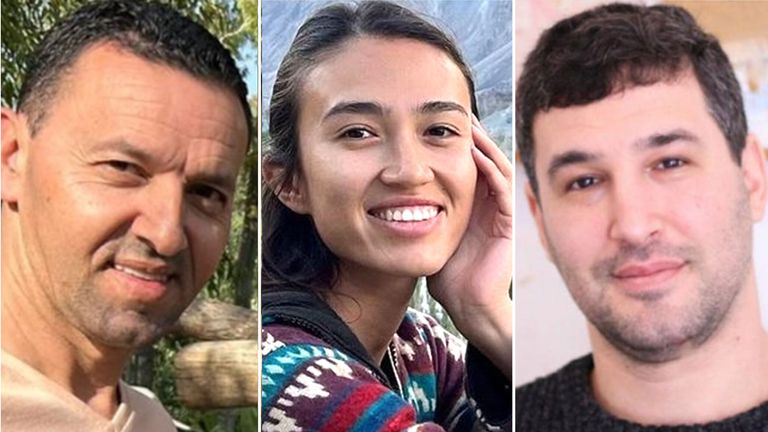
On January 14, Hamas released a video showing Noa, Yossi and another hostage, Itay Svirsky.

.

.

They read off a script obviously written by Hamas, telling Israel to stop the war and to save them. The same thing was said in earlier videos of other hostages. The message is always the same: stop the war, or we will kill your hostages. But never: if you stop the war, we will release the hostages and negotiate. Because that is not what their goal is.

To understand this, you must realize the fundamental reason of Hamas’ existence is jihad: a holy war against everything that isn’t radical Islam, and especially Jews. This principle trumps everything, even the lives of the Gazan people, peace and a chance for their own state. This kind of thinking is so alien to us in the West that we cannot believe this is really their mindset. I couldn’t believe it for twenty years living in Israel. Until October 7.

At the end of this video, Hamas showed this:

.

.

This is psychological warfare of the highest degree. The entire country is in mental and emotional anguish. It is very, very hard to deal with this kind of cruelty. It is a game that they play, to inflict the worst pain on us. They know we care desperately about these people. They also know that we cannot do this sort of things back to them – it goes against every principle of humanity. Also, they would laugh at us. They don’t care! They care about exterminating Jews and establising the Islamic State. At any cost. Even if every single Palestinian has to die for it.
How do you negotiate with people like that? You can’t. It’s impossible. The only thing they want is our death. That is why we have to conquer Hamas. If we fail, we will not only sign our own death warrant, but Europe’s, too.

Yesterday, 15/1/24, Hamas released another video. This time, it was only of Noa, who told us that Yossi and Itay were dead. According to the script she read, they were killed in an Israeli airstrike. We don’t know if this is true or if they were simply murdered by Hamas. At the end of the video, they showed two bloody and broken bodies. It was impossible to tell who they were. I haven’t watched it. But this is what I heard.

For all of their families, the excruciating pain goes on. They don’t know anything for sure. All they have is questions, which won’t be answered. Noa is alive, for now. I think that the civilians who captured her, sold her to Hamas. And they know that Noa one of the most famous hostages and that she is precious to us. They can use her as leverage. Although what they want from us is impossible.They want for Israel to cease existing and for every Jew to die. We obviously cannot let that happen.

The only thing we can hope is that the IDF will conquer Hamas, find the hostages and bring them home. Soon. Then, we can talk with the Gazans and see how to move on from here. But not before.

#bringthemhome

Blood feuds and family clans: Bedouin Israelis

(This is my video about the Bedouin victims of Hamas.)

28 Bedouin Israelis were killed by terrorists and rockets on October 7. Another 7 were taken hostage. Two of them, minors, were released during the ceasefire and one is known to have been killed in Gaza. The rest still languishes underground.

An estimated 200,000 Bedouins live in Israel, most of them in the Negev desert. They are a group of historically nomadic tribes, who used to roam the entire Arab peninsula and North Africa. Since the beginning of the 20th century, most Bedouins are no longer nomadic, but live in camps, villages and towns. Ethnically Arabs, they are Muslims and speak an Arabic dialect. However, they do not consider themselves Palestinians. They call themselves “Negev Arabs”. They live not only in Israel, but also in Jordan and in the Sinai pensinsula of Egypt.

I have always thought of Bedouins as the Gypsies / Travellers of the Middle East, and there are some similarities between the two groups. Like Gypsies, Bedouins hold on tightly to their culture and identity, even while surrounded by the modern world. Some things have had to change, but their distinct customs and lifestyle are very important to them. They have their own laws and codes of conduct, which are based on Islam. Their system is complicated and I don’t know much about it, but I know that kinship ties and honour codes are extremely important to them, and that their hospitality and their pita bread are famous.

Because they live mainly in the Negev desert in designated towns and villages, I don’t meet many Bedouins. But since I started my small hobby farm and taking in rescue animals, I have had some interaction with them. Some of those were positive, like the time when we went to a Bedouin town to buy a saddle and they proudly showed us their amazing, home-bred Arab horses, complete with beautifully decorated tack. And others less so, like when I sold a (different) saddle online and a group of four Bedouin men came over and basically intimidated me into accepting a much lower offer than I wanted. Well, you live and learn, and I wrote this down to male bullying more than anything else.

Bedouins were historically dependent on their animals to survive. For thousands of years, they relied on their camels for transport, milk and meat. I don’t know anyone who can handle a camel except the Bedouins. I am used to large animals, but I treat camels with extreme caution. They are amazing but so strange to me! I have no idea how they work. Whenever we go for trips to the desert, my face is glued to the window looking for Bedouin camps with camels and especially, horses.

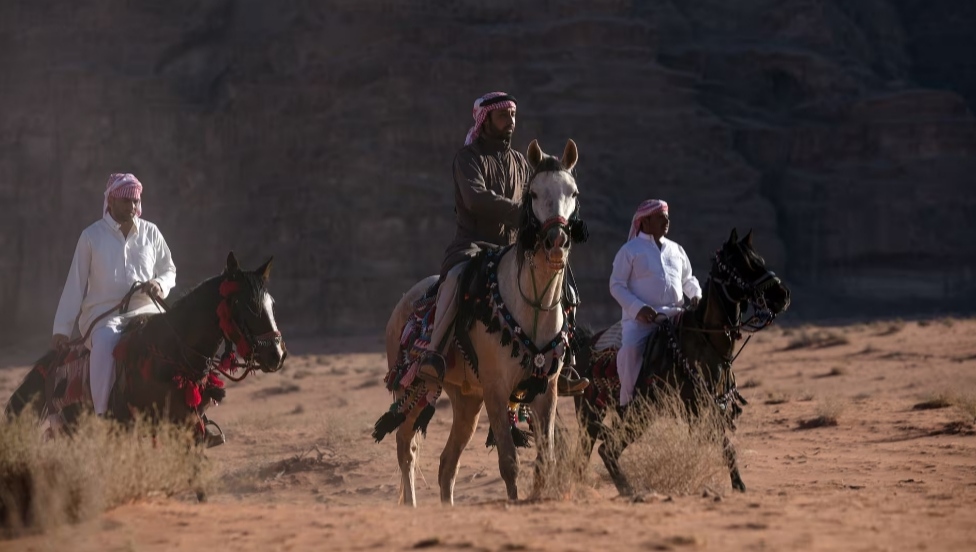
Arab horses are world renowned for their beauty, speed and strength. They are like the Jaguar of horses. And these magnificent creatures just live by Bedouin tents, between the goats, kids riding them bareback. Sometimes you see people riding on the streets, parading proudly with beautiful, coloured tack and decorations.

If Arab horses are the Jaguars of the horse world, Saluki dogs are the Jaguars of dogs. The Saluki is a breed that was traditionally used by Bedouins for hunting. These days, hunting is illegal in Israel, so anyone using their dogs to hunt runs the risk of the dogs getting confiscated. You don’t see Salukis much anymore. The breed that is now mostly associated with Bedouins is the Cana’an dog, a breed that is extremely watchful and makes great guard dogs. I should know, because I have Cana’an mix and he never stops barking.

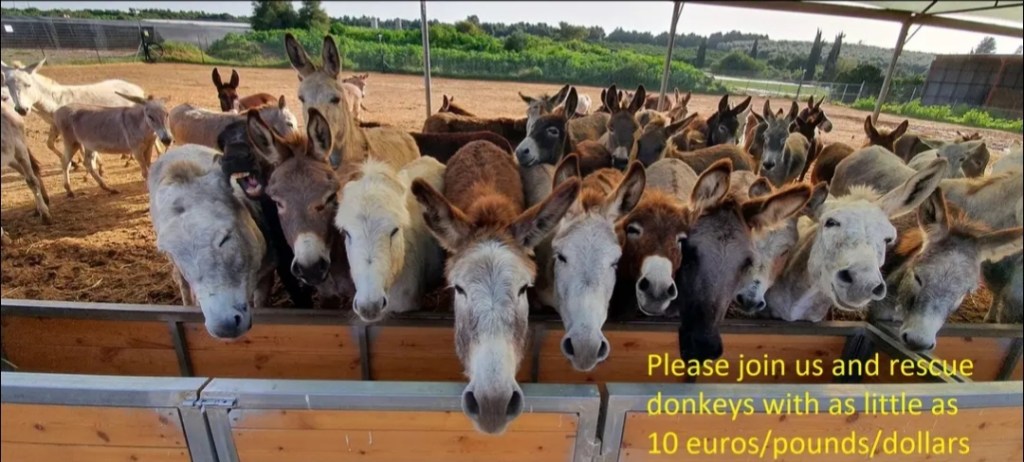
Now, the Bedouins are famous for their animal breeding and riding skills – but not always for their animal-friendliness. I have three rescue donkeys that have escaped from Bedouin villages. Two of them are terrified of people, full of scars and obviously traumatized. Sadly, donkeys are the dregs of the farm world. They have mostly been replaced by tractors and trucks, but are sometimes still used by Bedouins for riding, carrying burdens and pulling carts. They are frequently overloaded, mistreated and neglected, sometimes even subjected to extreme and malicious abuse. This is obviously not limited to Bedouins – people everywhere abuse animals. But there are several practices common amongst Bedouins that I consider problematic.

One of them is tying the legs of animals together. Traditionally, Bedouins don’t build fences and let their animals roam freely to find food for themselves. But obviously, they can’t go too far or run away when their owners come to get them. So their legs are tied together in such a way that they can walk small distances to graze, but not run. This is done to all animals: goats and sheep, camels, horses, donkeys. I have seen camels with all four legs and their head tied together. They could only hobble a few paces.

I don’t like it, but if this is done safely and with wide leather straps, I wouldn’t consider it abuse. But often, it is done with straw twine, which cuts into their legs and leaves wounds that never heal. These poor animals suffer constant pain. All my donkeys have these scars on their legs – except the one who was born in my care. One of them also has scars on his chest, probably from pulling a cart with an ill-fitting harness. Donkeys are extremely sensitive and intelligent animals. They figure out how to beat the system and untangle themselves. And when they’re gone, they’re gone. They remember everything and they will never go back to owners who abused them. So they start roaming. They walk along the roads and often end up in kibbutzim, where there are fields and horses. That way, I have now gathered three rescue donkeys – they were found wandering around, alone and hungry, with wounds on their legs. They have become less afraid with time, but they will never fully trust any human.

There are several large scale donkey sanctuaries in Israel. The most famous ones are Pegasus, Starting Over and Safe Haven for Donkeys. These people do incredible work that is vastly underrated. Donations and publicity are always greatly appreciated.

But I digress! I will get off my animal care soapbox now and concentrate on human rights. Because Bedouins and modern Israeli society do not always mesh well. Most Bedouins live in towns in the Negev, like Rahat or Tel Sheva. But there are many illegal villages, where the desert people decided to build their tents and huts, as is their tradition. But the land does not belong to them and the state does not recognize these villages. As a result, these places lack basic necessities like electricity, plumbing and, most importantly, bomb shelters and sirens. They are also not covered by the Iron Dome, the rocket interception system which keeps most of Israel safe from bombs launched at us from Gaza and Lebanon.

On the 7th of October, 2023, Hamas started their deadly invasion with a barrage of rockets shot into Israel. As many of the Bedouin villages do not have bomb shelters, seven people were killed by the impact of rockets. Six of those were children, and one a grandmother. This is absolutely heartbreaking. It is unacceptable that people have to live in this country without adequate protection against rockets. Hamas has been throwing rockets at us since 2005, when Israel left Gaza. You’d think every square inch of the country would be protected by now.

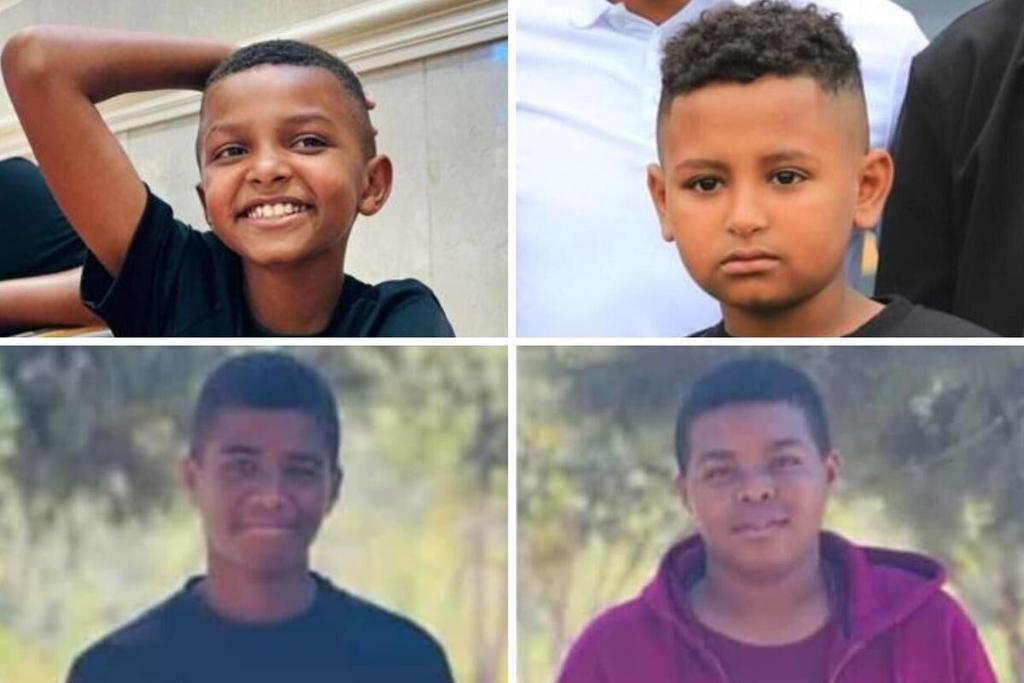
Malik, Jawad, Mohammed and Amin Al-Gourhan. Four children killed by a single rocket launched from Gaza.

Apart from casualties by rocket impacts, Hamas murdered 21 Bedouin Israelis. Some Bedouins serve in the Israeli army, but most of those killed on October 7 were civilians. Not that Hamas cared. They destroyed everything in their path.

Fatma Alttalaqat, 35, was a Bedouin mother of nine children. She was on the way to work with her husband and baby, when Hamas terrorists stopped the car and shot her point blank. Her body was found riddled with 40 bullets. She leaves a broken family behind, who cannot comprehend how Palestinians could shoot an innocent woman wearing a hijab in cold blood. I can’t either. It is inhuman.

I found no photo of Fatma, because Bedouins do not like publishing photos, especially not of women. The one exception was Aisha Alziadne, out of necessity.

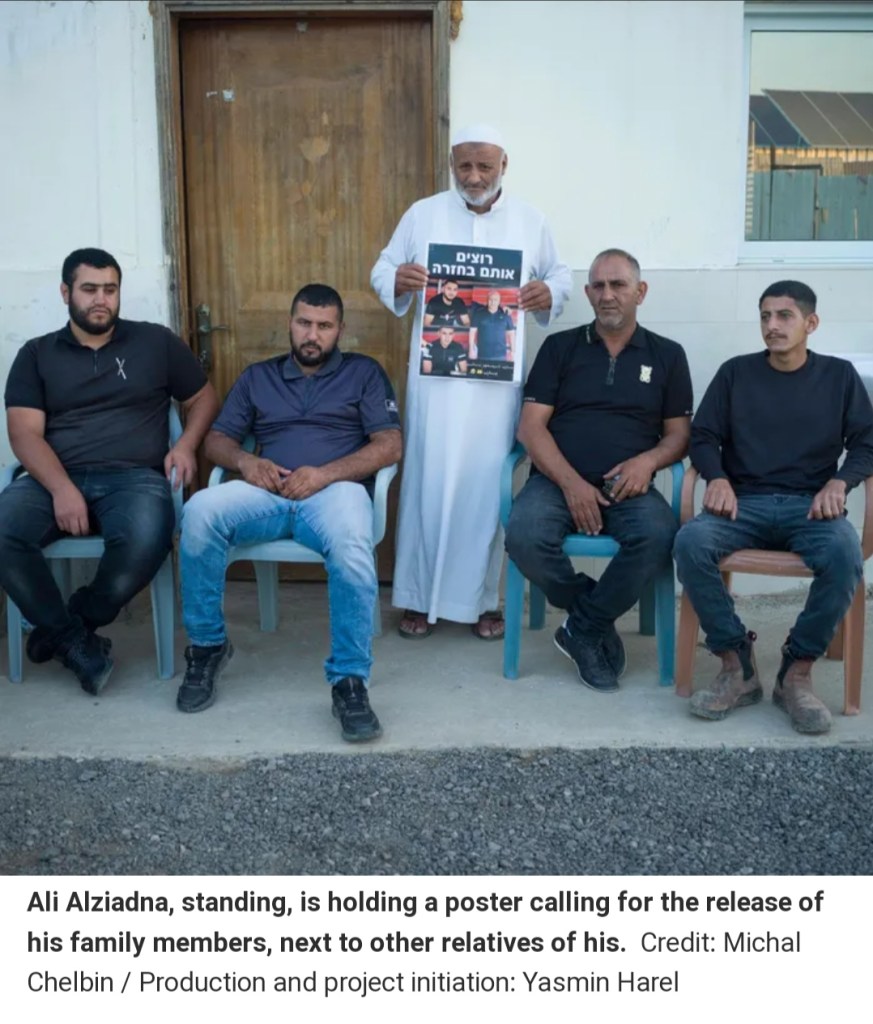
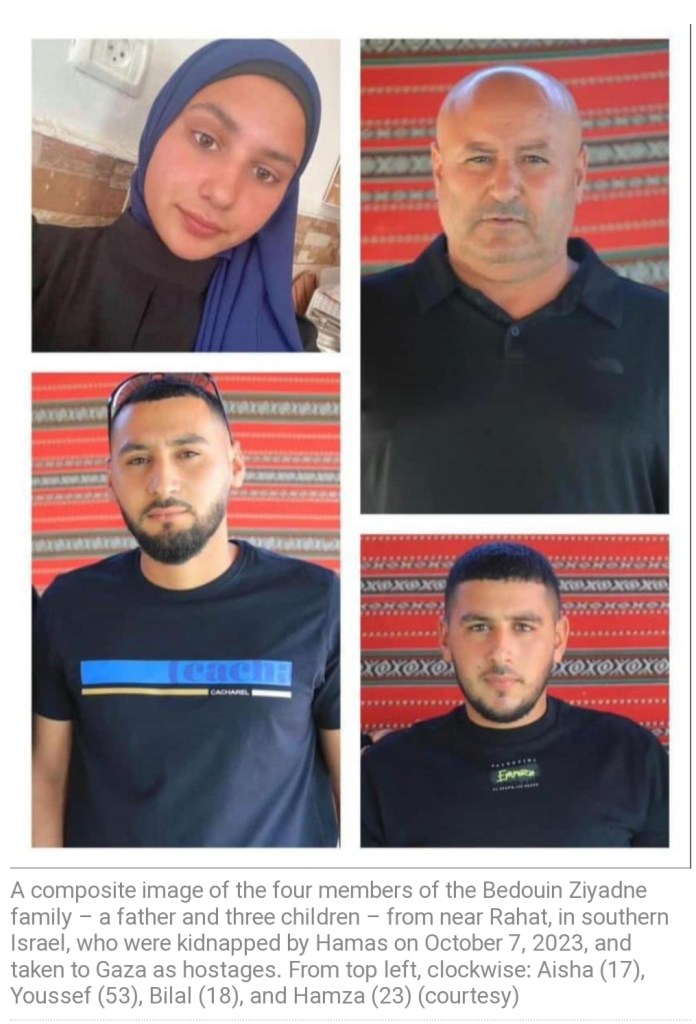
Four members of the same Bedouin family, the Alziadne clan, were abducted by Hamas. Youssef Alziadne has worked in the dairy farm of kibbutz Holit for seventeen years. When they were old enough, three of his children, Hamza, Bilal and Aisha, starting working with him. On October 7, they were all at work when the terrorists invaded kibbutz Holit. At the end of the day, all four were marked as missing. Later, they were seen in security footage, being led into Gaza on foot. Their status was adjusted to hostages.

A member of the same family, Abed Alrahman Ataf Alziadne, 26, was killed on Zikim Beach. Just like Fatma Alttalaqat, his body was absolutely riddled with bullets. He was machine gunned to death by rabid lunatics. It is horrific.

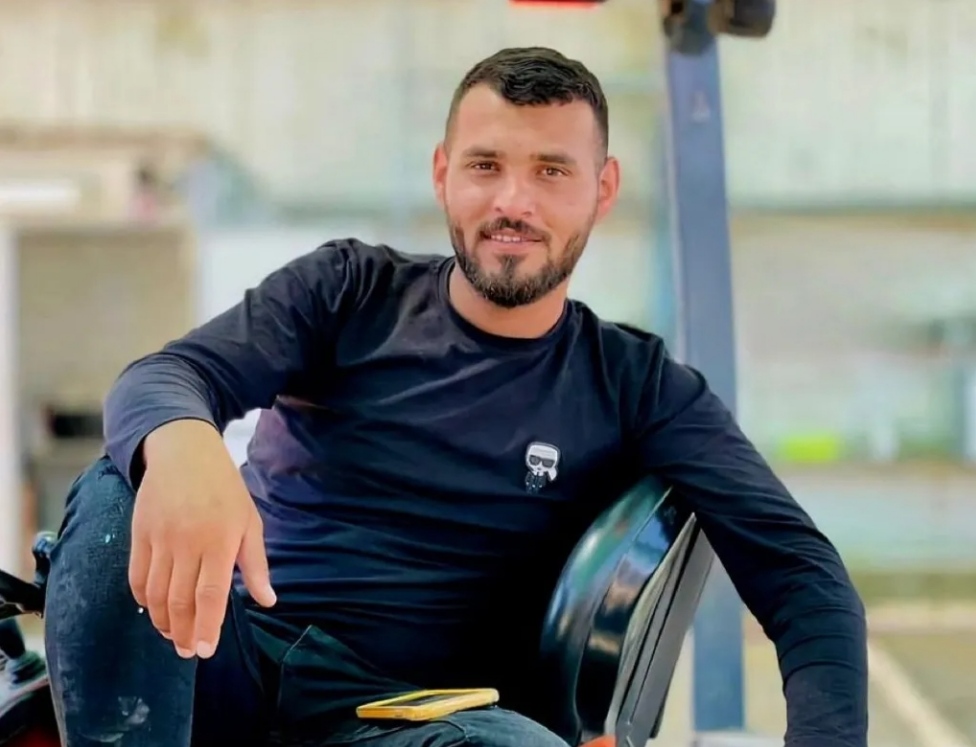
After 7 weeks of captivity, minors Aisha and Bilal were released. But Hamza and Youssef remain in the tunnels of Hamas. Their extensive family is terrified for them. Youssef has two wives and 19 children. He suffers from diabetes and his family is worried that he does not have his medication. Hamza is married and a father of two children. He suffers from migraines and does not have his medication either.

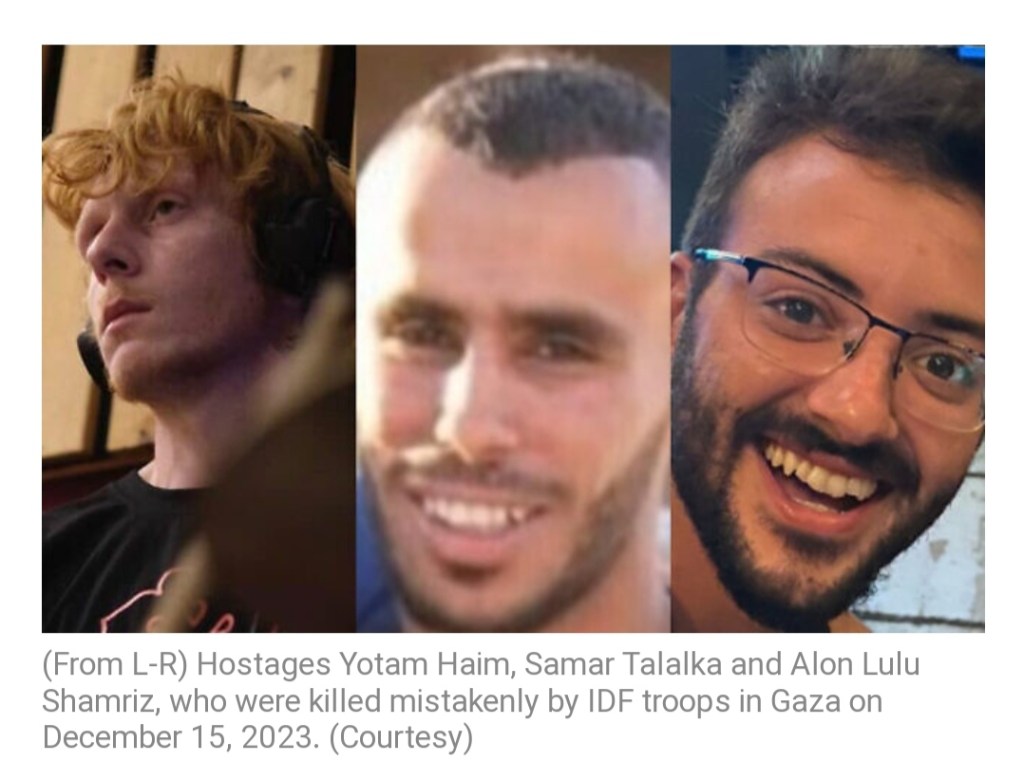
Other than the Alziadne family, there are three more Bedouin hostages. One of them was Samer Talalka. On December 15, Samer managed to escape his prison together with two other Israeli hostages. They tried to get the IDF to notice and rescue them, but instead, the IDF soldiers thought they were being ambushed and shot them. Tragically, the three were killed by fire from their own army. The absolute last thing anyone wanted.

One of the other Bedouin hostages remains unnamed, at the request of his family. The last one is Hisham al-Sayed, who has been held captive by Hamas since 2015.

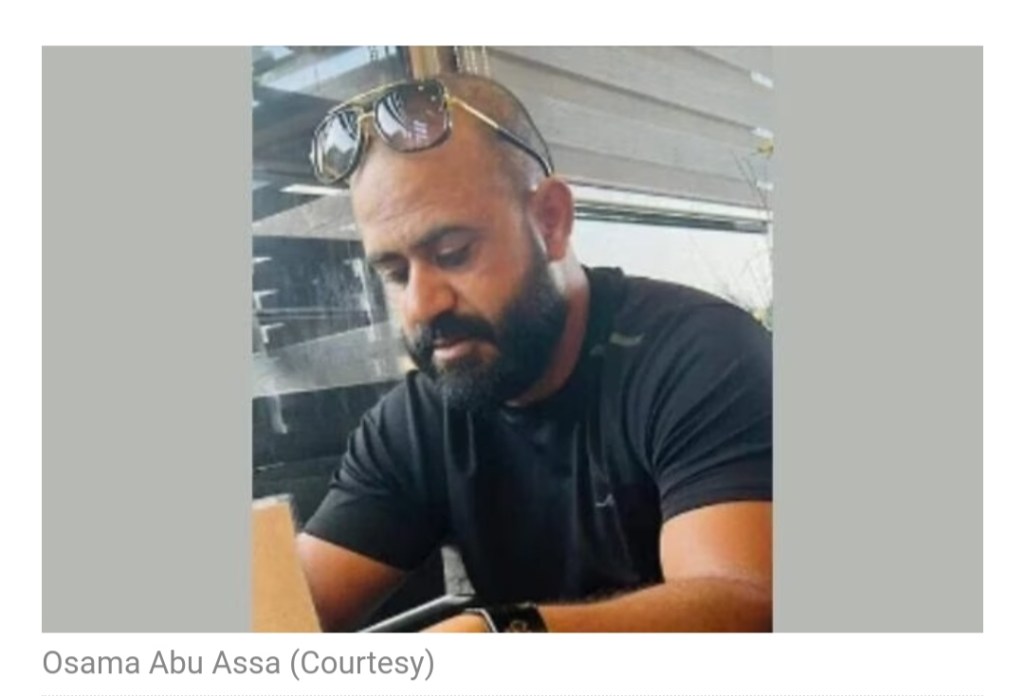
One other victim of Hamas that I want to mention is Osama Abu Assa. Osama was a Bedouin man from Tel Sheva, who worked as a security guard near kibbutz Re’im. In the early morning of October 7, he was returning home from his night shift when the sirens started wailing. He ran for a bomb shelter and hid there with other people. A security camera recorded the entire sequence of events. I saw the beginning of the video. The terrorists started firing into the bomb shelter and shouting for people to come out. Osama ran out, ducking to avoid the bullets flying around him. He shouted at them that all the people in the shelter were Arabs, that they were all civilians, women and children. This was not true, the other people in the shelter were Jews. Osama saved their lives. But he paid for it with his own life. The terrorists started beating him up. I couldn’t continue watching at that point, but I know they violently beat him, forced him to undress and robbed him of all his valuables – before finally executing him. Knowing this makes me sick to my stomach. What a horrendous, senseless murder. Osama was a good man who protected innocent people. Why? Why did they kill him? It is pure evil.

There is a twist to this story. Osama belonged to a large family clan with a lot of influence in the Bedouin community. His family has sworn bloody revenge and had offered a reward of 1 million dollars for information leading to Osama’s murderers. In an interview with Ynet, Osama’s brother, Joad Abu Assa, told the interviewer:

“(…) this is a blood feud – these people tortured him and it’s not a simple matter. My Bedouin, Druze and Jewish friends approached me asking to help us. If their families don’t fear us, they’ll do it again and again because this is a blood feud. Bedouins in Israel kill one another over trivialities all the time, so don’t you expect everyone, and the world, to rise up in this case?”

About Hamas, Joad Abu Assa said:

“Hamas is a crime syndicate, not a state working against a state. People there murder people for money and their own interests. This isn’t about a state or the war, this is about the people there. They only want more money and then fire rockets at Israel so that it has a chance to take a picture of a dead Palestinian child and show the world. We know this and we’ve had enough of Hamas, ISIS, and their violence. It’s not only about my brother, we’re aching for the Jewish children who were murdered as well, and the 80-year-old woman who was abducted, who does something like this?”

And finally:

“(…) their Islam doesn’t represent us, they’re not true Muslims. A Muslim doesn’t murder, they hide behind our Islamic religion, ours is a religion of peace and respect. Our religion tells us not to murder. It says much, but not to torture.”

I know I shouldn’t want revenge. I should want peace for everyone involved. And I do. But this, coming from an Israeli Bedouin, really lifts my spirit. I know about blood feuds. They’re seriously scary. But instead of fighting each other, the Negev Bedouins now have a common enemy: Hamas. They understand Arab culture in a way we don’t. And they are armed and ready. They are not done with Hamas.

Aisha, come home. By Yaara Eshet.

100 Days

Today, the hostages have been in captivity for 100 days. Most of the minors and their mothers, and elderly women, as well as most Thais and the 2 Filipinos, were released during the ceasefire after 7 weeks. But 136 living people are still assumed to be held prisoner in Gaza. Some of the hostages have died (were murdered) and their bodies are known to still be held captive, like Joshua Mollel, whose bloody murder was broadcast by Hamas. Some are known to be seriously injured, like Hersh Goldberg-Polin, whose arm was blown off during an explosion on October 7. Some are only teenagers, like Eden Alexander, who is 19 years old. Some are very old, like Oded Lifschitz, 83.

Some of those who are still being held are friends or family members of my friends. Like Noa Argamani, who is my friend’s cousin. Like Ofer Calderon, David Cunio and Ariel Cunio, who are friends of my friends.

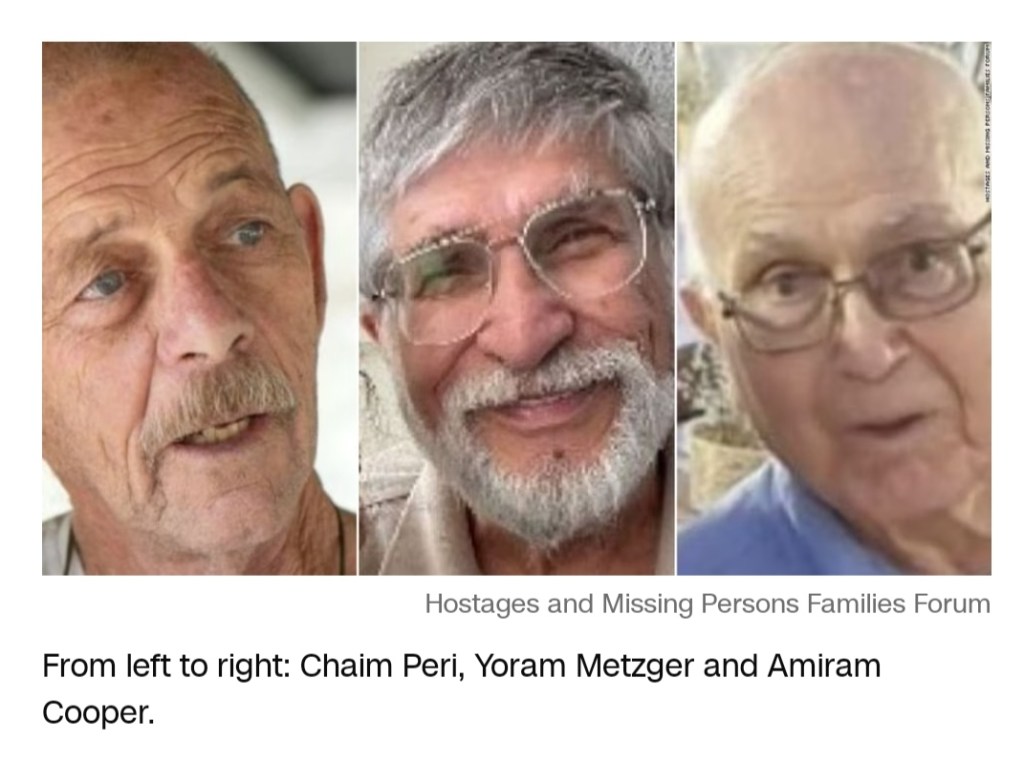
There have been practically no signs of life. A few weeks back, Hamas released a video of three of the oldest hostages, Haim Peri (79), Yoram Metzger (80) and Amiram Cooper (84). They were sitting in a row in front of the camera, looking thin and weak, with long beards. They pleaded with the Israeli government to stop the war and rescue them. Of course, they had been told exactly what to say by men with automatic guns, so we have no idea what they actually wanted to say.

This kind of thing has the dual effect of raising our hopes – they’re alive! – and feeding our anxiety: time is running out. It’s a known tactic of psychological warfare. It is entirely possible that these three elderly men were executed immediately after the recording of that video.

I hope to heaven that this is not what happened. I hope the majority of the hostages are alive and will one day be found safe and brought back home. But sometimes, I wonder if any of them are still alive right now. And if they are, what hell are they going through? We know from the released hostages that they were kept in harsh circumstances, fed very little and threatened constantly. Some men were beaten with electric cables. Some women were kept in cages and sexually assaulted, over and over again.

Some were not even abducted by Hamas at all. Some were taken by Islamic Jihad, another terror organization. And some were taken by civilians, who followed Hamas out of the gates and joined cheerfully in the plunder, murder and destruction. These civilians chose young girls and women to kidnap for themselves. No one knows where they are, but we can guess what is being done to them. Sexual violence was a big part of the October 7 massacre. It is no secret that many bodies were found naked and bleeding, gangraped violently and then shot. Hamas member have bragged about raping Israeli women.

.

.

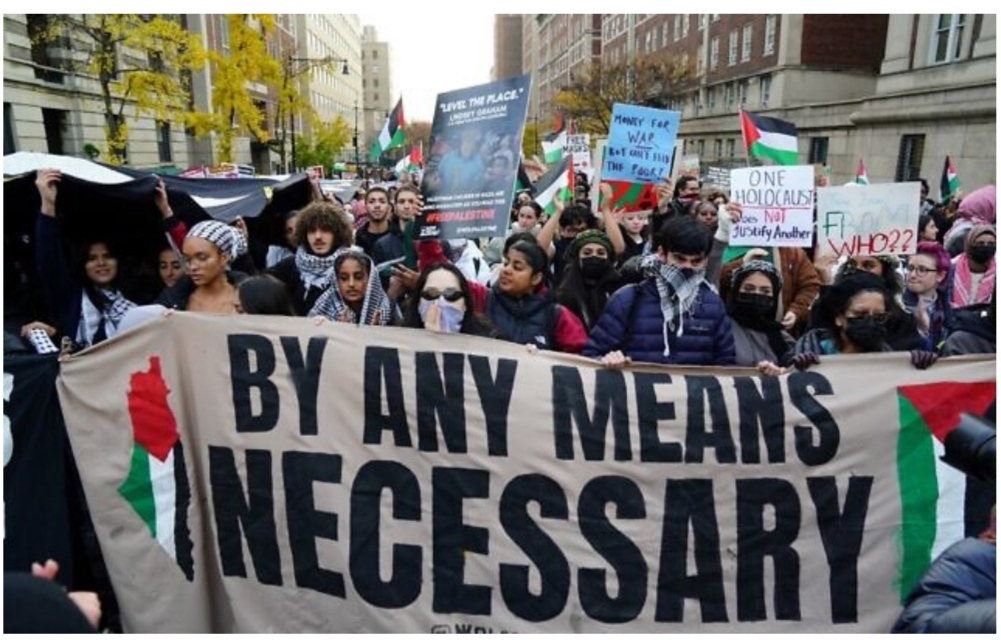
But somehow, this is still being contested by the world. Somehow, people all over the world manage to turn this atrocity around and twist it. Humans everywhere love to blame Jews. It has always been like this in history and these times are no exception. We are apparently to blame for progroms and holocausts, for hatred and massacres, just because we are Jews and we should not be wherever we are. People manage to justify to themselves what Hamas has done. They want to absolve their guilty conscience by saying: “Well, the Jews had it coming.” And they cheerfully campaign for Palestine, donate to Gaza (which all goes straight to Hamas), walk around with kefiyahs on their heads and feel like cool, edgy, progressive humans.

You’re not. You’re antisemites and neo-Nazis. Just a few days ago, someone from my own country stole my words, twisted them around and gleefully managed to suggest that not only did we have it coming, but Israel orchestrated the attack themselves, just to have an excuse to “commit genocide” in Gaza.

I have never been so ashamed to be Dutch in my life. People like this make me sick. They are holocaust deniers, victim blamers and no better than the Death Eaters themselves. But I know what is going to happen. Hamas has said it themselves, numerous times: the West is next. One day very soon, things like this will happen in Europe. Then, these people will finally start to realize that radical Islam is a horrific evil that wants to conquer the world and destroy everyone that doesn’t live exactly according to their draconian rules. But then, it will be too late.

I want to take this opportunity to draw attention to the women and children still in the hands of Gazans, and likely subjected to physical, sexual and psychological violence. Is this what you want? Is this what you want to see in your own country? To them, women are objects. Trophies, to be owned, stolen and discarded as they please. We need to fight this evil and make sure they do not conquer Europe! Because no matter what I shout, I care deeply about my old country. My heart breaks to see it slowly being subjected to Sharia law. As much as it breaks for these beautiful women. Please, please help us bring them home. Raise your voice. Say NO. This is evil, no matter what your race, religion or nationality is.

.

.

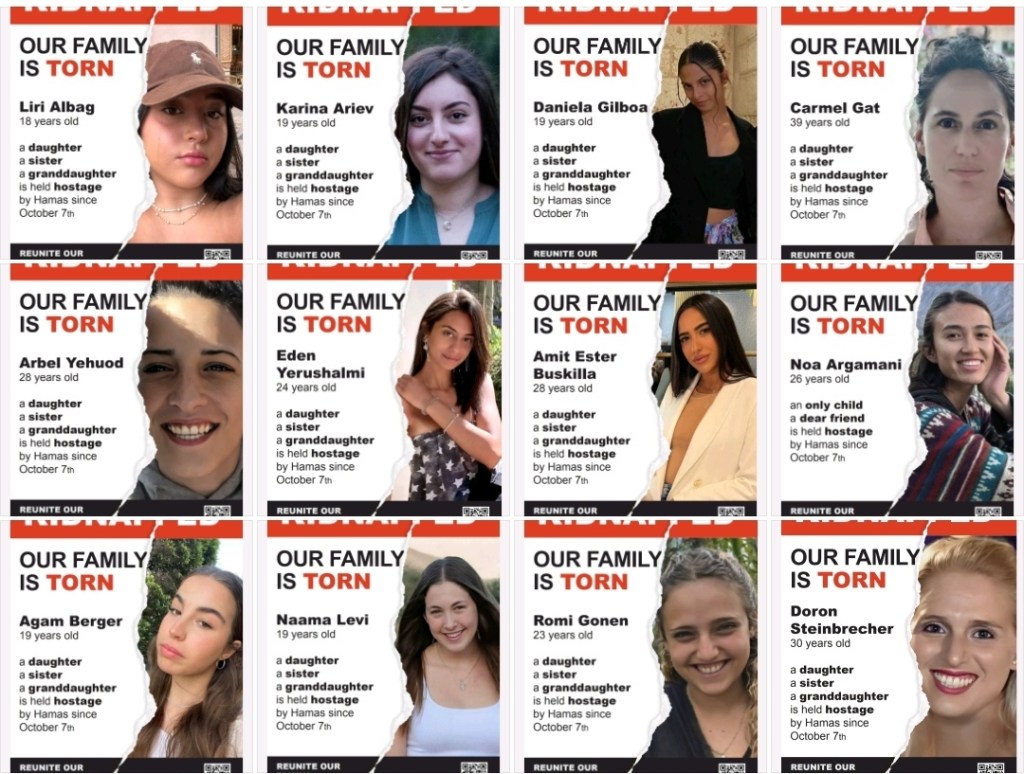
Liri, Karina, Daniela, Carmel, Arbel, Eden, Amit, Noa, Agam, Naama, Romi and Doron are still being held hostage. 100 days.

.

.

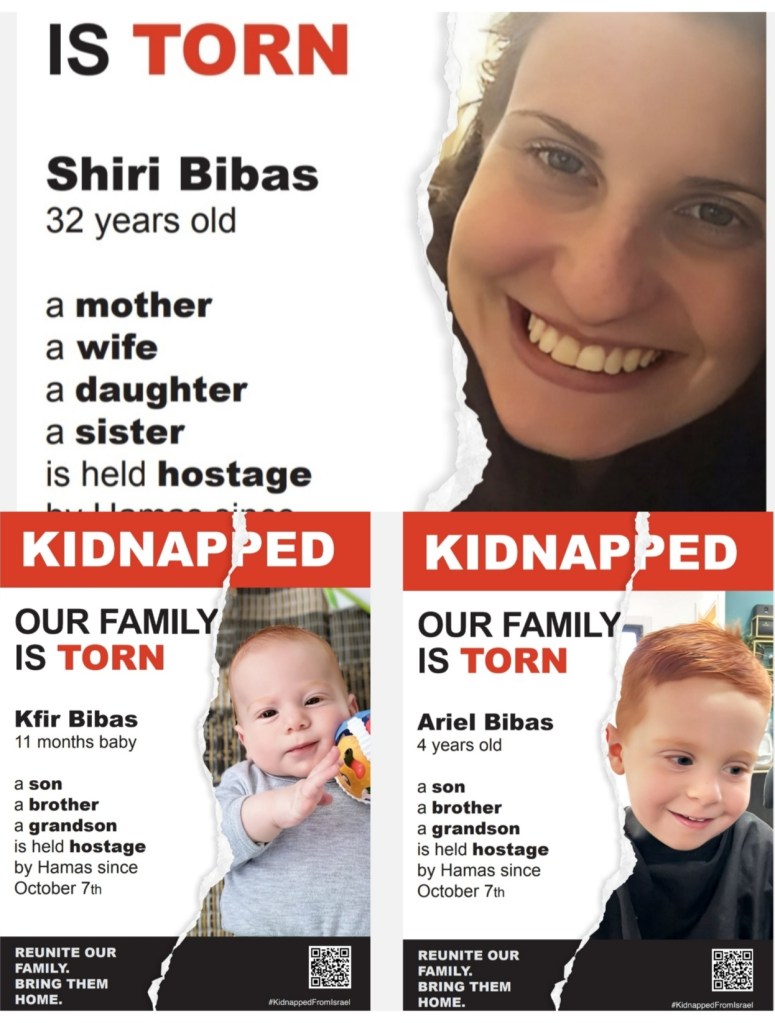
Shiri, Ariel and Kfir Bibas are still not back home. Kfir recently turned one year old. He has been captive for 100 days of his short little life.

.

.

Look them in the eyes, these young girls. See what the Death Eaters did to them. And then stand behind that with a clear conscience. I dare you.

#bringthemhome

The Sharabi Family

This story is about Eli and Yossi Sharabi, two brothers from Yemeni descent. They are the eldest and middle of three brothers who were born and grew up in kibbutz Be’eri. Eli, the eldest, married a British woman from Bristol called Lianne. Just like Thomas Hand, Lianne came to Israel as a kibbutz volunteer at age 19. That is when she met Eli Sharabi and decided to stay. They got married, had two lovely daughters and built a happy life together in kibbutz Be’eri.

.

This is Eli with Lianne, Noya (16) and Yahel (13).

.

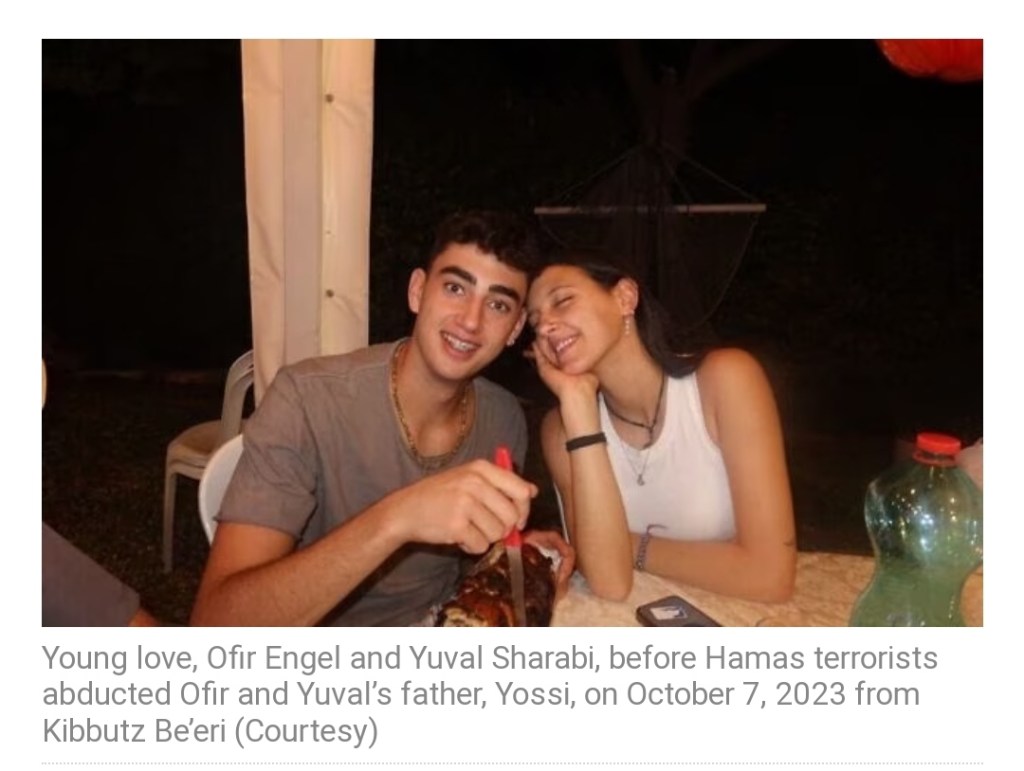
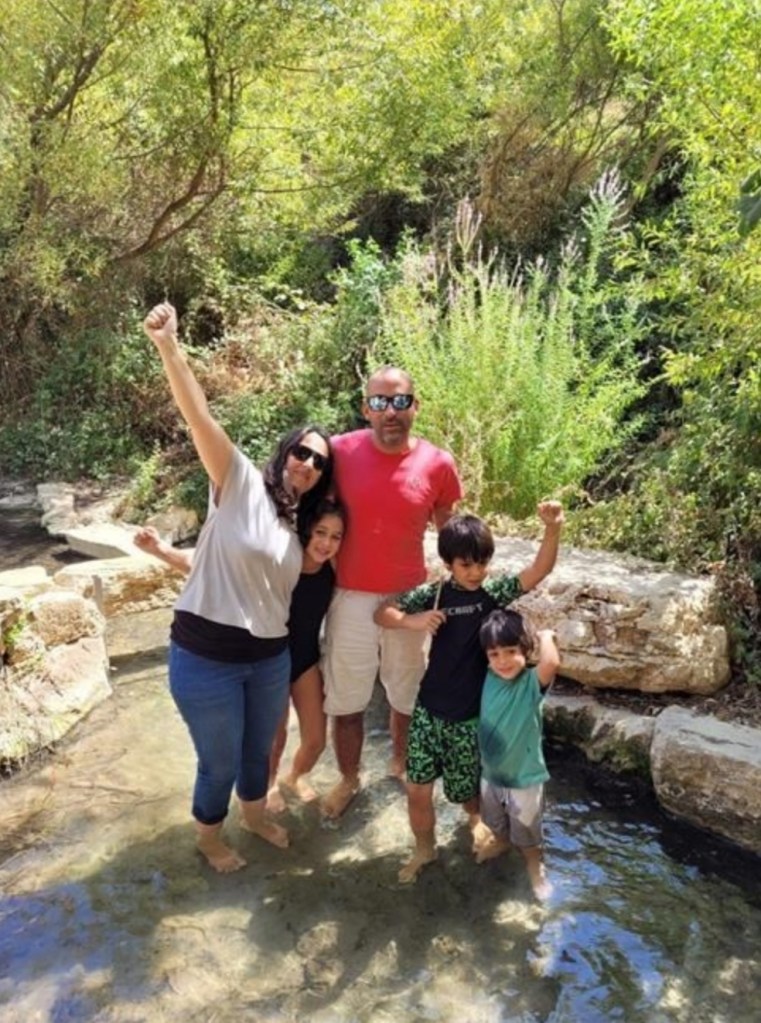
And this is Yossi’s family. He married Nira Herman, a nurse. They had three beautiful daughters: Yuval (17), Ofir (14) and Oren (13). They lived their lives, went to work and to school, saw family and friends. Like all people everywhere.

Until October 7, 2023. Black shabbath, the destruction of kibbutz Be’eri at the hands of Hamas. Terrorists broke through the Gaza border, gunning down everyone they saw, and invaded the kibbutz. Heavily armed men went from house to house, hunting down Israelis, leaving a trail of murder and destruction. Eli and Lianne’s home was on the list, too. When the intruders broke in, Mocca, the family dog, ran at them barking. Hiding in their safe room, the family heard the gunmen shoot their dog and then laugh. This mental picture is burned into my brain and makes my blood run cold.

In interviews, Nira later said that Lianne texted her, saying: “Nira, I can hear them. They are here at our house. They are shooting and shouting: “Die Israel”. Please call for help.”

Nira did call for help, but it would not come until hours later. It was too late for Lianne, Noya and Yahel. They were murdered in such a brutal way that it took weeks for their remains to be definitively identified. I don’t know the details of what was done to them, and I prefer not to know. But Noya and Yahel, young teenage girls, could only be identified through DNA testing.

.

Eli Sharabi lost his entire family on that horrific morning. But we don’t know whether he realizes they are dead. He was abducted by Hamas and there has been no contact with him whatsoever. We don’t know if he is alive at all, or if he will ever come home. But even if he does, he has no home anymore, no house, no kibbutz, no family. His entire life has been destroyed by the Death Eaters. I cannot imagine anything worse. My heart bleeds for Eli Sharabi.

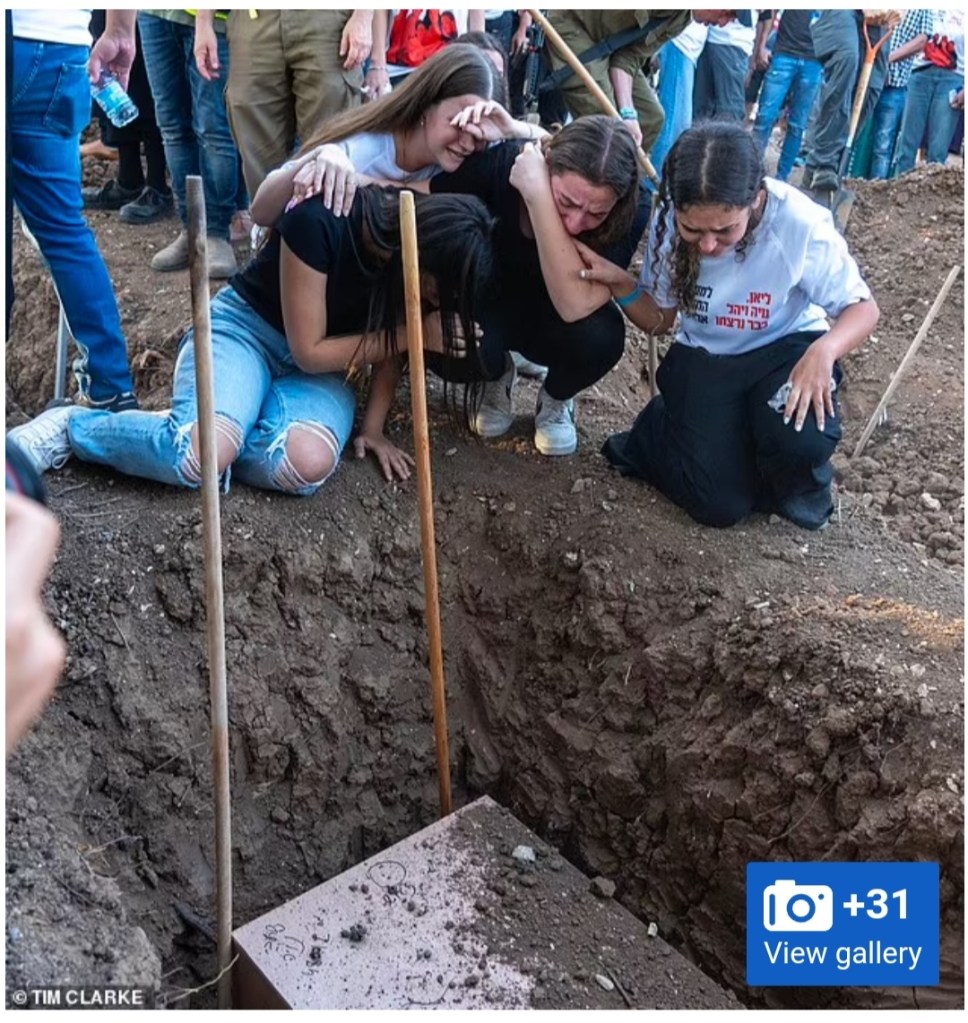
The following image is from Lianne, Yahel and Noya’s funeral (in the Daily Mail).

.

Yossi, Nira and their children were also hiding in their safe room. They could hear the terrorists outside, shouting and shooting. People started calling Nira, who is a nurse, with panicked requests for help, what to do for family members who had been shot. Nira tried to instruct them as well as she could without being able to leave her house and see the wounded people for herself. Lianne texted her, begging her to call for help. Ten minutes later, she lost contact with Lianne. Nira’s nephew called from the Supernova music festival, telling her they were under attack and he was coming to their kibbutz. Nira had to tell him not to come, that the terrorists were in Be’eri, too. Later, she heard that her nephew was killed at the site of Supernova.

To these people, it must have felt like the world was ending. The terror and despair they must have felt is unimaginable.

At 12:30, the Death Eaters reached Nira and Yossi’s house. They did the same thing as in Eli and Lianne’s home: they shot and killed their dog, Shoko, and laughed. Yossi then got up, walked out of the safe room and told the terrorists to take him and leave his family. In the documentary Burning in the hearts of Be’eri, Nira later described the following scene:

“They took us from the house, and they brought us downstairs to the garden. They took our phones with their weapons [aimed at us]. All three terrorists. They were dressed in black with the whole package and everything. (…) And they took pictures, a selfie, you know, to spread it all around. And they just took the flag. We had a flag of Israel down in the house, and they just ripped it and they started to smash it. And they start to yell in Arabic, “Down with Israel! This is Palestine! This is not Israel! Israel does not exist! Kill all the Jews!” “

The terrorists then told them to give them their car keys. They made Yossi Sharabi, Ofir Engel (Yuval’s boyfriend) and Amit Shani, their neighbour’s son, get into the car. Then, they drove away with the three Israelis as hostages. Nira and her daughters and their neighbour, Amit’s mother, stood there and cried, looking after the car that took their loved ones away.

Seven weeks later, in the ceasefire, minors Ofir and Amit were released. The video footage of the reunion of Ofir and his girlfriend, Yuval Sharabi, is so very touching. Amit’s grandmother, Simcha Shani, was shot in the stomach but survived the ordeal. The entire family is extremely lucky to all be alive and together.

Unlike the Sharabi family. Not only were Lianne, Noya and Yahel murdered, but both Eli and Yossi are still hostages. Nira and her daughters cannot return to Be’eri, their house has been burned to the ground. They stay in a hotel in Eilat, and try to survive the hours, days, weeks and months that they are apart from their husband and father. Nira says she has no idea why the terrorists didn’t simply shoot them all. They had no problems shooting other women and children.

Yossi and Eli’s younger brother, Sharon, supports them the best he can and campaigns for the release of his brothers. He keeps Shabbath and so he did not get any of the messages that his family sent him that day, until the evening, when he switched on his phone and saw what had happened to them. He says: “My job is to bring my brothers home.”

.

I don’t know if Eli and Yossi Sharabi are alive or if they will ever come home. I hope and pray they are and they will. But what they will find if they do, will be incredibly hard for them.

#bringthemhome

.

Update 17/1/24

With a heavy heart, I have to add here that Yossi Sharabi was murdered in Hamas captivity. This has been made public yesterday.

Hamas released a video on January 14, 2024, showing three hostages: Noa Argamani, Yossi Sharabi and Itay Svirsky. They were forced to say that if Israel didn’t stop the war, they would die. Hamas ended the video with a nice little game: we got to guess who was going to be murdered that night.

Sadly, Noa was the only one who survived this demonic game.

I am heartbroken for Nira and her daughters. This family had to go through way too much.

Rest in peace, Yossi Sharabi.

Shoshan Haran – the best of us

I firmly believe that Hamas took out the best of us. They targeted the kibbutzim close to Gaza, where peace activist Vivian Silver lived, where human angels like Jimmy Pacheco and Angelyn Aguirre worked, and where Shoshan Haran and her family came from.

.

.

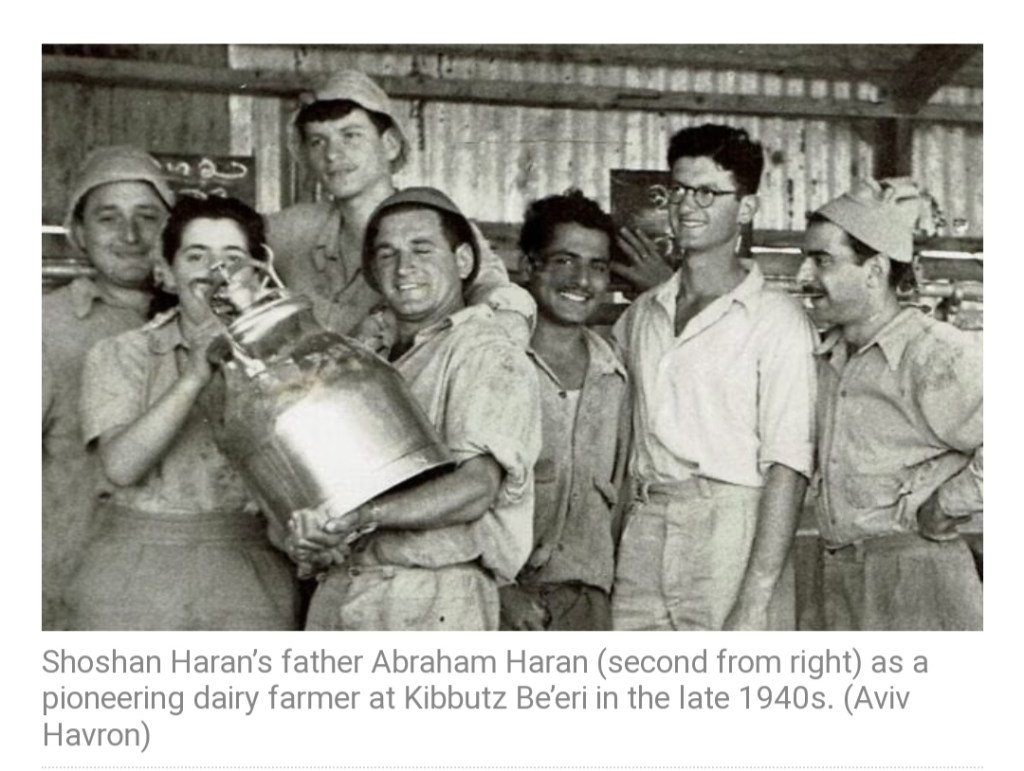
Dr. Shoshan Haran, 67, comes from a family of highly educated, highly driven lifesavers. Her grandparents were orthopedic surgeons in Stuttgart, Germany, before the Second World War. They came to Israel to escape Hitler’s reign of terror and continued their work in the new country: they treated children with polio and severe injuries in the Alyn Hospital for disabled children. Their son, Avraham Havron, left the relatively wealthy and comfortable home of his parents in Jerusalem to help to establish the agricultural community of kibbutz Be’eri.

.

Abraham Havron’s children, Shoshan, Lilach and Aviv, were born and raised in kibbutz Be’eri. Shoshan married Avshalom Haran. The couple lived in Be’eri and had 3 children together: Adi, Yuval and Shaked. These names will all come back later in this story.

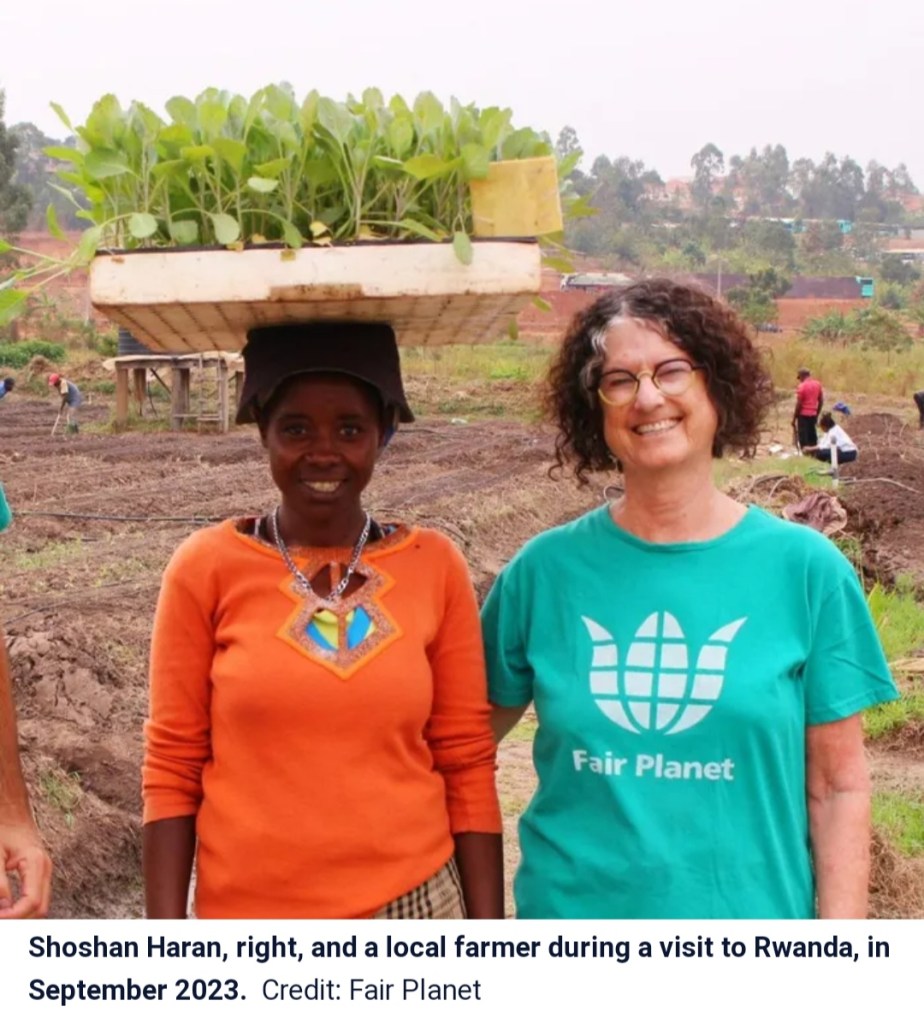
Shoshan studied biology and plant protection in Jerusalem and started working at Hazera Genetics, a leading seed producing company. But after years of working in the seed industry, Shoshan wanted to use her knowledge to help people. She founded the non-profit organization Fair Planet, which develops high quality seeds specifically for African farmers. The NGO operates in Ethiopia, Tanzania and Rwanda and has helped thousands of farmers achieve much more successful harvests than before. This way, not only has Fair Planet improved the lives of the farmers themselves, but also the lives of hundreds of thousands of people who now have food to eat, instead of failed harvests and hunger.

.

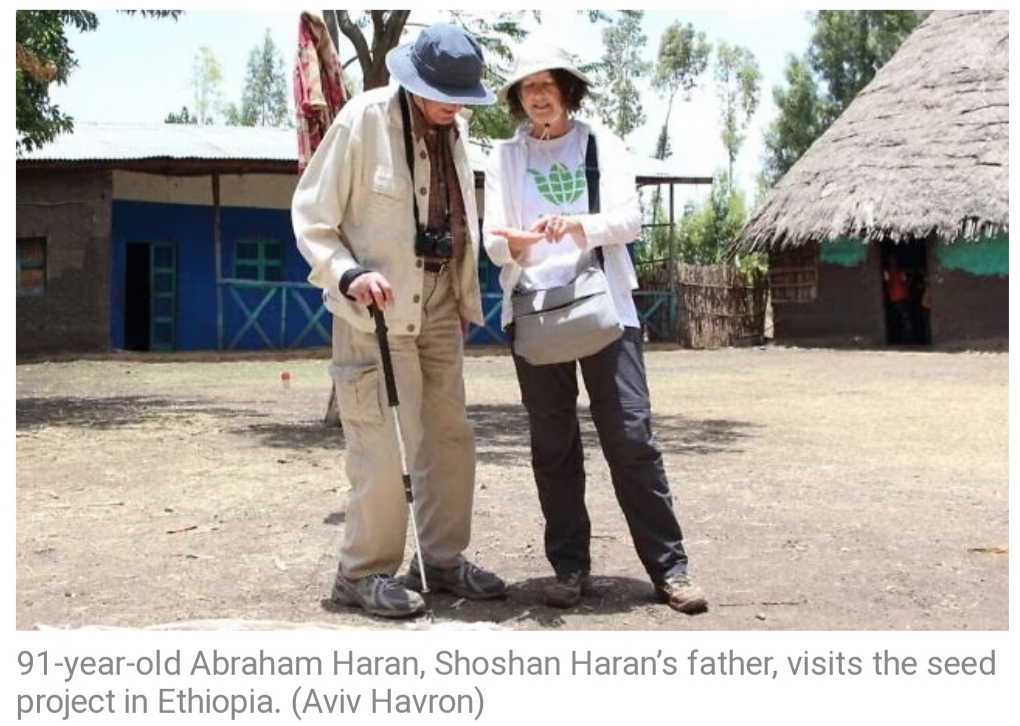
Shoshan travelled to Africa several times a year. Her father, Avraham, was so proud of her work that, at 91 years old, he decided to come with her on one of her field trips. Avraham Havron passed away at the age of 96 in 2022. It is a blessing that he did not have to live through the horror of October 7, 2023.

.

Over the years, their succes grew. Some of the biggest seed companies in the world, like Bayer and Syngenta, started funding Fair Planet, because they are developing the African market, which is profitable for them. The NGO doesn’t only provide the farmers with seeds, but also with education and practical help from volunteers. With the assistance of this project, the farmers are able to produce up to six times more vegetables of better quality than before, which has a huge effect on entire communities. It is fair to say that Shoshan Haran’s work changed millions of lives for the better. How many of us can say that?

Of course, Hamas does not ask people what good they have done in the world. The terrorists, crazed and bloodthirsty, hopped up on a cocktail of drugs, didn’t care about anything or anyone. On October 7, kibbutz Be’eri was raided and destroyed by hundreds of inhuman demons from hell. Murdering, torturing, burning. Screaming about the greatness of their cruel god. The Death Eaters of our world, full of hate, sadism and cocaine. I cannot imagine anything more terrifying than that.

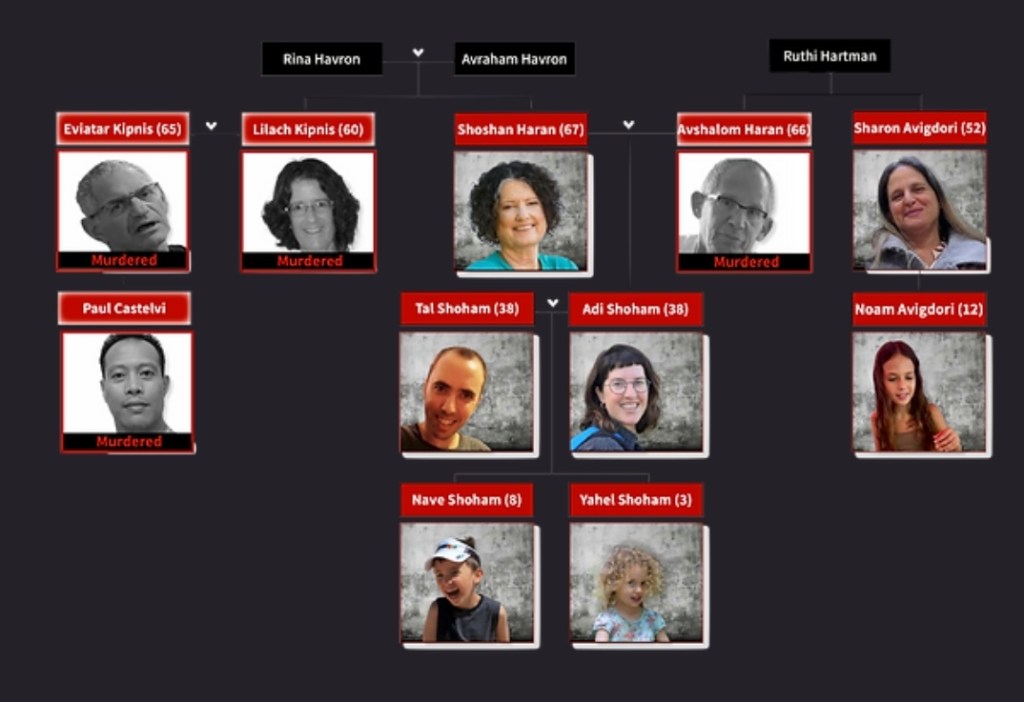
Shoshan’s husband, Avshalom Haran, was murdered in cold blood. So were her sister, Lilach Kipnis, her husband, Eviatar Kipnis, and Eviatar’s caretaker, Paul Vincent Castelvi. And Shoshan was abducted, together with six other members of her family: her daughter Adi Shoham, Adi’s husband Tal Shoham, their children Yahel (3) and Naveh (8), Avshalom’s sister Sharon Avigdori and her daughter Noam. Eleven members of the same family (including Paul) were missing or dead. Try to imagine it. I can’t. My brain just refuses to wrap itself around this idea.

.

.

Shoshan and Lilach’s brother, Aviv Havron, found a blackened ruin where his sister’s house once stood. It had been blown up with explosives by the terrorists.

.

.

For seven long weeks, Shoshan and her family members were hostages, hidden underground in the tunnels system of Gaza. They were kept in the dark, with very little food or water. They could not wash or brush their teeth. They had to stay quiet and speak in whispers. They were threatened, verbally and with weapons. Shoshan was the one who kept them all together, who told them to stay positive, that they would get out. And they did, on November 26. In Gazan clothes, accompanied by hooded, armed terrorists, who handed them over to the Red Cross. Finally, Shoshan’s brother and her two other children could hug her again. Yahel and Naveh could play again. They could eat and shower.

But not all of them. Tal Shoham, the children’s father, was not released. As I am writing this, on the last day of 2023, he is still imprisoned in Gaza. And Shoshan had to be told about the murder of her husband and sister. She didn’t know, she thought they had also been kidnapped. Like so many others, this family has been torn apart by the horrible crimes of Hamas on October 7.

But Shoshan Haran will come back from this, and she will continue her work at Fair Planet and save countless lives. Because that is who she is: the best of us.

.

Filipinos face Hamas

Israel is home to more than 300,000 foreign workers. Many of those are Thai. 30,000 to 50,000 are Filipinos, who most often work as caregivers for elderly and disabled people. Many Filipinos live and work in other countries to take financial care of their families. They are called overseas foreign workers (OFW’s). They are educated according to the country they are aiming at, in courses where they learn the language alongside nursing. Israel is a popular destination for Filipino OFW’s. In Israel, they earn a salary many times higher than what they could earn in the Philippines, and they are treated better than in countries like Saudi Arabia. Some Filipinos have children back home, who are in the care of their grandparents. To take care of their families financially, these parents give up raising their own children, to work in Israel and make sure their kids have a home, food and an education. They make the ultimate personal sacrifice to take care of their loved ones – and of our elderly. For that only, they deserve all our respect and admiration.

But apart from that, Filipino caregivers are most often lovely people and wonderful nurses, who decicate themselves to the care of their patients. They often stay with the same patient for years and become a member of their families. The elderly or ill person whose family can afford hiring a Filipino nurse is truly a lucky human being.

On October 7, four Filipino nationals were killed and two taken hostage. These are their stories.

Jimmy Pacheco

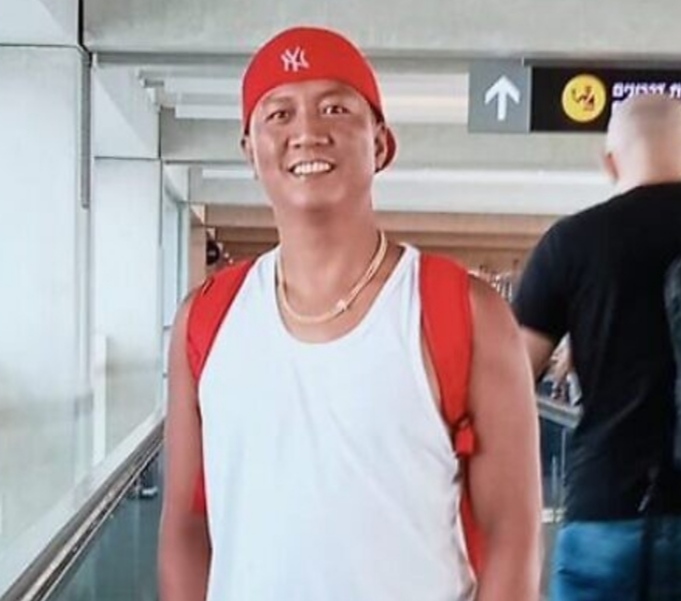
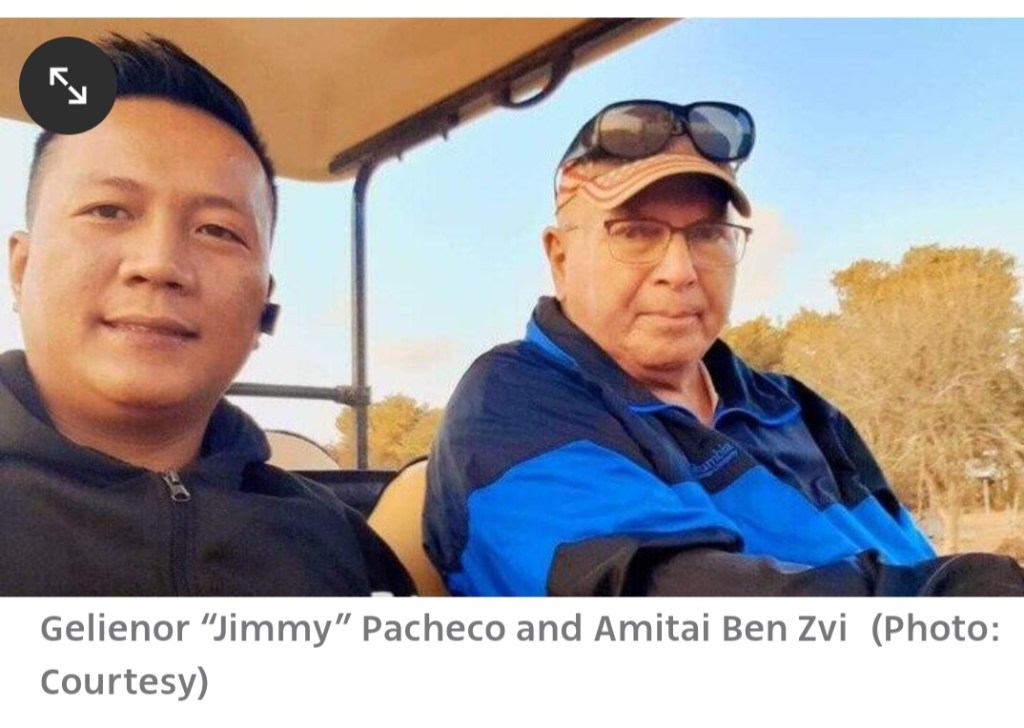
Gelienor (Jimmy) Pacheco had been in Israel for five years. Four of those years he had cared for Amitai Ben Zvi (80) in kibbutz Nir Oz. He called his patient Abba (dad). The relationship between the two of them was very good and the family loved Jimmy. Amitai’s daughter said that he took care of her father “with quiet, admirable devotion, always attentive to his needs and supportive in countless ways.” Jimmy’s wife and three children lived in the Philippines and kept in contact with him through video calls.

On Black Shabbath, when Hamas terrorists attacked kibbutz Nir Oz, Jimmy was there with his patient. The invaders shot Amitai, an 80 year old man with Parkinson’s, point blank. Jimmy managed to call his friends to tell them his Abba had been murdered and he was being kidnapped. Two Hamas videos showed Pacheco handcuffed and surrounded by armed men.

Jimmy was a hostage in the tunnels of Hamas for 49 days. He describes the terror and harsh conditions he went through on Ynet, telling them how he ate toilet paper because he was so determined to survive, and how thoughts of his children and his Catholic faith pulled him through. Pacheco was released on November 24, together with 10 Thai nationals, as part of an agreement with the Thai and Filipino governments. Jimmy went back to visit Nir Oz and the grave of Amitai Ben Zvi. He showed the destruction in a live video on Facebook.

On December 18, Jimmy Pacheco finally landed in the Philippines and was reunited with his family. The good news is that he will never have to leave them again. He will get lifetime benefits from Israel. To us, he is a hero.

.

Noralyn Babadilla

Noralyn Babadilla, 60, lived and worked in Israel for over 30 years. She married an Israeli, Gideon Babani, and gained dual Israeli-Filipino citizenship. She and her husband lived in Yehud, a town in central Israel. On October 6, they went to visit friends in kibbutz Nirim in the Gaza Envelope, where they stayed overnight. Early in the morning of October 7, the kibbutz was attacked by Hamas terrorists. At around 7 AM, Noralyn called her brother and told him terrorists were shooting at them, and she was afraid. That was the last anyone heard of her.

Gideon Babani was found murdered in kibbutz Nirim, but Noralyn was missing. No one knew for certain what had happened to her. Her brother and sisters were desperately worried. Fortunately, on November 28, Noralyn was released by Hamas, together with a small number of other women and children. She had been a hostage all that time. She was seen in the videos of the release of the hostages that day, assisting an elderly woman.

Noralyn survived her ordeal in reasonably good health, and was reunited with her siblings, who also live and work in Israel. But her husband and her friends were murdered before her eyes. How do you even begin to recover from such a terrible trauma?

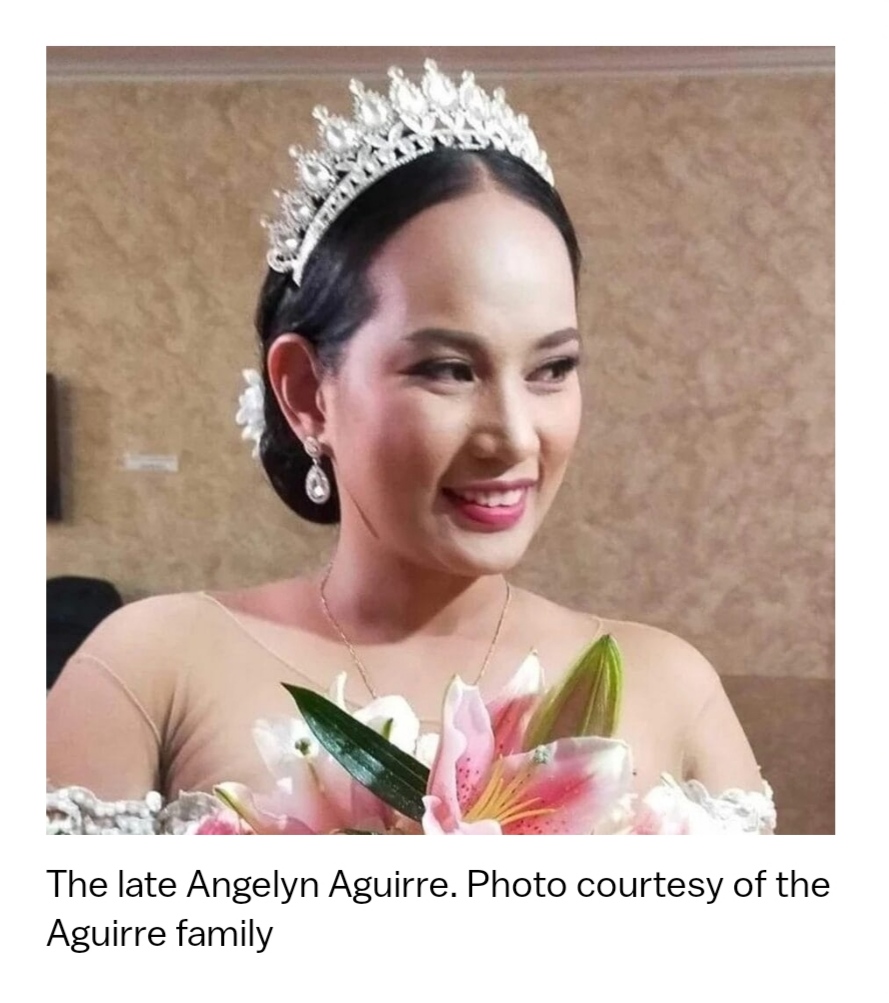
Angelyn Aguirre

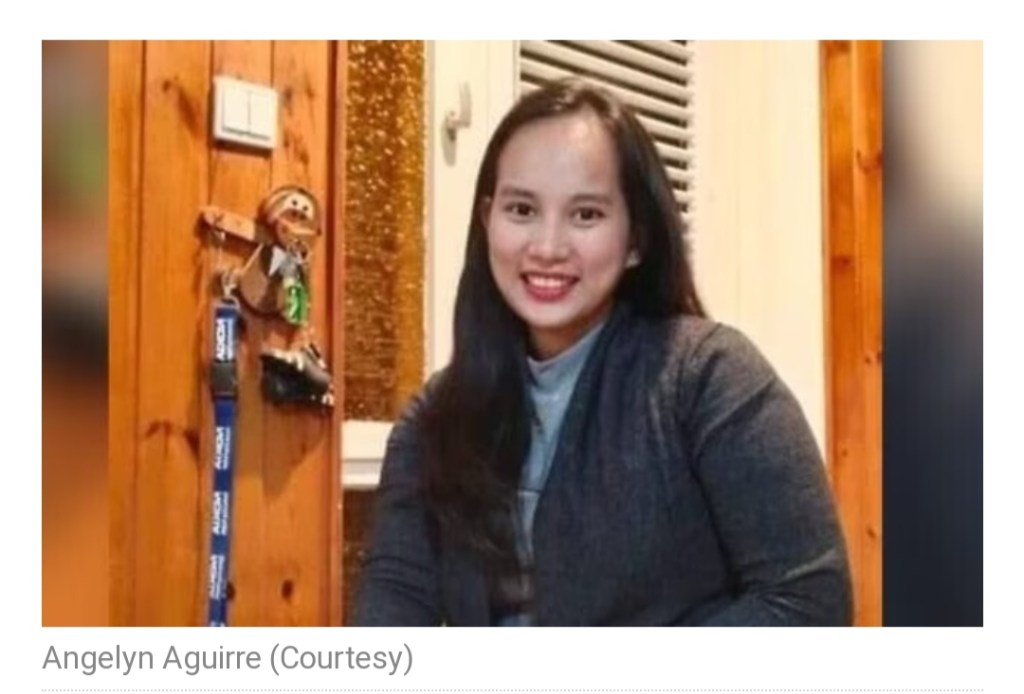
The story of Angelyn Aguirre is desperately sad. It is one of those that doesn’t leave me alone. Just look at that beautiful, sweet face. Angie was 33 years years old. She had been working in Israel for seven years, but she had just got married and in a few months’ time, she was going to return to the Philippines to be with her husband and start a family.

Angie took care of Nira Ronen (86) in kibbutz Kfar Aza. When the terrorists ransacked and burned their way through the kibbutz, Angie took Nira into the safe room of the house and tried to hold the door closed, while armed men on the other side forced it open and opened fire at the two defenseless women inside the room.

The mental image is mind-boggling. It is just beyond anything I can ever understand. How can things like this have happened? What kind of soulless beings gun down an 86 year old lady and her young Filipino carer in their home? What kind of unimaginable evil took over the minds of those invaders? I want to know. But it breaks my heart, every time again, to read and research these stories.

After the bodies of Nira and Angie were found, the deputy mayor of Jerusalem, Fleur Hassan-Nahoum, wrote on X/Twitter: “Despite having a chance to flee the Hamas terror attacks, Angeline showed unbelievable humanity and loyalty by remaining Nira’s side during the violence, resulting in both of them being brutally murdered by Hamas. Unimaginable honor in the face of evil.”

Later, in an emotional interview with ABS-CBN News, Hassan-Nahoum said: “The Filipino community in the State of Israel is very much loved and appreciated. They take care of our elderly and they take care of special needs children. My mother was taken care of by two wonderful nurses and I owe them so much. There are so many people in this country that owe the Filipino community so much. For us, it’s as painful to lose one of you as it is to lose one of us.”

I agree completely.

.

Paul Vincent Castelvi

Paul Castelvi (42) lived and worked in kibbutz Be’eri. He was the caretaker of Eviatar Kipnis, who suffered from an auto-immune disease. Paul was the main breadwinner for his entire family back in the Philippines; his parents, his three siblings and his nieces and nephews. He was married to Jovelle Santiago, who also lived and worked in Israel. Jovelle was pregnant with the couple’s first child. The baby was due in November, and Paul’s employers had given him and his wife tickets to fly home for Christmas, to surprise their families and show them the new baby.

Instead, Jovelle arrived alone at Manila Airport on December 23, holding her newborn baby and an urn containing Paul’s ashes.

.

Paul was murdered by Hamas together with his wheelchair-bound patient, Eviatar Kipnis, and Eviatar’s wife, Lilach Leah Kipnis. Many of their family members were abducted, including young children.

Yotam Kipnis, the son of Eviatar and Lilach, wrote on Facebook: “Paul was an incredible man, and I have still not come to terms with his death. It’s unimaginable, and I can’t believe that I won’t meet him again… Rest in Peace, Paul Vincent Castelvi.”

After learning of Paul’s death, Jovelle Santiago wrote on Facebook: “I don’t know how and where I am now to start when you are gone — so hard. I feel like I lost half of my life. Guide us always with our baby boy.”

After giving birth to her baby, who she called Jhayzen Paul Castelvi, she wrote: “Worth every pain… Worth the wait. Thank you for coming to our life… Tatay is surely smiling at us from above.”

Loreta Alacre

Loreta Alacre (49) was dearly beloved both in Israel and in the Philippines. She was the breadwinner for her entire extended family back home – most of her seven siblings and their children. Loreta financed the building of their house and the education of her nieces and nephews, and paid for hospital bills, birthdays, weddings, baptisms and funerals. The whole family was dependent on Loreta, who dedicated her entire life to them and to her patients. She worked overseas for 19 years, of which almost 15 years in Israel.

On October 8, Loreta’s employer, Noam Solomon, wrote the following on Facebook (my translation):

“Lori, my devoted caregiver of the last 6 years is missing! She was last seen yesterday in the early morning hours, between Netivot and Ashkelon. Her partner, who was with her, told a friend on the phone that he had been shot in the back. We located him in the Barzilai hospital, but he had no knowledge of where my dear, beloved Lori is. If anyone knows, hears or sees anything, please let me know in a private message as soon as possible.”

On October 11, Loreta’s body was found. The news caused anguish for her Filipino family as well as for her Israeli family. Lori had been the carer of Noam Solomon’s grandmother for many years. After her grandmother passed away, Noam, who had become disabled after an accident, asked Lori to be her caretaker. After receiving the news of Lori’s death, Noam posted (again, translation is mine):

“My dear, beloved Lorie Alacre, an inseparable part of my family for over 14 years, and for the last 5 years my right hand, my confidante, was sadly murdered in cold blood by Hamas killers on the cursed Sabbath. May her memory be blessed.”

.

Slowly, the events that led to Lori’s death were pieced together. Lori had been travelling to Ashkelon, where Noam lives, together with her partner. They took a sherut minibus with several other people. On the way, the terrorists stopped the minibus and shot its occupants. Lori did not survive the shooting.

Loreta’s family in the Philippines will get aid and benefits from Israel, as all dependants of terror victims do. But nothing can make up for the loss of this amazing, caring human being. Hamas took away the very best of us on that terrible day.

Grace Cabrera

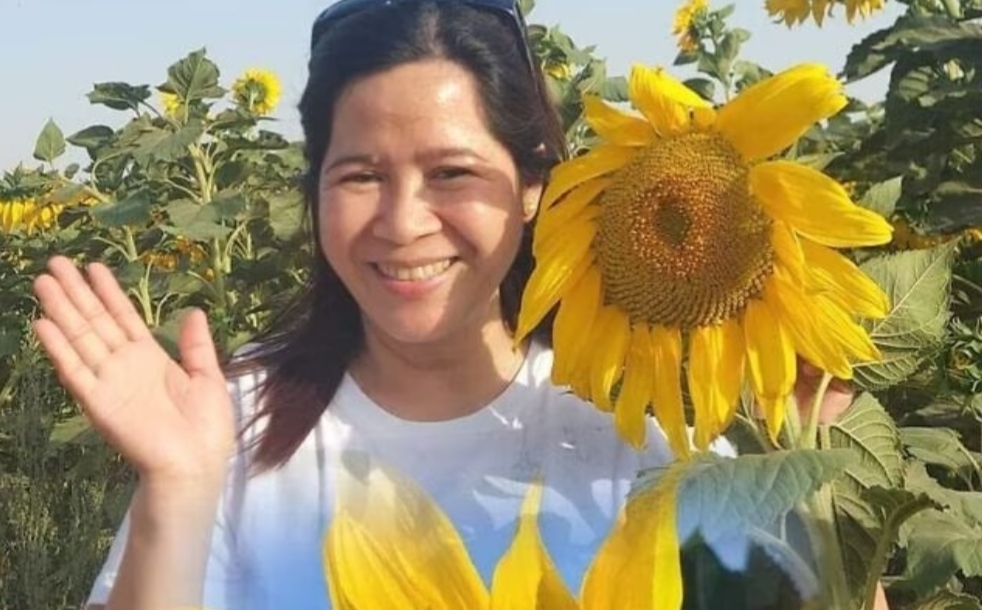
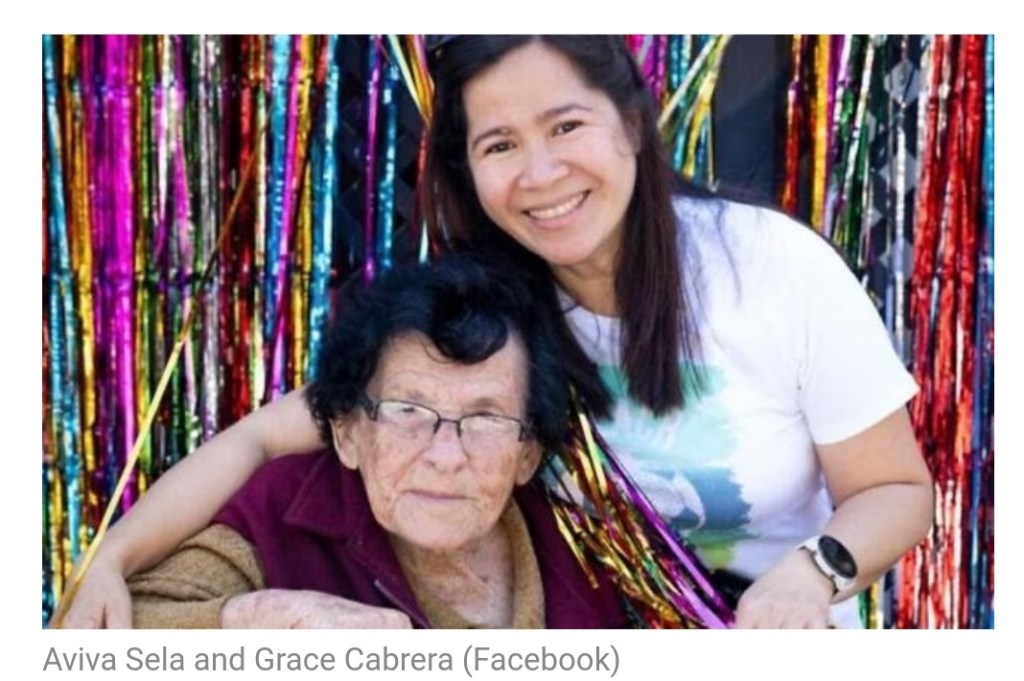
This is another story of love, loyalty and kindness in the face of unimaginable terror. Grace Cabrera (45) lived and worked in kibbutz Be’eri as the caretaker of Aviva Sela (95). She had parents, siblings, a husband and a child back in the Philippines, who depended on her salary. Her sister, Mary June, also lived in kibbutz Be’eri.

On the morning of October 7, when it was clear that their kibbutz was under attack, Grace took her patient into the safe room of their house and held the door closed for hours (these doors don’t have locks). Days later, security cameras showed that Hamas broke into the room and held Grace and Aviva at gunpoint on the porch. The porch of this house was apparently used as headquarters and weapons assembly. At the end of the day, Grace was taken by the terrorists, leaving 95 year old Aviva alone in the swing chair on the porch.

Aviva does not remember much, but she remembers deciding to leave the kibbutz. She took her walker and started walking, without her glasses or hearing aids. At some point, someone from the kibbutz took her into their car, and she called her daughter, Osnat Weinberg. When her family came to pick her up, they found the basket of her walker packed with everything she needed, including medication and food. “Only Grace could have gotten her ready like that,” Osnat said.

Grace’s body was found on October 19. She had been shot and dumped by the terrorists. Words fail me.

Osnat Weinberg said of Grace:

“Her composure, her wisdom and her best intentions for my mother were far beyond the realm of ordinary. She was simply an angel with her feet on the ground. What a good soul, how wise… we are so thankful to the wonderful Grace who became part of our family, and we are crying over her loss.”

Mary June Prodigo, Grace’s sister, wrote on Facebook : “No words can explain the pain I feel right now… I lost my sister/best friend. Now everything is gone… all the happy memories will be replaced by pain.”

There are more stories of the way Filipino caregivers protected their charges. There is a story of a carer who somehow managed to bribe the terrorists with money. Both she and her patient escaped with their lives.

I am heartbroken that they had to go through this. I am so sad for their families. And I am beyond furious that the evil incarnate called Hamas did this to them, and to us. That anger is what fuels me to keep writing. This article was exceptionally hard to write. The cruelty and sadism of the Death Eaters stands in such heavy contrast to the kindness and sacrifice shown by the Filipinos. It’s like good and evil faced each other that day.

Grace, Loretta, Paul and Angie were killed ruthlessly. But they left their impression on the world. Their love, kindness and energy lives on in the memories of both their Filipino and Israeli families, and in their children. And in the collective memory of Israel and the world. We will always remember that they were good, and kind, and protective of their patients. Hamas is their polar opposite, and their days are numbered. They will pay for what they did to these innocent people.

.

Avigail Idan, the Girl Who Lived

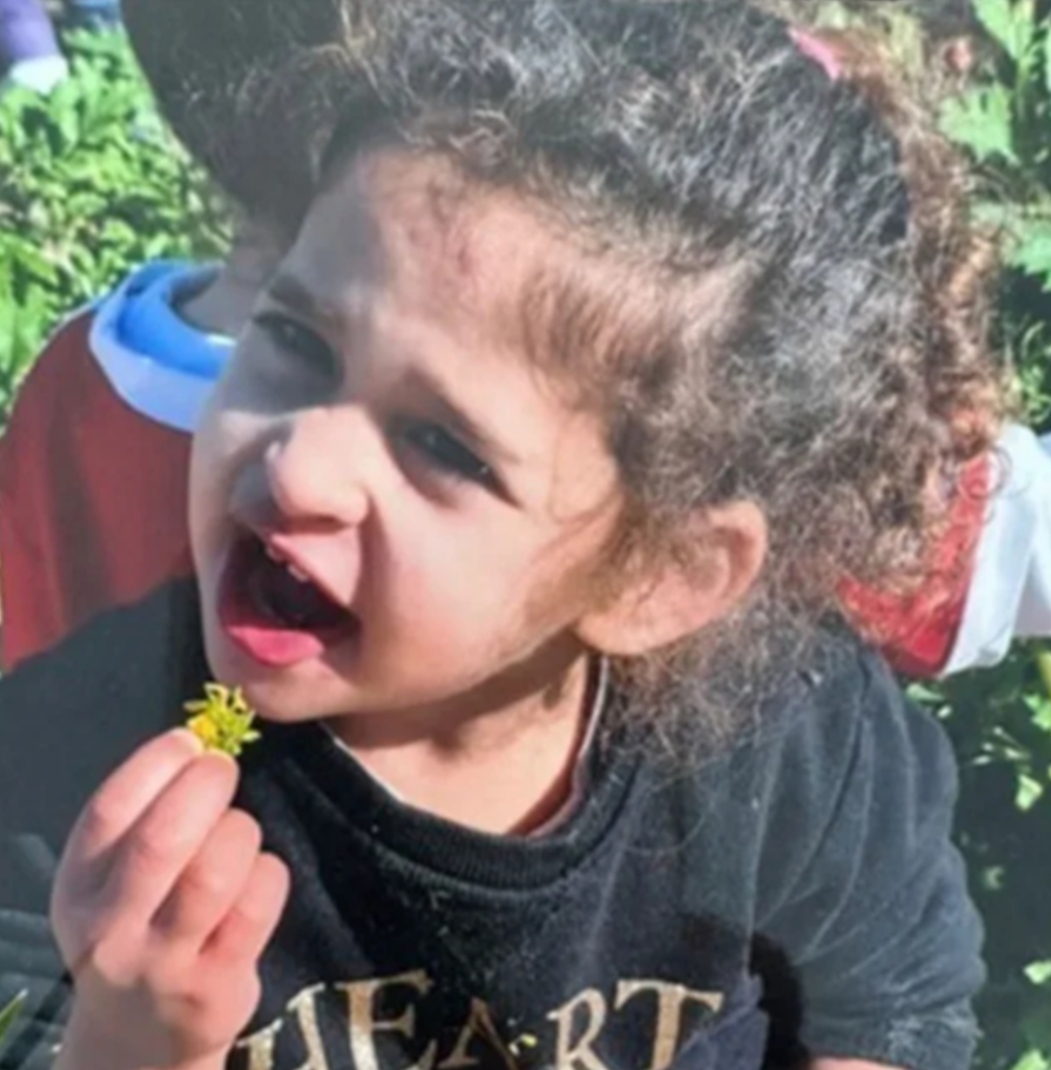
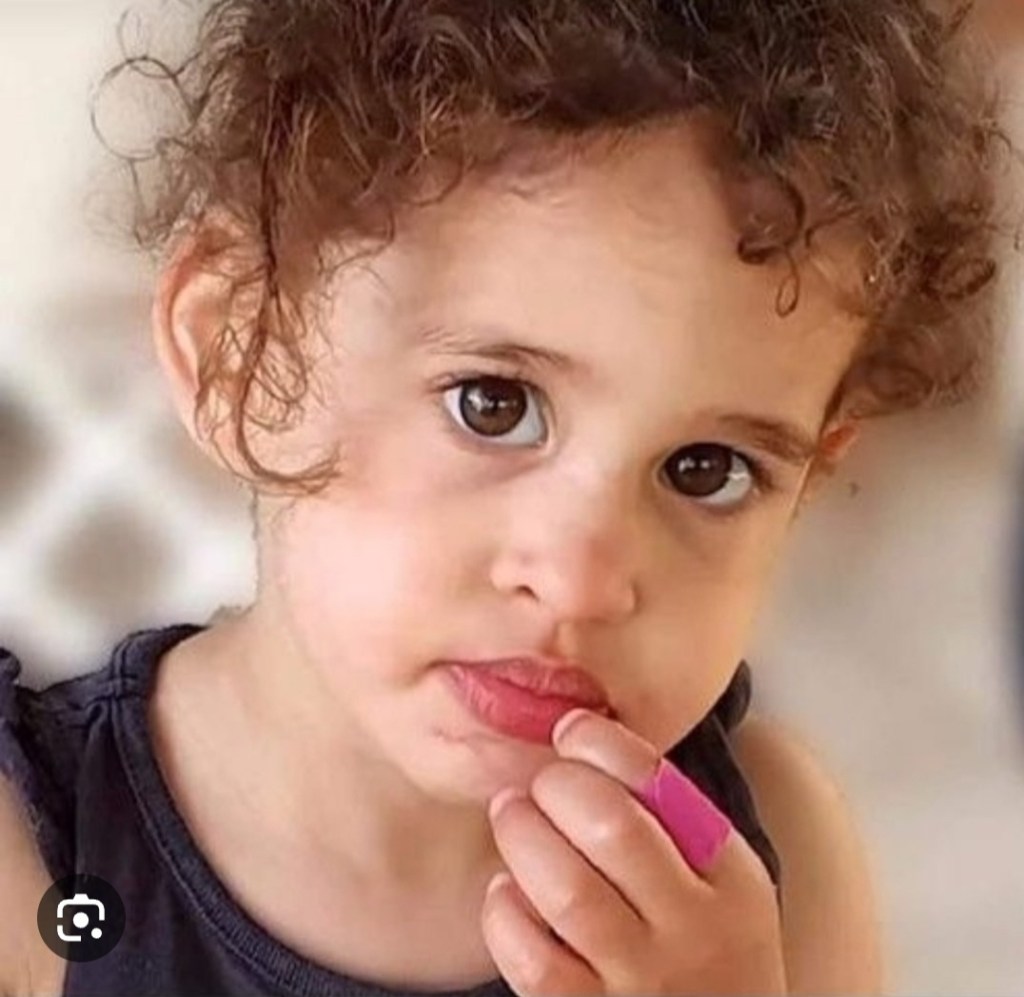
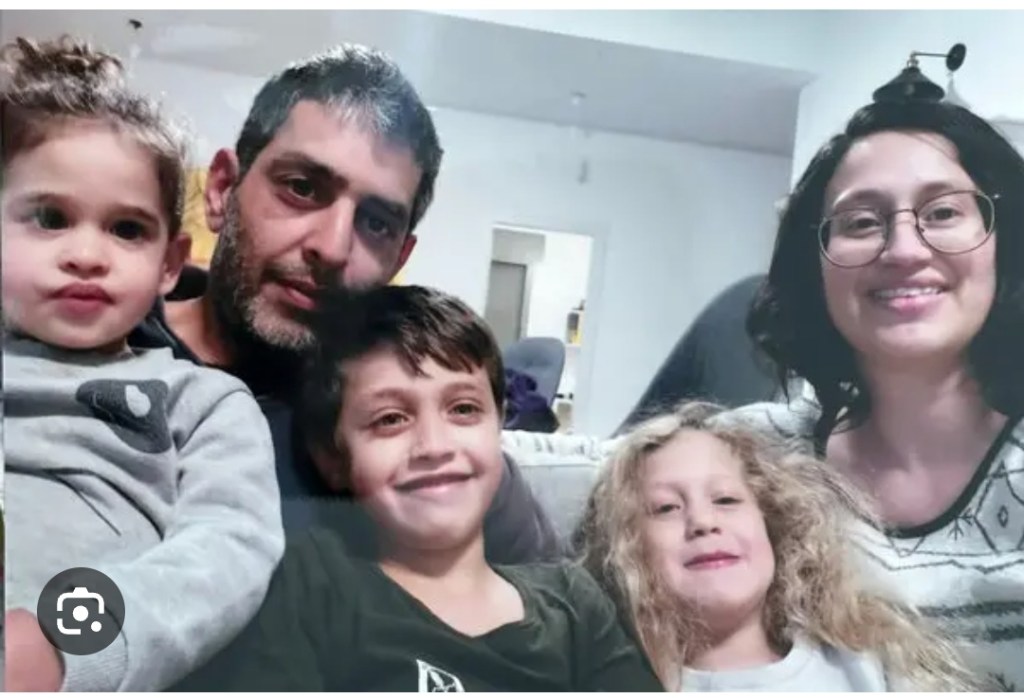
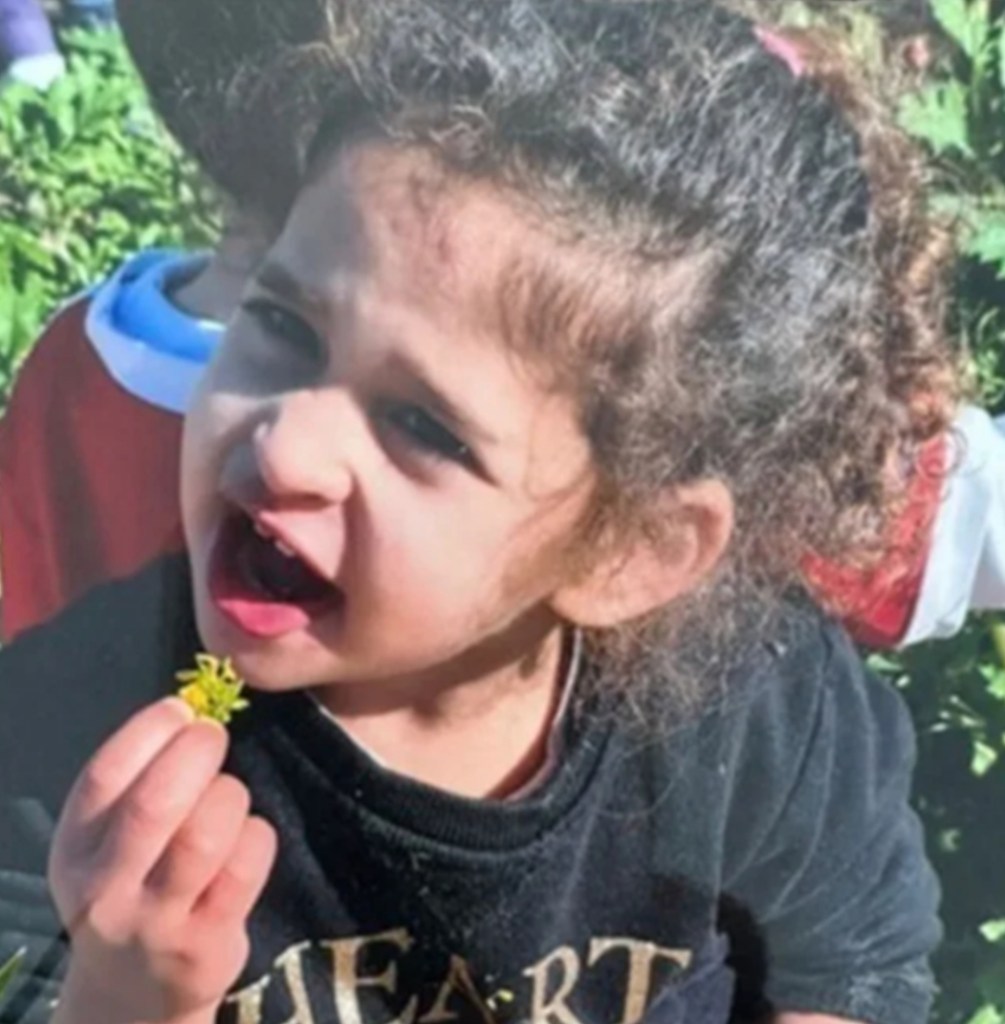
This is Avigail Idan. She’s four. Can anyone tell me what kind of threat a four year old baby poses for the two-state solution? What type of terrible power did she have that justifies executing her parents and trying to take her out, too, Voldemort style? Does Avigail hold the key to the freedom of the Palestinian people?

Of course not, and the freedom of the Palestinian people is not what concerns Hamas. The terror organization of Hamas has only one ultimate goal: the establishment of the Islamic State. That means 1. the total destruction of Israel and all Jews on the planet and 2. conquering the entire world until every single person is under radical Islamic control. Sounds fun? Not really. But because these goals are kind of hard to reach, in the mean time, they will satisfy themselves by inflicting as much death, pain and destruction on Israel as they possibly can. Go to town, boys! You can do anything you like to them. Really live out those sadistic fantasies. That’s what I imagine Yahya Sinwar said to them. Or, as I prefer to call him: You-Know-Who.

.

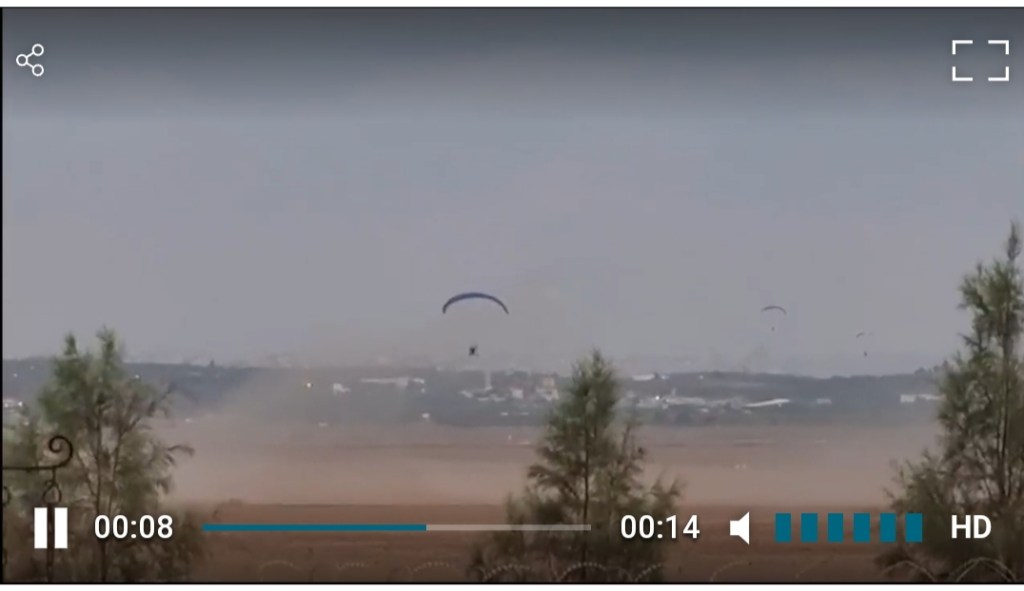
On October 7, Avigail Idan was three years old. She lived in kibbutz Kfar Aza with her father, Roee, her mother, Smadar, and her 2 siblings, Michael and Amalia. Roee Idan was a photojournalist for the news website Ynet. On the morning of October 7, he actually went outside with a camera and filmed the arrival of the terrorists in paragliders. This is a still from one of his videos, as published on Ynet:

.

At the end of the video, Roee drops the camera and starts running. He runs home, grabs his wife and children, tells them to run, to hide, that terrorists are flooding into their kibbutz. But they would not get far. Hamas gunmen broke into their home at that very moment and opened fire. Smadar collapsed. The two older children ran and hid in a closet. Roee, who was holding Avigail, was shot too, and fell to the ground, covering Avigail with his body.

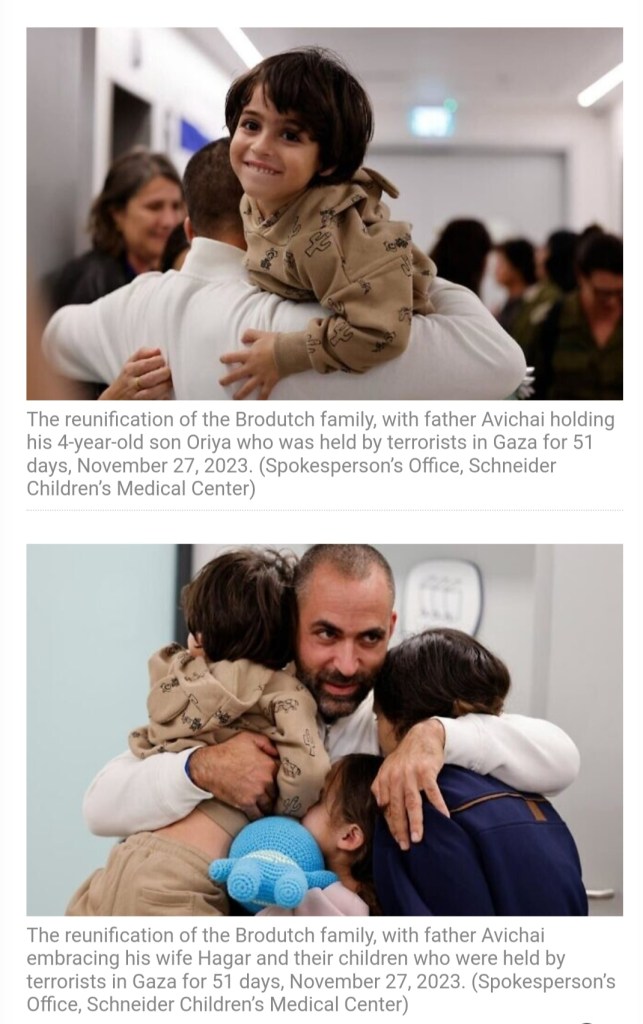
The murderers must have thought they had shot Avigail too, because they left. But Avigail was unhurt. She crawled out from under her father’s body, covered in his blood. She fled in terror and ran to her neighbours’ house, the Brodutch family. Hagar Brodutch took Avigail into the safe room with her own three children, while her husband went out to fight. But when Avihai Brodutch came back to his house, he found his wife, his three children and Avigail missing. They had all been abducted to Gaza. Avigail was gone, in the hands of the monsters who murdered her family.

.

The Brodutch family: Hagar, Avihai, Ofri (10), Yuval (9) and Oriya (4).

Avigail and the Brodutches were in captivity for 50 days. Avigail turned four years old on November 24. US president Joe Biden took a specific interest in Avigail, because she has dual citizenship with ties to Arizona, and because of her status an an orphan. “What she endured is unthinkable,” he said.

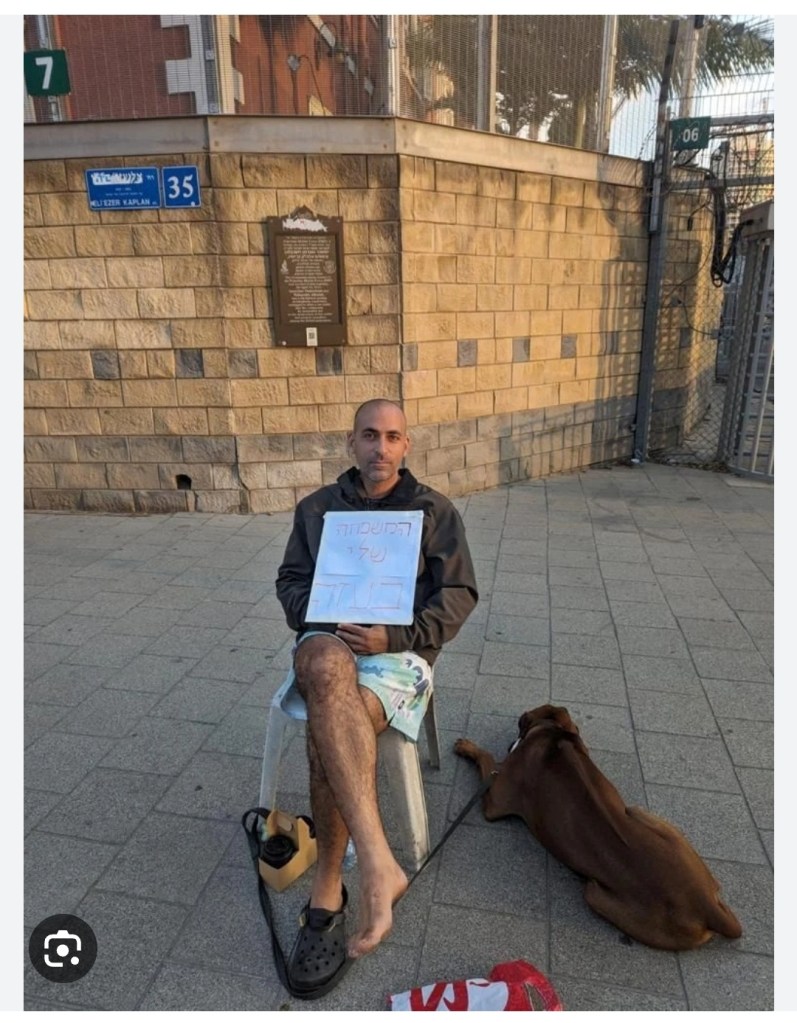
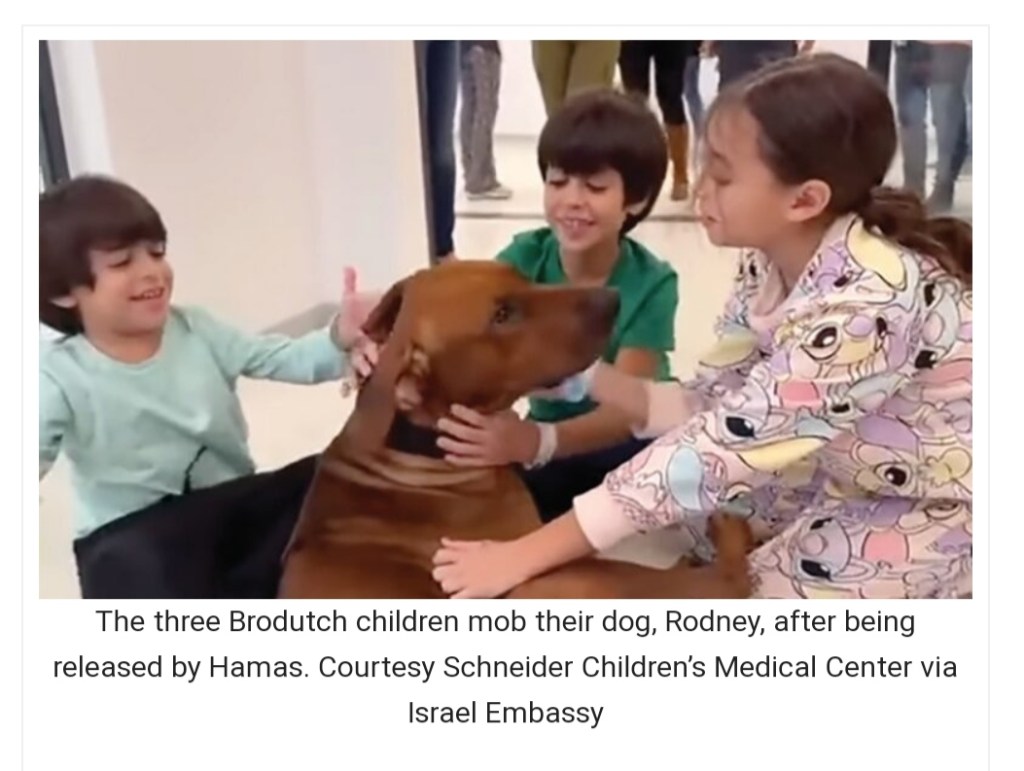
Avihai Brodutch was in a way the opposite of an orphan: a father whose family was torn away from him. He didn’t know what to do. So he went to Tel Aviv with his dog, Rodney, and sat in front of the Ministry of Defense. He waited for 50 days.

.

On November 26, the third day of the ceasefire, Avigail and the Brodutches were finally released. The reunion of Hagar and the children with their father and their dog was one of the most healing, wholesome things I have ever seen. Their joy made the whole country smile through their tears.

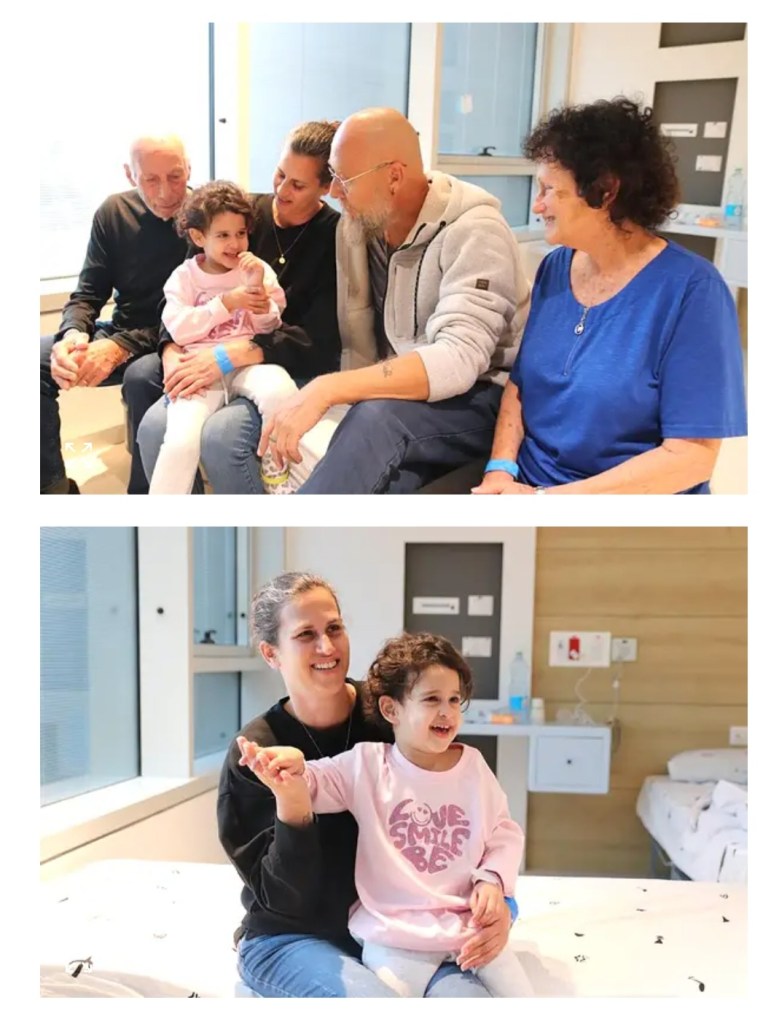
But Avigail Idan had no parents to come back to. She was welcomed by her extended family, her grandparents and her aunt and uncle. I was touched to the heart to see her smile, holding the hand of her aunt, who looks remarkably like her.

Her grandparents and aunt are now taking care of her and her siblings. They are all traumatized beyond anything we could ever imagine. How can young children even understand such horror? I can’t understand it either, and I’m 49.

I can only hope that the children and the whole family will receive all the help they need and will eventually be able to heal from this. We love you, Abigail. You are the Girl Who Lived.

.

The kidnapping of Emily Hand

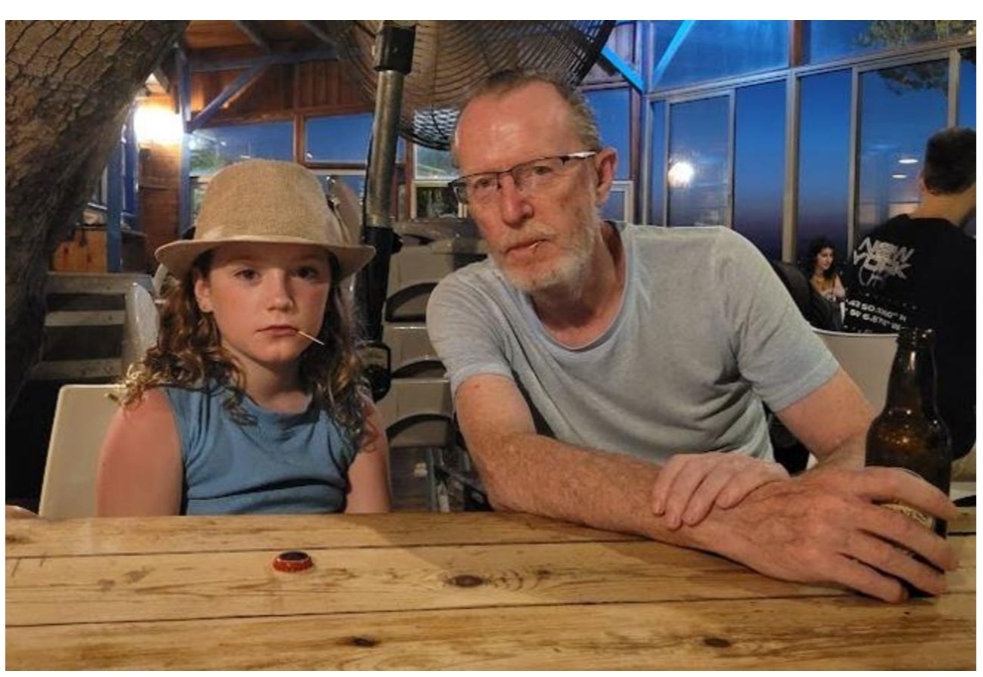
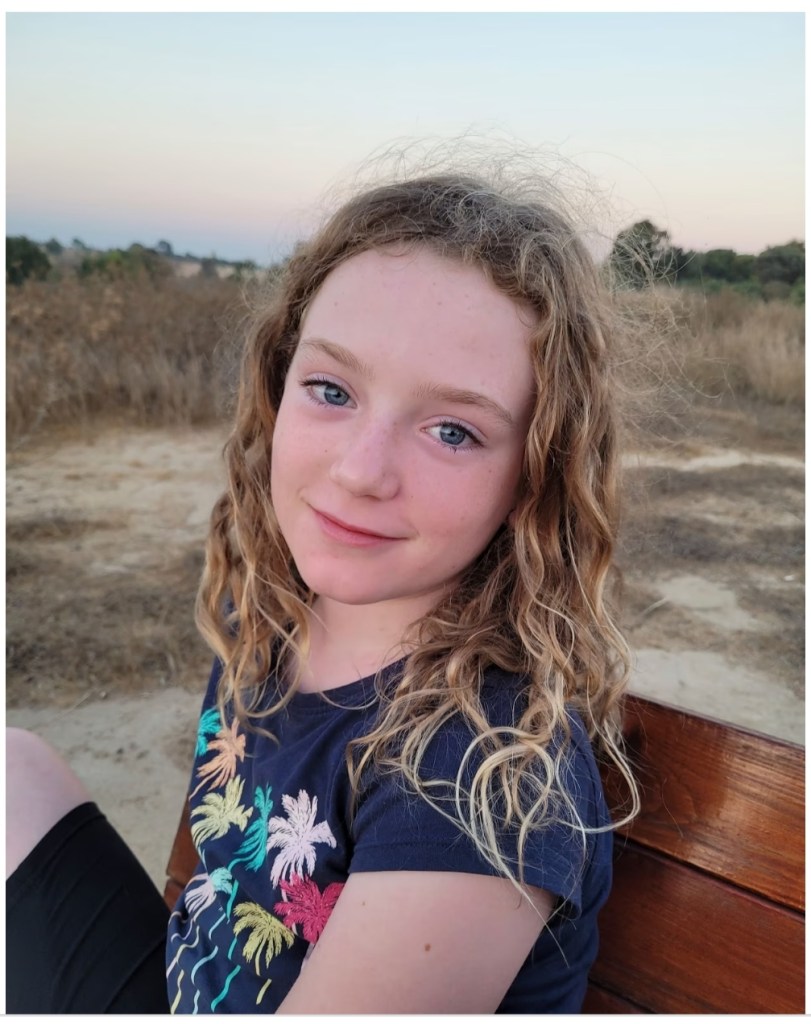
This is the story of Emily Hand. It will shatter your heart and then put it back together again. Partly, at least. Emily saw and experienced things no child should ever have to go through. She wasn’t the only one. But I feel a special connection to her and her father, because they are so much like me.

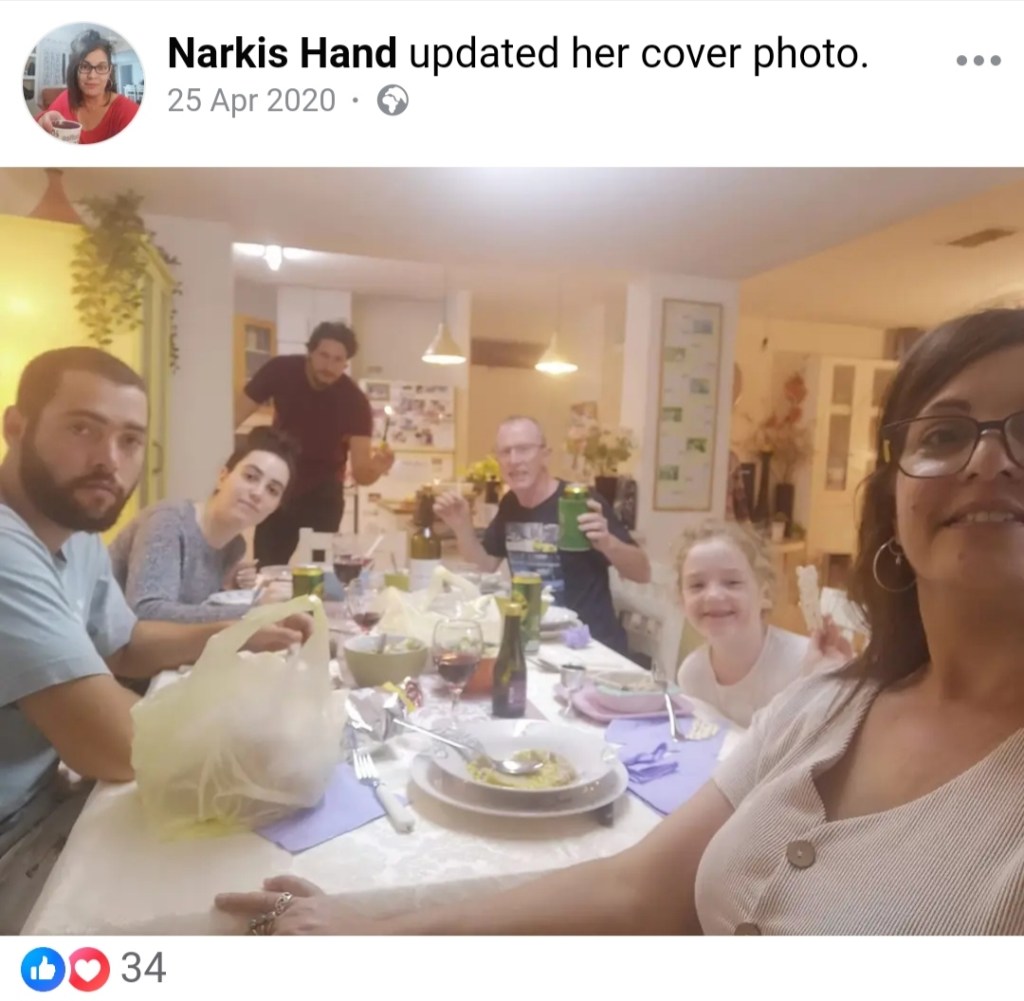
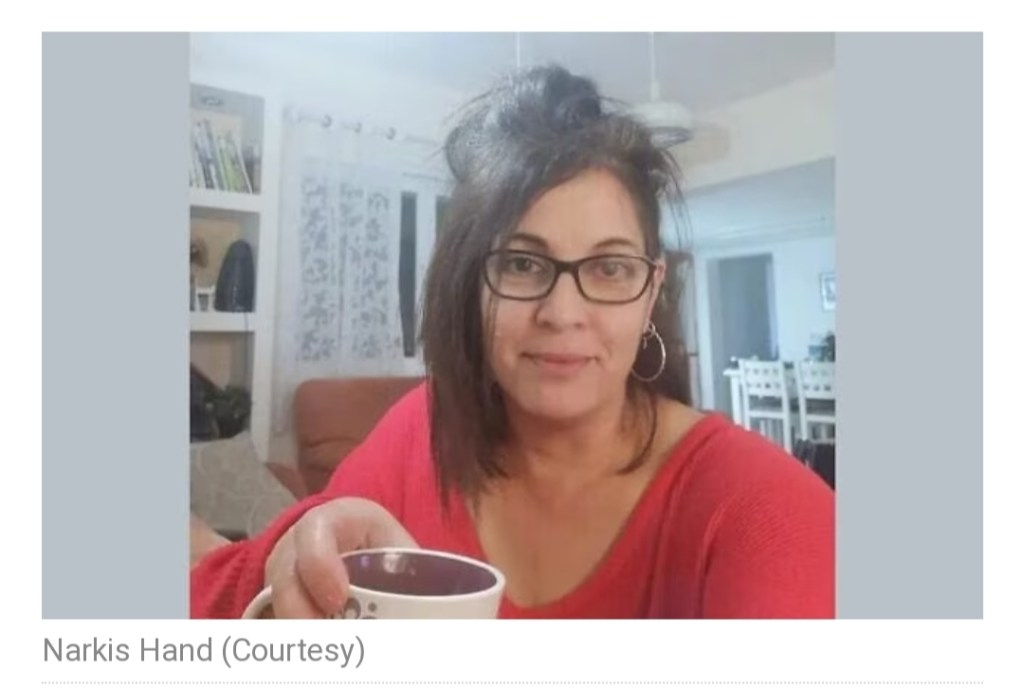
Emily is nine years old. She is the daughter of Thomas Hand, who is Irish and came to Israel as a kibbutz volunteer. Like I did. Thomas volunteered on kibbutz Be’eri and met a woman called Narkis, who he married and had two children with: Eden and Natali. The family lived in Be’eri. Later in life, when the children were teenagers, Thomas and Narkis divorced. Thomas met Liat Korenberg and they had a daughter together: Emily Tony Korenberg Hand. Sadly, Liat died of cancer when Emily was only two years old. So Emily lived alone with her father in kibbutz Be’eri. But she also spent a lot of time with Thomas’ ex-wife, Narkis, and her half-siblings, Eden and Natali. Narkis was like a mother to Emily. The family might have been unusual, but they were happy and close. This beautiful picture from Narkis’ facebook page shows that. In the photo, Narkis, Eden, Natali, Thomas and Emily are all sitting around the dinner table together. I can’t imagine a better way to be co-parents.

.

On October 7, 2023, Emily was at a sleepover at the house of her friend, Hila Rotem. At 6 in the morning, the terrorists reached the kibbutz. In interviews, Emily’s father describes locking himself into the safe room in his house, hearing the terrorists outside, and exchanging text messages with his ex-wife. He describes the terror and helplessness he felt, knowing he couldn’t protect his daughter. If he had gone outside, he would have been murdered, which would not help Emily.

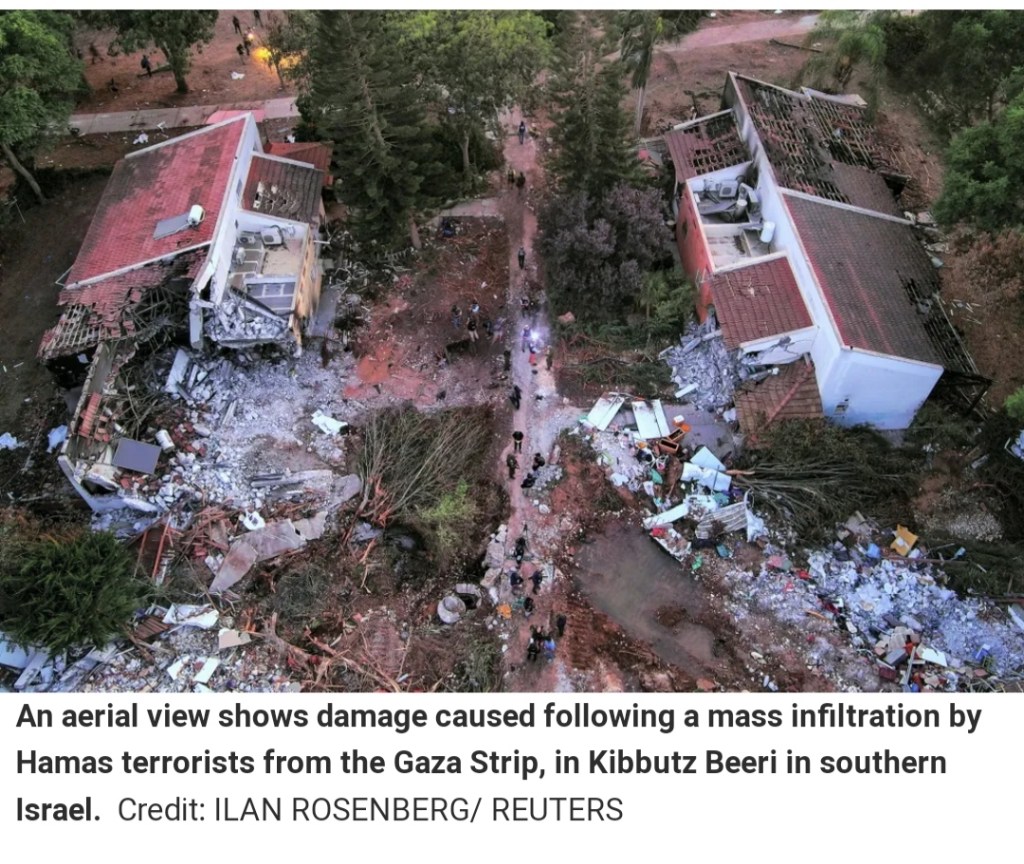
When at the end of the day, finally, the IDF regained control over the area, kibbutz Be’eri was a smoking, bloodstained ruin. Thomas had survived. But Emily was gone. So were her friend Hila and Hila’s mother, Raaya. And Narkis Hand had been murdered in her house. The happy blended family had been torn apart, half of it gone. The pain this kibbutz went through is indescribable. More than 120 people were brutally murdered and another 29 taken hostage.

Thomas was told that Emily was dead, that her body had been found. His first reaction was relief. He thought that being abducted to Gaza would have been a fate worse than death. He said in the Daily Mail: “They’d have no food. They’d have no water. She’d be in a dark room filled with Christ knows how many people, and terrified every minute, hour, day, and possibly years to come.”

But the initial report was wrong. Emily’s remains were not found, and later she was seen in security footage, being loaded into the bed of a terrorist truck with Hila and Raaya Rotem, and driven away. Thomas’ worst fear had come true: Emily was one of the hostages. But at the same time, he had been given hope again. Emily might come back home.

Time passed. Thomas and his adult children campaigned for the release of the hostages. They flew to London and Ireland and gave interviews. Emily turned 9 years old in the tunnels of Hamas, but she had no idea it was her birthday.

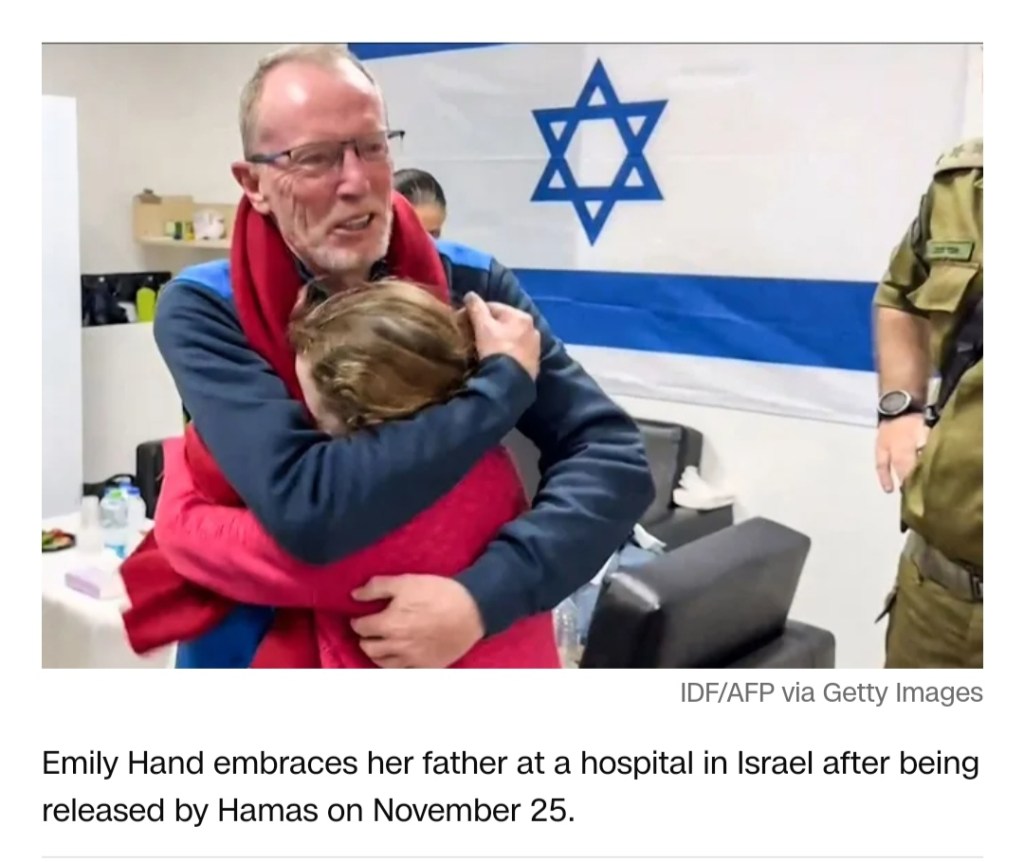
Then, after eight long weeks, a ceasefire was negotiated and an agreement was reached for some of the hostages to be freed. Emily was on the list but didn’t come home the first day. But finally, on November 25, after 49 days of captivity, Emily Hand was released into the embrace of her father.

.

I will never forget sitting in front of the tv, every evening of the ceasefire, desperately tired but refusing to go to bed until I knew who was coming home that day, and until I had seen them escorted into Israel by the Red Cross, and reunited with their family. The tears I cried every evening, happy tears but also tears of sadness, for those who didn’t come home, and those who would never come back again. Seeing Emily run to her father, and seeing Thomas’ smile, was everything. It healed something in me.

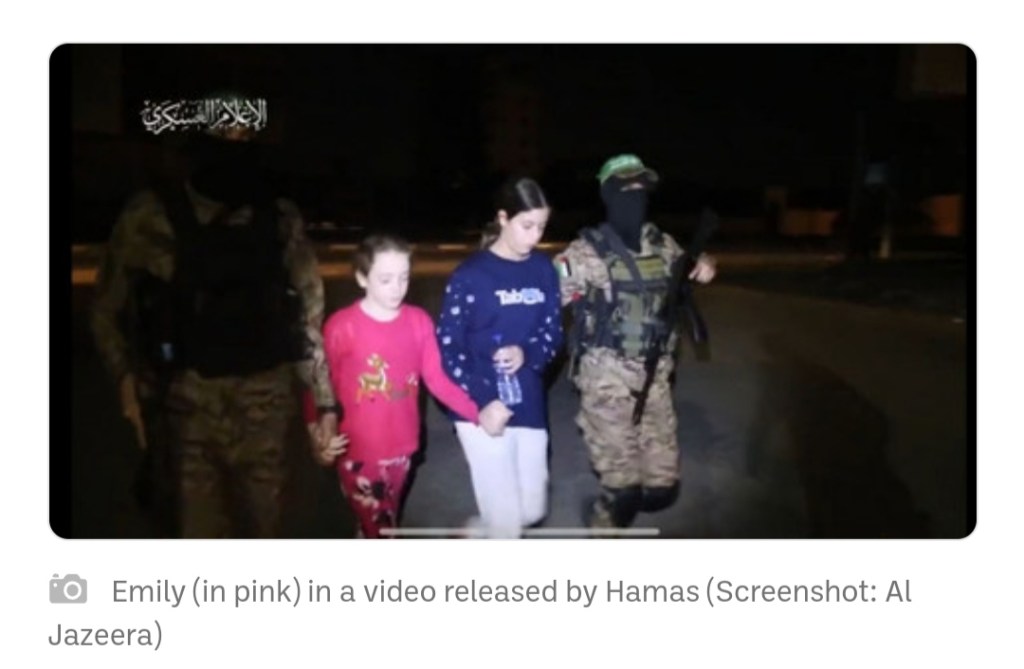
Emily was released together with her friend, Hila Rotem. The girls had clung together in the long weeks of captivity, under the care of Hila’s mother, Raaya. Raaya was not released that day, but fortunately, a few days later, she was. There was no rhyme or reason for that, apart from Hamas’ psychological warfare tactics – breaking up families and putting them through mental anguish is their favourite thing to do. Apart from causing death and destruction. They are Death Eaters.

This picture shows Emily and Hila walking hand in hand to the Red Cross ambulance, flanked by armed and hooded terrorists.

Emily had gone through hell and come back from it. But her pain is not over. Far from it. First, she had to be told that Narkis Hand, her second mother, was dead.

Narkis Hand was 54 years old when she was killed. She was described as a kind and generous person and a wonderful mother. She loved dancing and travelling and was the centre of her blended family. She leaves a gaping hole in her community.

.

Since Emily has been back, she has told her family bits and pieces about her experience in the tunnels of Gaza – a place she calls “the box”. There was no sense of time in the darkness. She thought she had been there for a year. She thought her father had been kidnapped as well and was held somewhere else. She had lost weight and was very pale. And she whispered. The children had been threatened and told to be quiet, so she only spoke in whispers. She had learned how to say “be quiet!” in Arabic. She cries at night, for her stepmother, for her friends, for the trauma she went through. But she is alive, she is safe, and she will be ok again.

The Irish Prime Minister described Emily as a child “lost and found” – an unfortunate choice of words, that doesn’t even begin to describe the reality of what Emily went through. She was stolen in the middle of a massacre, abducted and held hostage underground for 49 days, then finally released under immense pressure. This could have been me, my child, or any of my friends. By pure chance of geography, it was not. But Emily and Thomas are forever etched onto my heart.

.