
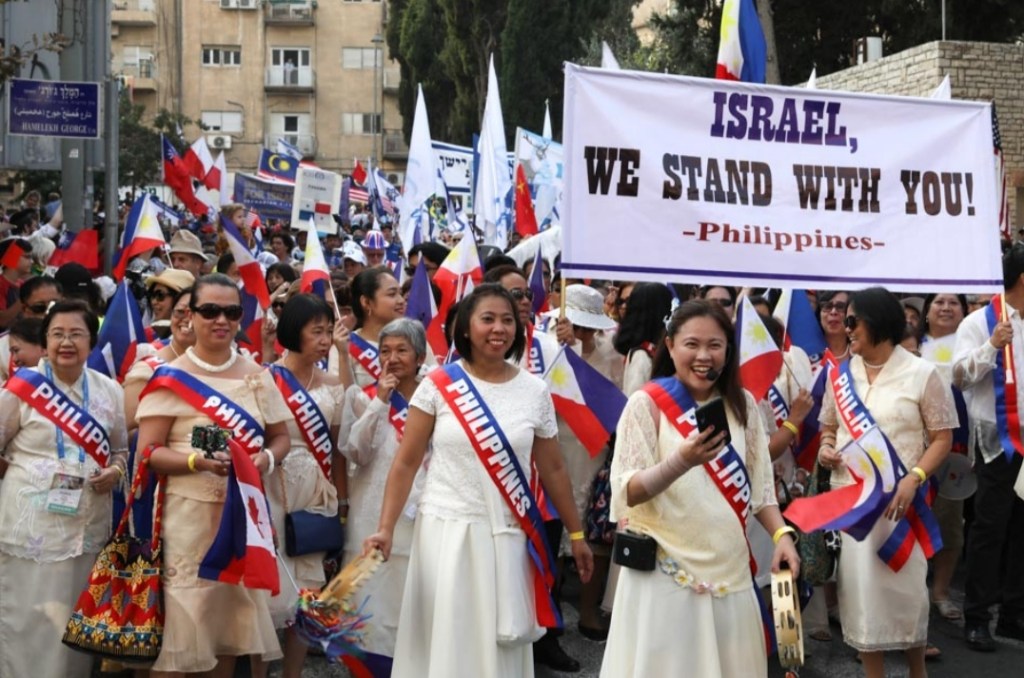
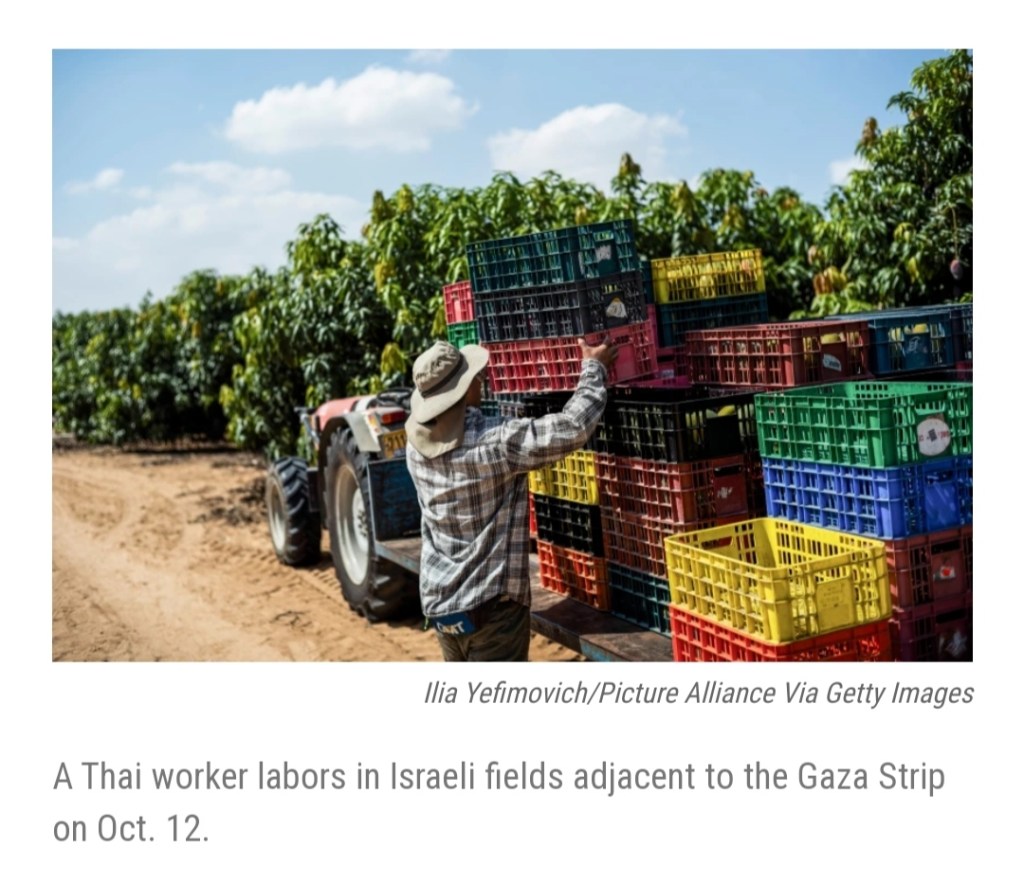
Israel is home to more than 300,000 foreign workers. Many of those are Thai. 30,000 to 50,000 are Filipinos, who most often work as caregivers for elderly and disabled people. Many Filipinos live and work in other countries to take financial care of their families. They are called overseas foreign workers (OFW’s). They are educated according to the country they are aiming at, in courses where they learn the language alongside nursing. Israel is a popular destination for Filipino OFW’s. In Israel, they earn a salary many times higher than what they could earn in the Philippines, and they are treated better than in countries like Saudi Arabia. Some Filipinos have children back home, who are in the care of their grandparents. To take care of their families financially, these parents give up raising their own children, to work in Israel and make sure their kids have a home, food and an education. They make the ultimate personal sacrifice to take care of their loved ones – and of our elderly. For that only, they deserve all our respect and admiration.
But apart from that, Filipino caregivers are most often lovely people and wonderful nurses, who decicate themselves to the care of their patients. They often stay with the same patient for years and become a member of their families. The elderly or ill person whose family can afford hiring a Filipino nurse is truly a lucky human being.
On October 7, four Filipino nationals were killed and two taken hostage. These are their stories.
—
Jimmy Pacheco
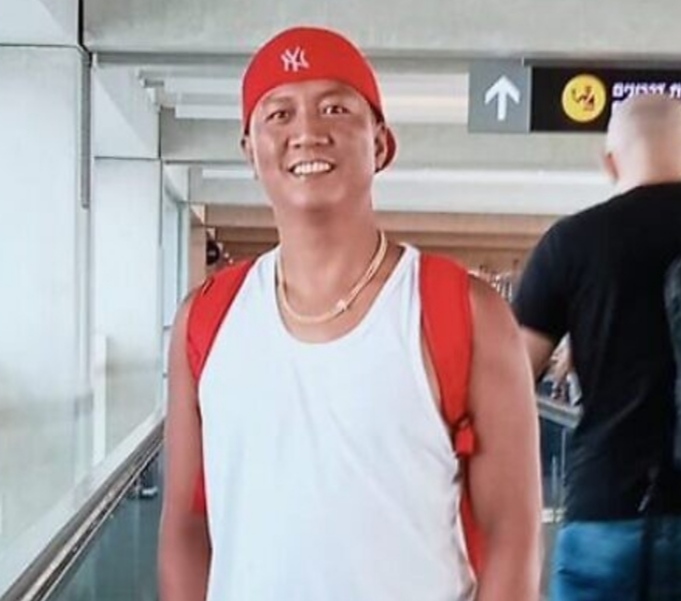
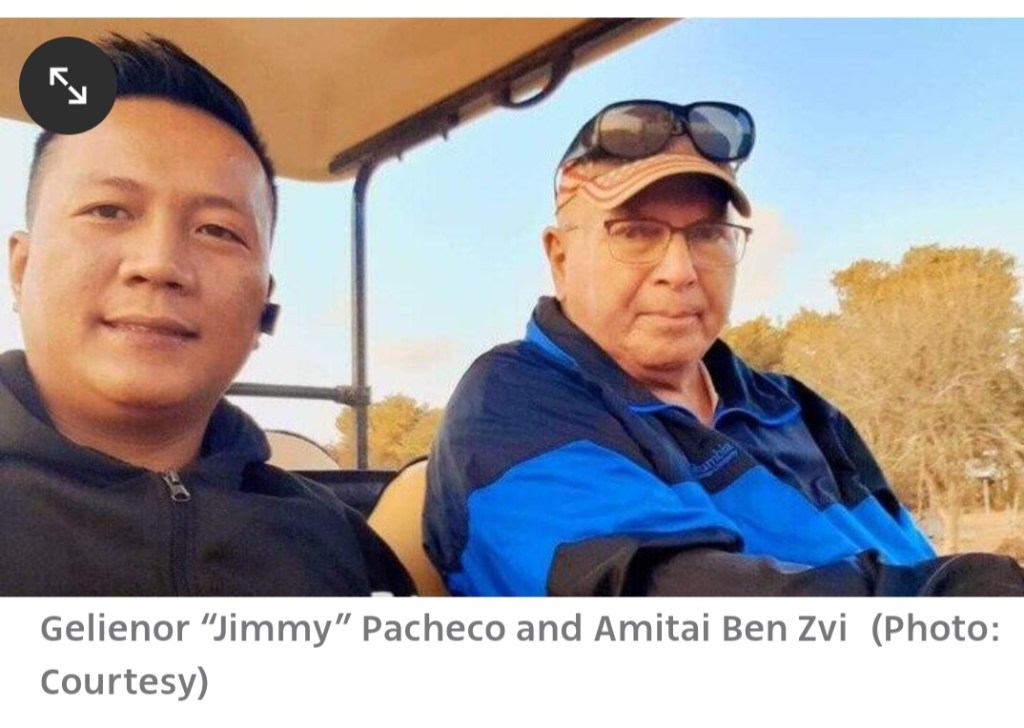
Gelienor (Jimmy) Pacheco had been in Israel for five years. Four of those years he had cared for Amitai Ben Zvi (80) in kibbutz Nir Oz. He called his patient Abba (dad). The relationship between the two of them was very good and the family loved Jimmy. Amitai’s daughter said that he took care of her father “with quiet, admirable devotion, always attentive to his needs and supportive in countless ways.” Jimmy’s wife and three children lived in the Philippines and kept in contact with him through video calls.
On Black Shabbath, when Hamas terrorists attacked kibbutz Nir Oz, Jimmy was there with his patient. The invaders shot Amitai, an 80 year old man with Parkinson’s, point blank. Jimmy managed to call his friends to tell them his Abba had been murdered and he was being kidnapped. Two Hamas videos showed Pacheco handcuffed and surrounded by armed men.
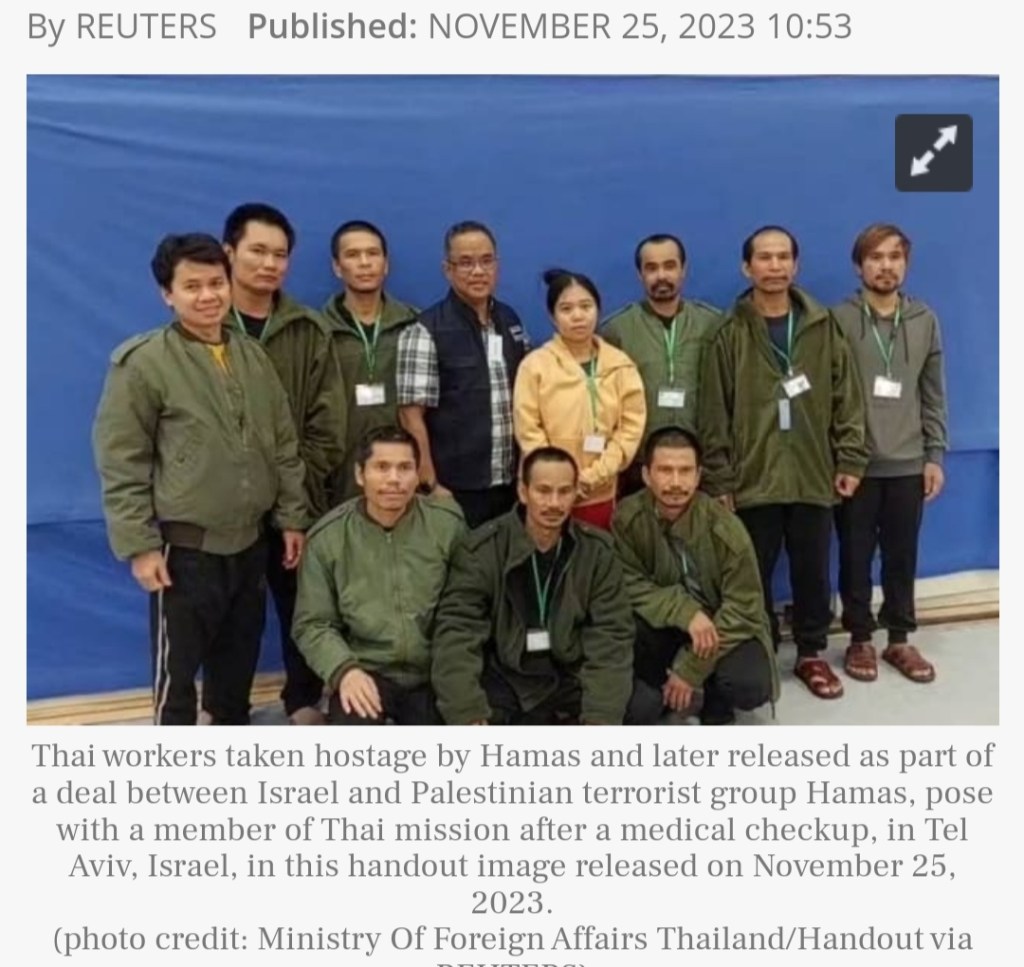
Jimmy was a hostage in the tunnels of Hamas for 49 days. He describes the terror and harsh conditions he went through on Ynet, telling them how he ate toilet paper because he was so determined to survive, and how thoughts of his children and his Catholic faith pulled him through. Pacheco was released on November 24, together with 10 Thai nationals, as part of an agreement with the Thai and Filipino governments. Jimmy went back to visit Nir Oz and the grave of Amitai Ben Zvi. He showed the destruction in a live video on Facebook.
On December 18, Jimmy Pacheco finally landed in the Philippines and was reunited with his family. The good news is that he will never have to leave them again. He will get lifetime benefits from Israel. To us, he is a hero.
.
—
Noralyn Babadilla

Noralyn Babadilla, 60, lived and worked in Israel for over 30 years. She married an Israeli, Gideon Babani, and gained dual Israeli-Filipino citizenship. She and her husband lived in Yehud, a town in central Israel. On October 6, they went to visit friends in kibbutz Nirim in the Gaza Envelope, where they stayed overnight. Early in the morning of October 7, the kibbutz was attacked by Hamas terrorists. At around 7 AM, Noralyn called her brother and told him terrorists were shooting at them, and she was afraid. That was the last anyone heard of her.
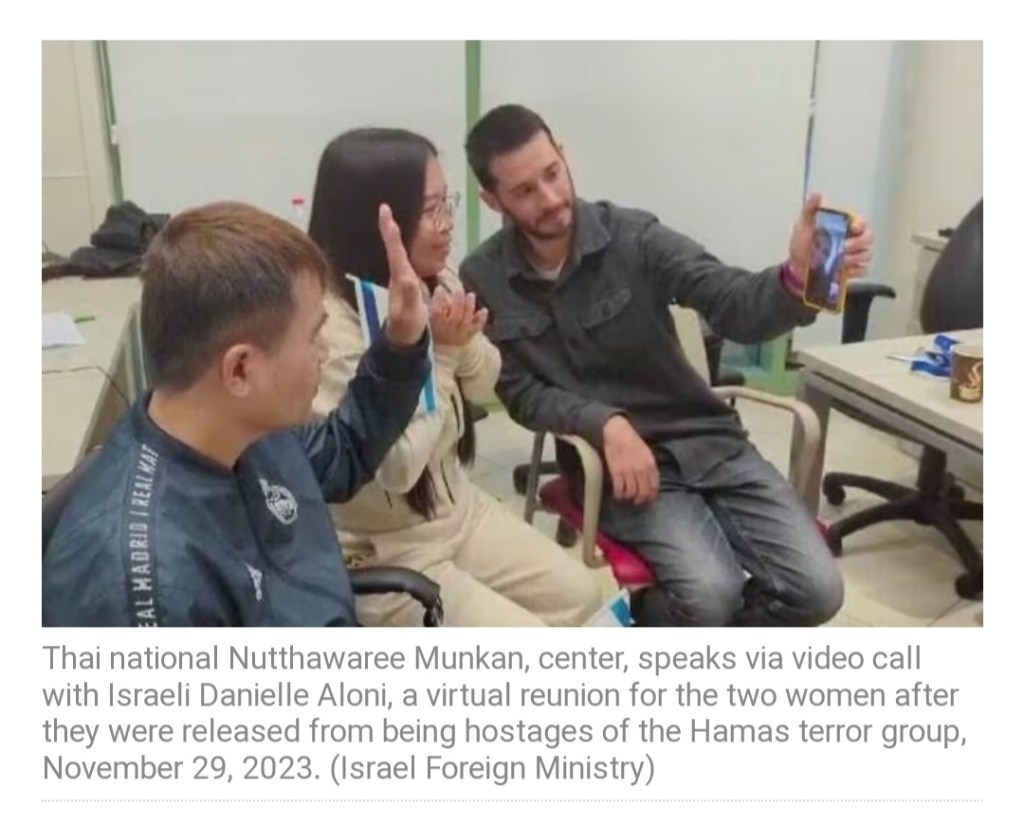
Gideon Babani was found murdered in kibbutz Nirim, but Noralyn was missing. No one knew for certain what had happened to her. Her brother and sisters were desperately worried. Fortunately, on November 28, Noralyn was released by Hamas, together with a small number of other women and children. She had been a hostage all that time. She was seen in the videos of the release of the hostages that day, assisting an elderly woman.
Noralyn survived her ordeal in reasonably good health, and was reunited with her siblings, who also live and work in Israel. But her husband and her friends were murdered before her eyes. How do you even begin to recover from such a terrible trauma?
—
Angelyn Aguirre
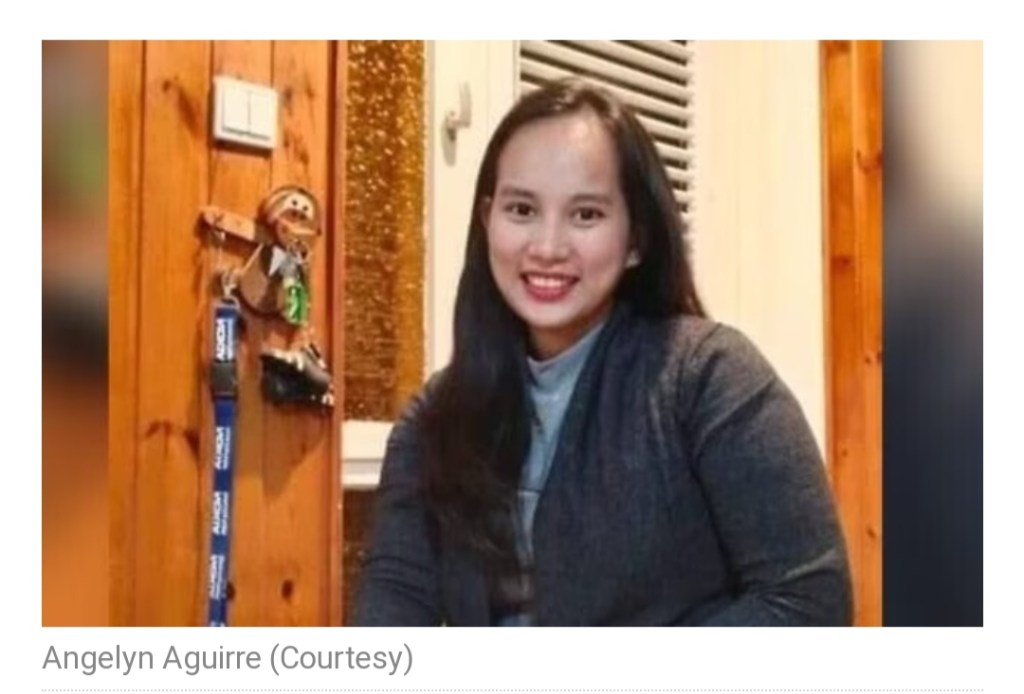
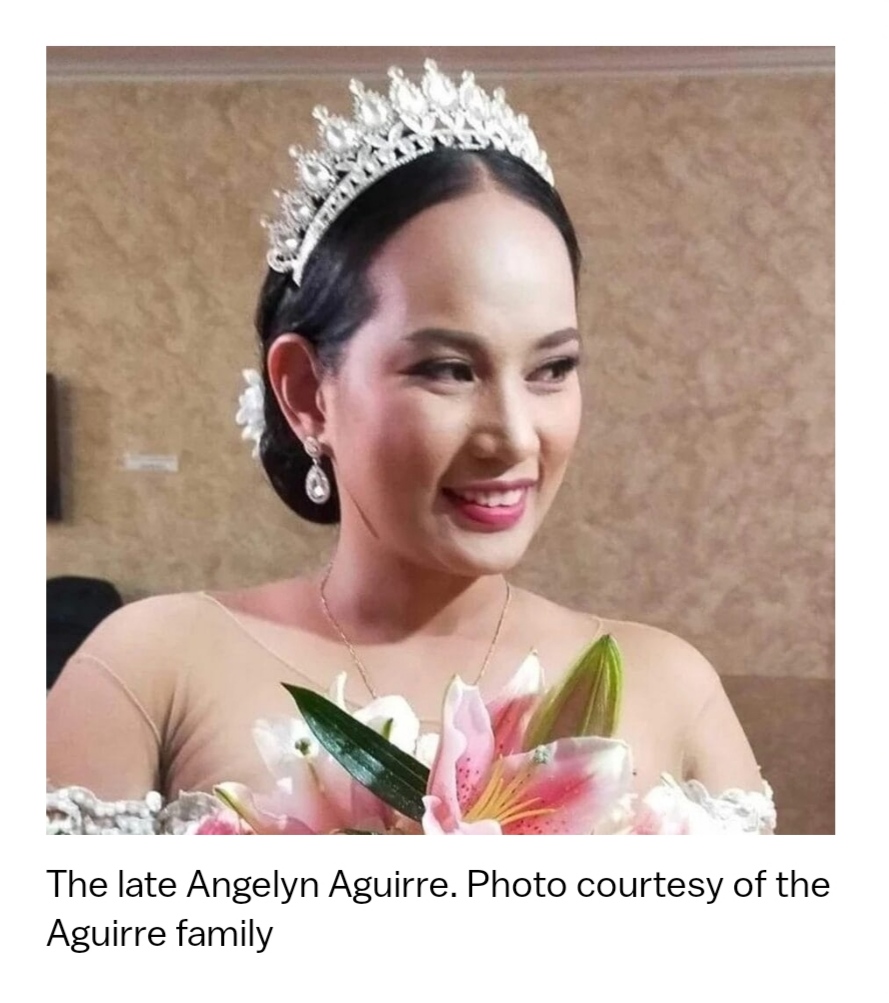
The story of Angelyn Aguirre is desperately sad. It is one of those that doesn’t leave me alone. Just look at that beautiful, sweet face. Angie was 33 years years old. She had been working in Israel for seven years, but she had just got married and in a few months’ time, she was going to return to the Philippines to be with her husband and start a family.
Angie took care of Nira Ronen (86) in kibbutz Kfar Aza. When the terrorists ransacked and burned their way through the kibbutz, Angie took Nira into the safe room of the house and tried to hold the door closed, while armed men on the other side forced it open and opened fire at the two defenseless women inside the room.
The mental image is mind-boggling. It is just beyond anything I can ever understand. How can things like this have happened? What kind of soulless beings gun down an 86 year old lady and her young Filipino carer in their home? What kind of unimaginable evil took over the minds of those invaders? I want to know. But it breaks my heart, every time again, to read and research these stories.
After the bodies of Nira and Angie were found, the deputy mayor of Jerusalem, Fleur Hassan-Nahoum, wrote on X/Twitter: “Despite having a chance to flee the Hamas terror attacks, Angeline showed unbelievable humanity and loyalty by remaining Nira’s side during the violence, resulting in both of them being brutally murdered by Hamas. Unimaginable honor in the face of evil.”
Later, in an emotional interview with ABS-CBN News, Hassan-Nahoum said: “The Filipino community in the State of Israel is very much loved and appreciated. They take care of our elderly and they take care of special needs children. My mother was taken care of by two wonderful nurses and I owe them so much. There are so many people in this country that owe the Filipino community so much. For us, it’s as painful to lose one of you as it is to lose one of us.”
I agree completely.
.
—
Paul Vincent Castelvi
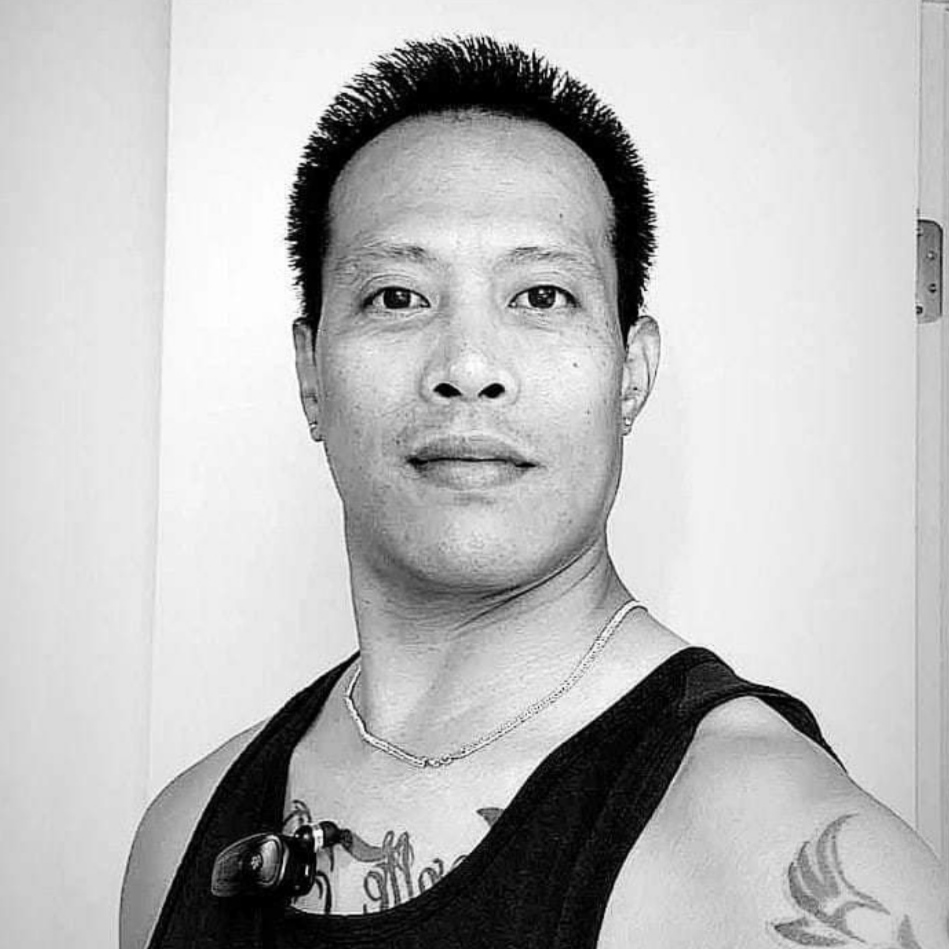
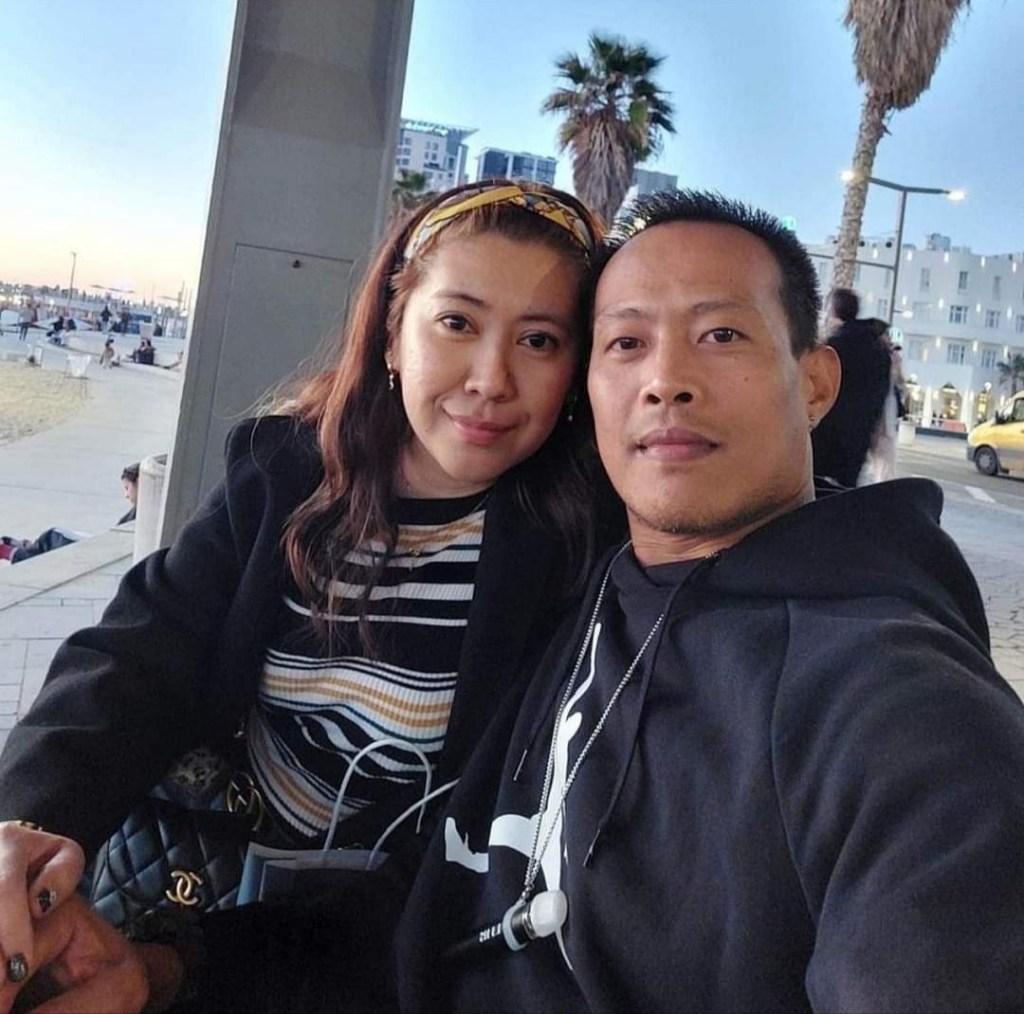
Paul Castelvi (42) lived and worked in kibbutz Be’eri. He was the caretaker of Eviatar Kipnis, who suffered from an auto-immune disease. Paul was the main breadwinner for his entire family back in the Philippines; his parents, his three siblings and his nieces and nephews. He was married to Jovelle Santiago, who also lived and worked in Israel. Jovelle was pregnant with the couple’s first child. The baby was due in November, and Paul’s employers had given him and his wife tickets to fly home for Christmas, to surprise their families and show them the new baby.
Instead, Jovelle arrived alone at Manila Airport on December 23, holding her newborn baby and an urn containing Paul’s ashes.
.

Paul was murdered by Hamas together with his wheelchair-bound patient, Eviatar Kipnis, and Eviatar’s wife, Lilach Leah Kipnis. Many of their family members were abducted, including young children.
Yotam Kipnis, the son of Eviatar and Lilach, wrote on Facebook: “Paul was an incredible man, and I have still not come to terms with his death. It’s unimaginable, and I can’t believe that I won’t meet him again… Rest in Peace, Paul Vincent Castelvi.”
After learning of Paul’s death, Jovelle Santiago wrote on Facebook: “I don’t know how and where I am now to start when you are gone — so hard. I feel like I lost half of my life. Guide us always with our baby boy.”
After giving birth to her baby, who she called Jhayzen Paul Castelvi, she wrote: “Worth every pain… Worth the wait. Thank you for coming to our life… Tatay is surely smiling at us from above.”
—
Loreta Alacre
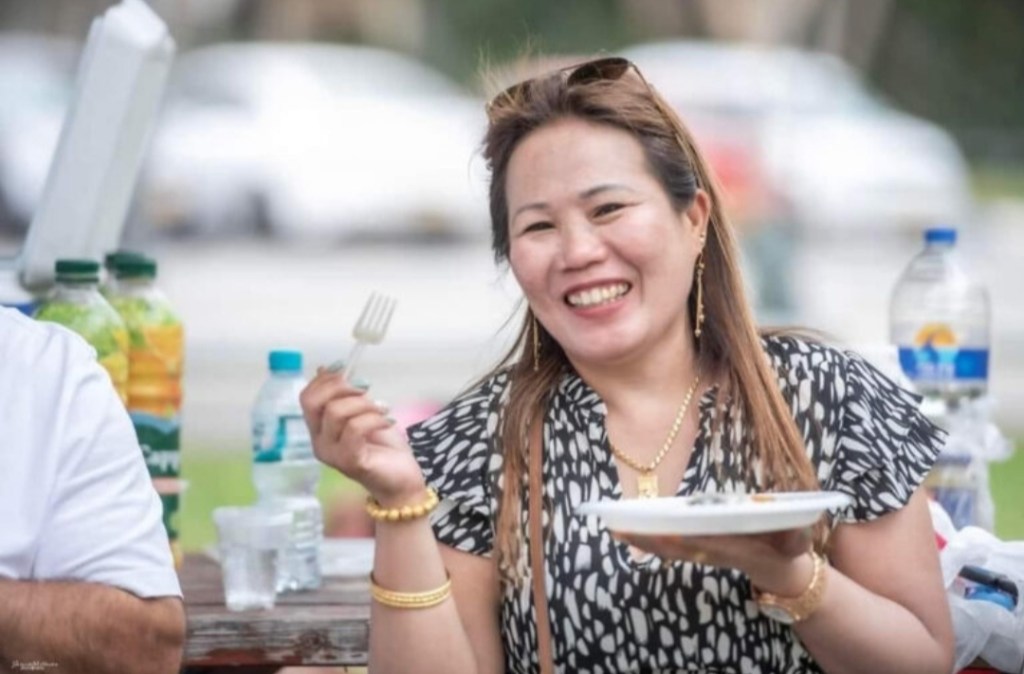
Loreta Alacre (49) was dearly beloved both in Israel and in the Philippines. She was the breadwinner for her entire extended family back home – most of her seven siblings and their children. Loreta financed the building of their house and the education of her nieces and nephews, and paid for hospital bills, birthdays, weddings, baptisms and funerals. The whole family was dependent on Loreta, who dedicated her entire life to them and to her patients. She worked overseas for 19 years, of which almost 15 years in Israel.
On October 8, Loreta’s employer, Noam Solomon, wrote the following on Facebook (my translation):
“Lori, my devoted caregiver of the last 6 years is missing! She was last seen yesterday in the early morning hours, between Netivot and Ashkelon. Her partner, who was with her, told a friend on the phone that he had been shot in the back. We located him in the Barzilai hospital, but he had no knowledge of where my dear, beloved Lori is. If anyone knows, hears or sees anything, please let me know in a private message as soon as possible.”
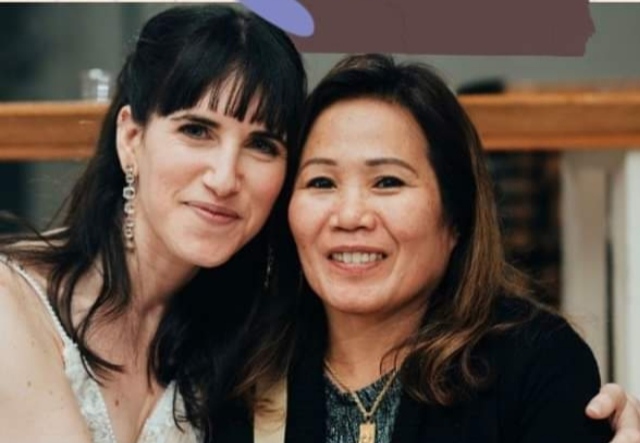
On October 11, Loreta’s body was found. The news caused anguish for her Filipino family as well as for her Israeli family. Lori had been the carer of Noam Solomon’s grandmother for many years. After her grandmother passed away, Noam, who had become disabled after an accident, asked Lori to be her caretaker. After receiving the news of Lori’s death, Noam posted (again, translation is mine):
“My dear, beloved Lorie Alacre, an inseparable part of my family for over 14 years, and for the last 5 years my right hand, my confidante, was sadly murdered in cold blood by Hamas killers on the cursed Sabbath. May her memory be blessed.”
.
Slowly, the events that led to Lori’s death were pieced together. Lori had been travelling to Ashkelon, where Noam lives, together with her partner. They took a sherut minibus with several other people. On the way, the terrorists stopped the minibus and shot its occupants. Lori did not survive the shooting.
Loreta’s family in the Philippines will get aid and benefits from Israel, as all dependants of terror victims do. But nothing can make up for the loss of this amazing, caring human being. Hamas took away the very best of us on that terrible day.
—
Grace Cabrera
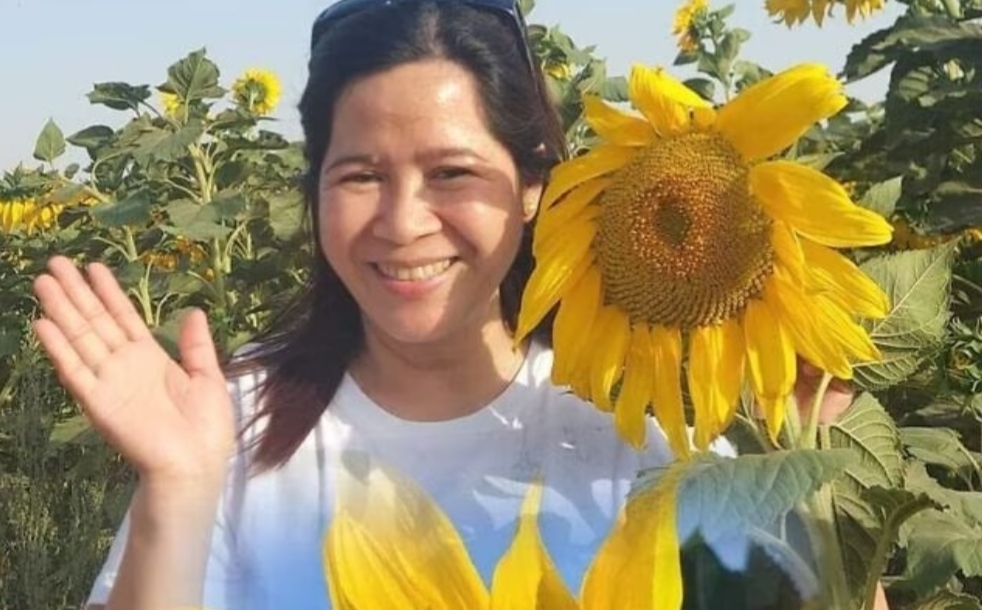
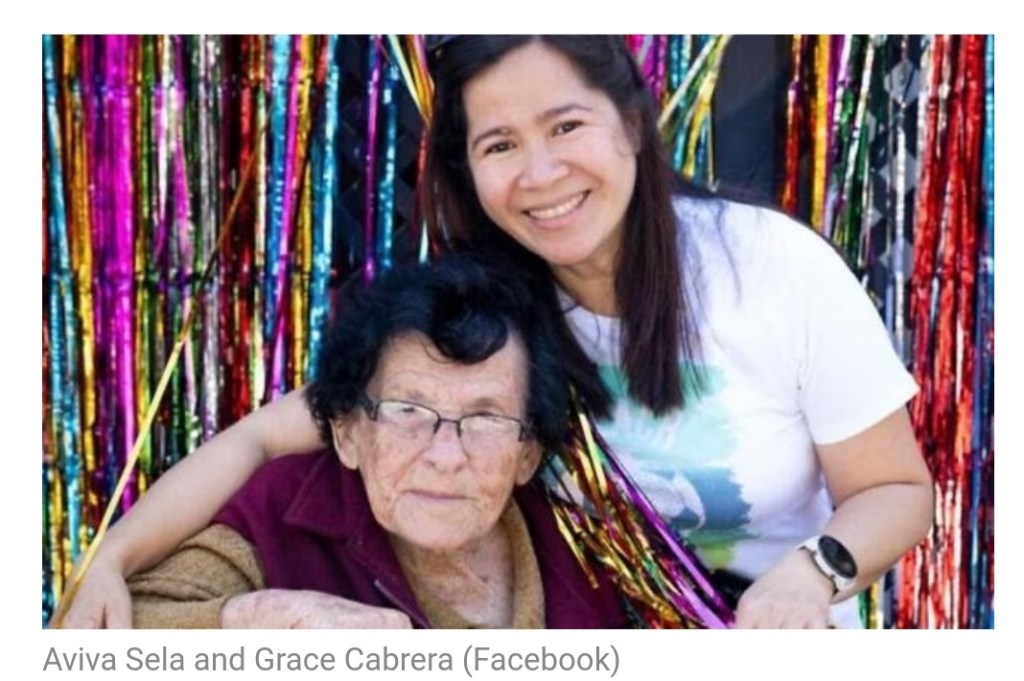
This is another story of love, loyalty and kindness in the face of unimaginable terror. Grace Cabrera (45) lived and worked in kibbutz Be’eri as the caretaker of Aviva Sela (95). She had parents, siblings, a husband and a child back in the Philippines, who depended on her salary. Her sister, Mary June, also lived in kibbutz Be’eri.
On the morning of October 7, when it was clear that their kibbutz was under attack, Grace took her patient into the safe room of their house and held the door closed for hours (these doors don’t have locks). Days later, security cameras showed that Hamas broke into the room and held Grace and Aviva at gunpoint on the porch. The porch of this house was apparently used as headquarters and weapons assembly. At the end of the day, Grace was taken by the terrorists, leaving 95 year old Aviva alone in the swing chair on the porch.
Aviva does not remember much, but she remembers deciding to leave the kibbutz. She took her walker and started walking, without her glasses or hearing aids. At some point, someone from the kibbutz took her into their car, and she called her daughter, Osnat Weinberg. When her family came to pick her up, they found the basket of her walker packed with everything she needed, including medication and food. “Only Grace could have gotten her ready like that,” Osnat said.
Grace’s body was found on October 19. She had been shot and dumped by the terrorists. Words fail me.
Osnat Weinberg said of Grace:
“Her composure, her wisdom and her best intentions for my mother were far beyond the realm of ordinary. She was simply an angel with her feet on the ground. What a good soul, how wise… we are so thankful to the wonderful Grace who became part of our family, and we are crying over her loss.”
Mary June Prodigo, Grace’s sister, wrote on Facebook : “No words can explain the pain I feel right now… I lost my sister/best friend. Now everything is gone… all the happy memories will be replaced by pain.”
—
There are more stories of the way Filipino caregivers protected their charges. There is a story of a carer who somehow managed to bribe the terrorists with money. Both she and her patient escaped with their lives.
I am heartbroken that they had to go through this. I am so sad for their families. And I am beyond furious that the evil incarnate called Hamas did this to them, and to us. That anger is what fuels me to keep writing. This article was exceptionally hard to write. The cruelty and sadism of the Death Eaters stands in such heavy contrast to the kindness and sacrifice shown by the Filipinos. It’s like good and evil faced each other that day.
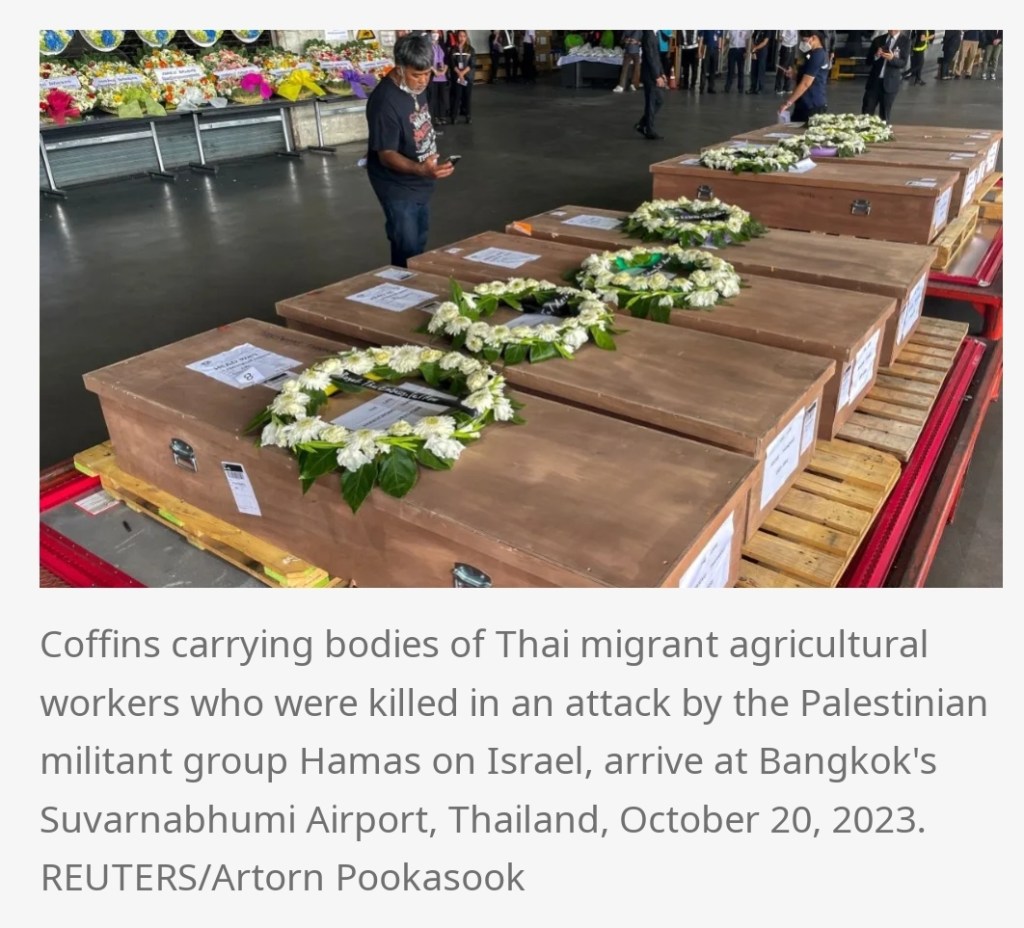
Grace, Loretta, Paul and Angie were killed ruthlessly. But they left their impression on the world. Their love, kindness and energy lives on in the memories of both their Filipino and Israeli families, and in their children. And in the collective memory of Israel and the world. We will always remember that they were good, and kind, and protective of their patients. Hamas is their polar opposite, and their days are numbered. They will pay for what they did to these innocent people.
.
 Stories of Israel
